WCED STEAM Conference
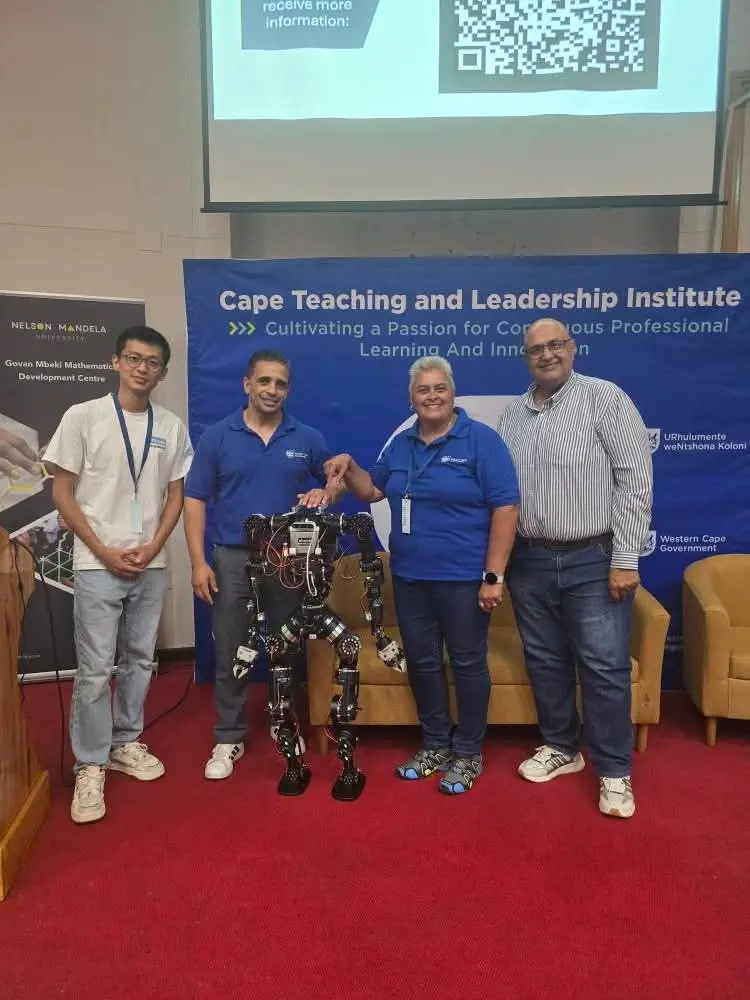
At the WCED STEAM conference in February 2026 we brought a humanoid robot in front of a South African public audience for the first time — into a room full of teachers, which is exactly where it needed to land first.
On 7 February 2026 Sheen Robotics brought a humanoid robot to a public audience for the first time, at a STEAM conference hosted with the Western Cape Education Department at the Cape Teaching and Leadership Institute.
The right room to do it in
CTLI, in Kuils River, is the WCED's teacher professional development institute — its banner reads "cultivating a passion for continuous professional learning and innovation". The conference also brought in Nelson Mandela University's Govan Mbeki Mathematics Development Centre.
In other words: a room of teachers and teacher educators, not a trade-show audience. That was the point. A humanoid robot in front of the public generates excitement. A humanoid robot in front of the people who will decide what a STEAM lesson looks like next term generates questions — which is a much more useful reaction, and a much harder audience.
What we were actually arguing
The demonstration was not a sales pitch for humanoid robots in schools. Nobody is putting one in a Grade 6 classroom, and anybody claiming otherwise should be treated with suspicion.
The argument was narrower and more defensible: the technology children are being prepared for is arriving faster than the curriculum describing it. A learner starting Grade 8 in 2026 enters the workforce around 2035. Between now and then, robotics moves out of manufacturing cells and into environments built for people — and the classroom framing of "robot" as a line-following car on a taped track will be badly out of date.
Seeing a walking, balancing, general-purpose machine at close range changes how an educator holds that. It is no longer a speculative claim in a policy document. It is a thing that just walked across the carpet.
Teachers ask better questions
What a room of educators asks is not "how much does it cost". It is:
- What does a child need to understand before any of this makes sense?
- Which of my existing subjects does this actually connect to — and which claims of relevance are stretched?
- What can I do next term, with the equipment I already have?
- How do I teach this honestly without either hyping it or dismissing it?
Those questions shape our work more than any conference feedback form. A good deal of what goes into our school programmes and teacher training comes from days like this.
From Shanghai to Kuils River
Three months earlier we had taken a South African delegation to AgiBot's headquarters in Shanghai to see mass-produced humanoids on the factory floor. This was the return leg — bringing it home, in front of the people whose reaction matters most.
Learn more about our humanoid robotics work, or ask about a demonstration for your school or district.