Laerskool Paul Greyling
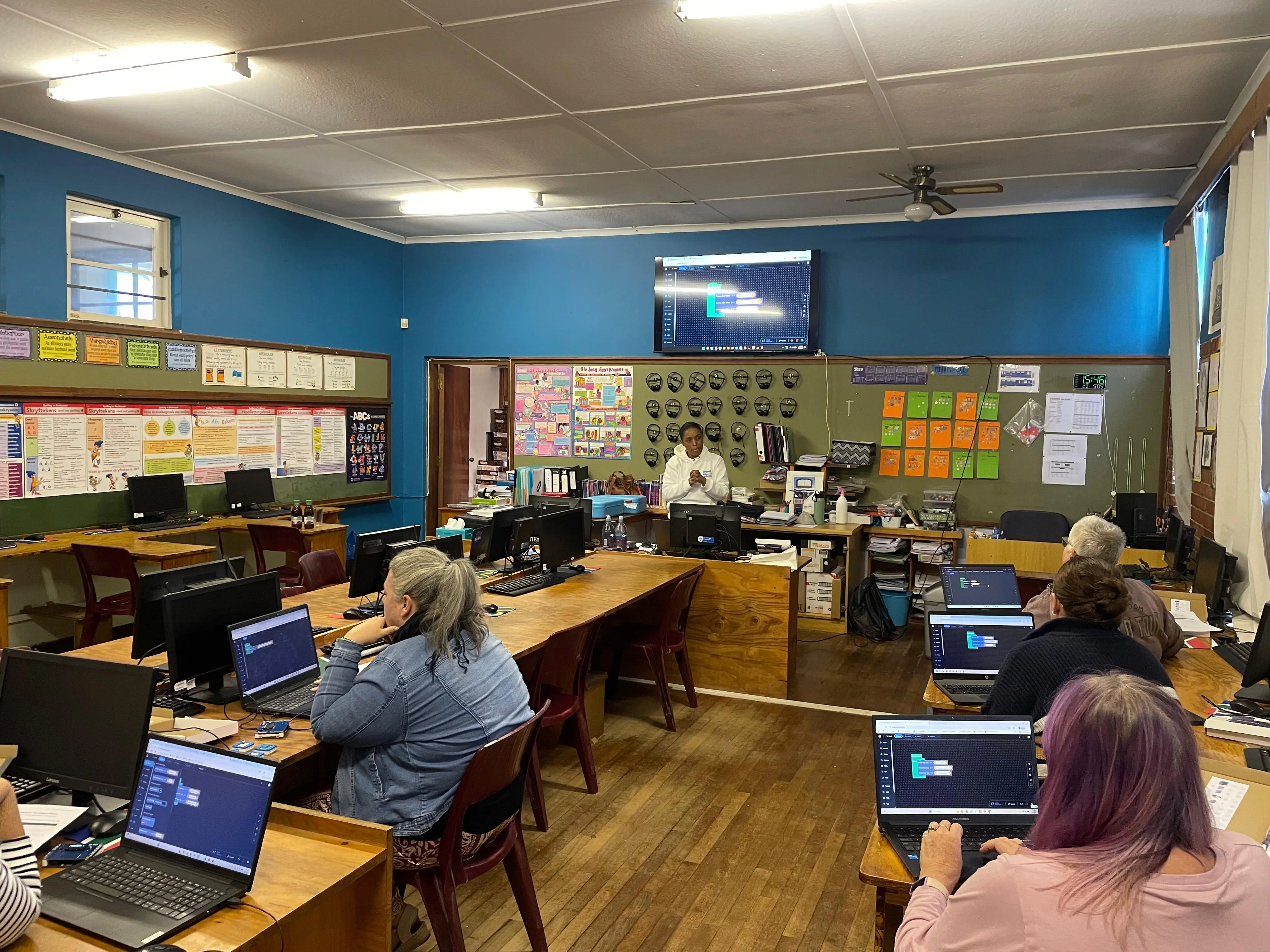
In May 2026 Laerskool Paul Greyling became our first smart-farm partner school. The training day put teachers — not learners — in front of the laptops, which is the only version of this that survives past the first term.
On 6 May 2026 Sheen introduced smart farming and delivered teacher training at Laerskool Paul Greyling, making it our first smart-farm partner school.
Teachers in the seats
The photograph from that day is a school computer lab with teachers at the machines, block code on the screens, and a facilitator at the front. No learners. That is the whole design.
The failure mode in school technology programmes is well documented and entirely avoidable: an outside provider runs a spectacular session, the learners have a great day, the provider leaves, and nothing continues. What survives is what the staff can run themselves in week seven of a busy term, with a class of thirty and no one to call.
So a partnership starts with the teachers, on the actual hardware, in their own lab, on their own network — because "it worked at the training venue" is not a useful guarantee.
Why smart farming
Of all the contexts to teach sensing and automation in, agriculture is the one that needs the least explaining in the Western Cape. It is the industry surrounding many of these schools, and it is already digitising: soil moisture monitoring, irrigation control, climate sensing and yield tracking are not future concepts here, they are current practice on commercial farms.
That makes a classroom smart-farm project unusually honest. The learner is not simulating an industry that exists somewhere else; they are building a small version of something operating down the road.
It is also a well-shaped teaching problem. A plant is a slow, forgiving, genuinely uncertain system:
- Real measurement — soil moisture, temperature, light and humidity, with sensors that disagree with each other and have to be reasoned about.
- Real consequences — a watering rule that is wrong is visible in the plant a week later, which is a far better feedback loop than a mark on a page.
- Cross-curricular by nature — natural sciences, technology, mathematics and data handling all arrive in the same project without being forced together.
- It runs over time — data logged across weeks turns "a coding lesson" into an investigation.
What a partner school gets
The same support structure as our other partner schools: hardware, printed manuals and activity booklets, online tutorials, and a live teacher community for the questions that come up at 21:00 on a Sunday. Plus, for smart farming, the growing setup itself and the curriculum that runs alongside it.
Where it connects
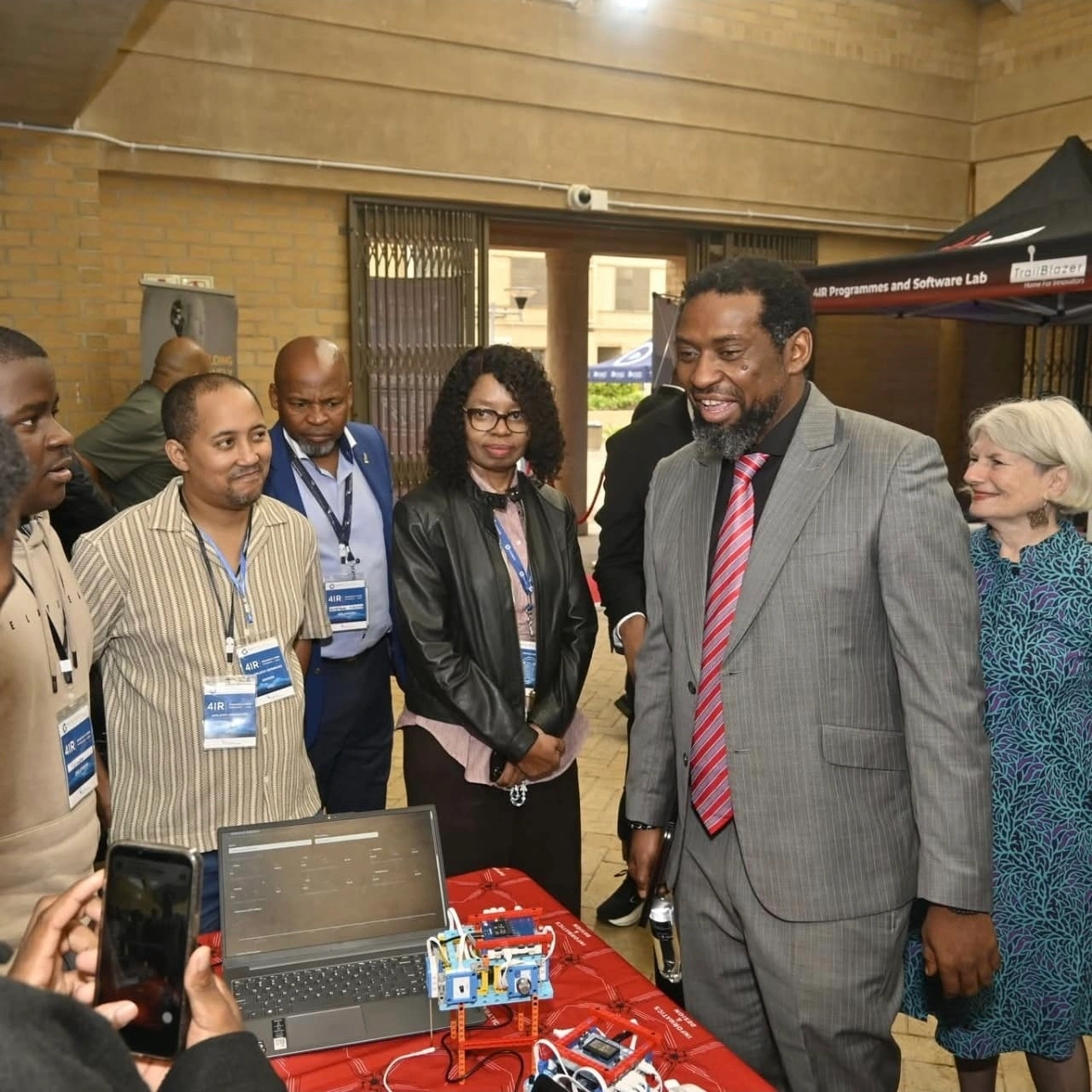
Three weeks later, students presented a smart-farm solution built on our hardware at the MICT SETA 4IR symposium and IoT hackathon. The same thread — sensors, rules, plants, data — runs from a primary school computer lab up to a national symposium.
See our smart farming programme and classroom hydroponics, or ask about becoming a partner school.