
Humanoids meet the classroom: reflections from the WCED STEAM conference
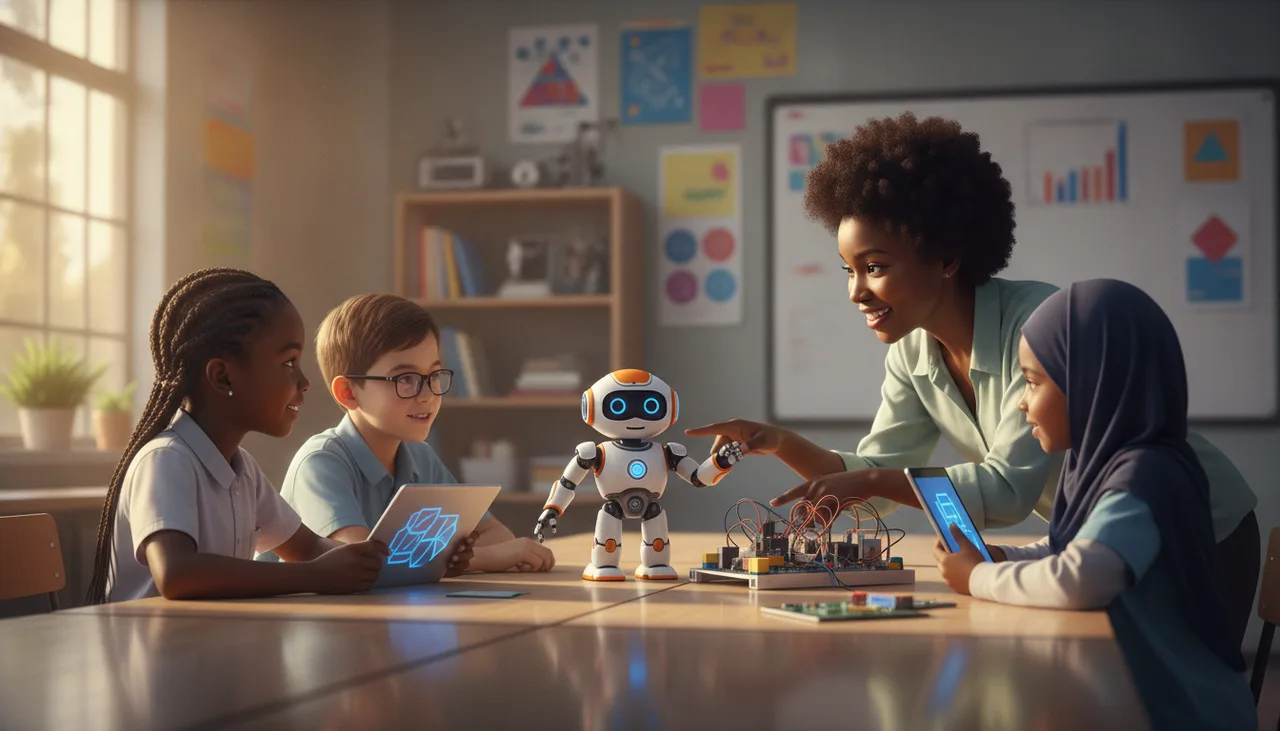
Humanoid robots stole the show at the February 2026 WCED STEAM conference. Here is what they are actually for in education, and where a class set of desktop kits still teaches more.
The Western Cape Education Department's STEAM conference in February 2026 had a clear star. Full-size humanoid robots that walked, waved and held short conversations pulled the biggest crowds on the floor. That reaction is worth taking seriously, and it is also worth unpacking. A humanoid on a stage is a brilliant way to make a room care about technology. It is not, on its own, the best way to teach a class of thirty learners to code.
This is a reflection, not a product review. The short version: humanoids earn their place in education as tools for demonstration, inspiration and research. For the daily work of building skills, most classrooms still learn more, and for far less money, from simple desktop kits.
What happened on the floor
STEAM conferences at the start of the school year are where teachers, districts and suppliers compare notes on what to buy and teach for the year ahead. This one landed in the opening weeks of the 2026 school year, when budgets are being set and pilots are being planned. Among the exhibits, the coding platforms, the 3D printers, the sensor trays, the humanoid robots drew the longest queues. People wanted to watch one move, ask it a question, and see it respond.
None of that is a surprise. A machine shaped like a person triggers a different kind of attention than a circuit board on a desk. The useful question for a school is what happens after the crowd disperses and the demo unit goes back in its case.
What humanoids are genuinely good for
Humanoid robots do three jobs well in an education setting, and it helps to name them honestly rather than pretend one platform does everything.
- Demonstration. A humanoid is a superb way to show a room what modern robotics and AI can do. It is ideal for open days, assemblies and career expos, where the goal is to spark curiosity in a few minutes.
- Career signalling. Seeing a walking, responsive robot can make a young person picture a future worth working toward, in mechatronics, robotics engineering or AI. Competitive robotics does the same job, which is why a pathway like FIRST Tech Challenge support pairs well with a big demonstration piece.
- Research and senior projects. At advanced secondary or university level, a capable humanoid is a real research platform for motion, perception and human-robot interaction.
Notice that all three sit at the top of the pipeline. Every one is about inspiration or advanced work. None of them is about a beginner's first hour of writing code.
Where a desktop kit still wins
The gap opens the moment you divide by the number of learners in the room. One humanoid demonstration unit reaches a crowd for a few minutes each. A class set of small kits puts a working device in every pair of hands for a full lesson, every week. That difference in hands-on time is where actual skill is built.
Beginners learn robotics by making small things fail and fixing them: a motor that spins the wrong way, a sensor that reads nothing, a loop that never ends. That loop of build, break and debug needs a device each learner can hold, wire and reprogram without fear of damaging an expensive machine. A simple board such as the sheenbot infinity is designed for exactly that kind of daily, low-stakes tinkering, and a browser simulator like sheenVerse lets a class practise the logic even before the hardware arrives.
| Consideration | Humanoid demo robot | Class set of desktop kits |
|---|---|---|
| Reach per lesson | One unit, a crowd watches | One device per learner or pair |
| What it teaches | What is possible; inspiration | Coding, wiring, debugging, iteration |
| Cost per learner | High | Low |
| Maintenance risk | High; a single point of failure | Spread across many cheap units |
| Best moment to use | Open day, assembly, career fair | Weekly lessons all year |
This is not an argument against humanoids. It is an argument for using each tool for the job it is good at. The humanoid fills the hall on open day. The kits fill the timetable for the rest of the year.
What to do if you run a STEAM budget
If you left the conference impressed and are now deciding where the money goes, a few practical checks help keep the wow factor from eating the whole budget.
- Separate the two lines. Fund a demonstration or event budget for inspiration pieces, and a separate teaching budget for the per-learner kits that carry weekly lessons.
- Count contact time. For any purchase, work out how many minutes of hands-on practice it gives each learner per term. That number, not the appearance, predicts what they will learn.
- Ask about spares and repairs before you buy. One damaged humanoid can idle an entire programme; a broken kit costs a fraction and the lesson continues.
- Match hardware to a curriculum you can actually run, not the other way around. Start from the skills you want and choose the cheapest device that teaches them.
- Consider borrowing or hiring the crowd-pullers for events, and owning the everyday kits.
Schools that want help mapping a full-year plan rather than a single showpiece can look at a structured school robotics programme, which starts from the timetable and the teacher, then fits the hardware to it.
Takeaway
Humanoid robots deserved the crowds they drew at the WCED STEAM conference. They are the best tool we have for making people care about robotics in the first few minutes. Just be clear-eyed about the handover: inspiration is the start of the journey, not the journey itself. The learning happens later, quietly, on a cheap board that a learner is allowed to break. Spend on the spark, but spend more on the practice.