
Students pitched smart farms to the Minister: inside the MICTSETA 4IR symposium
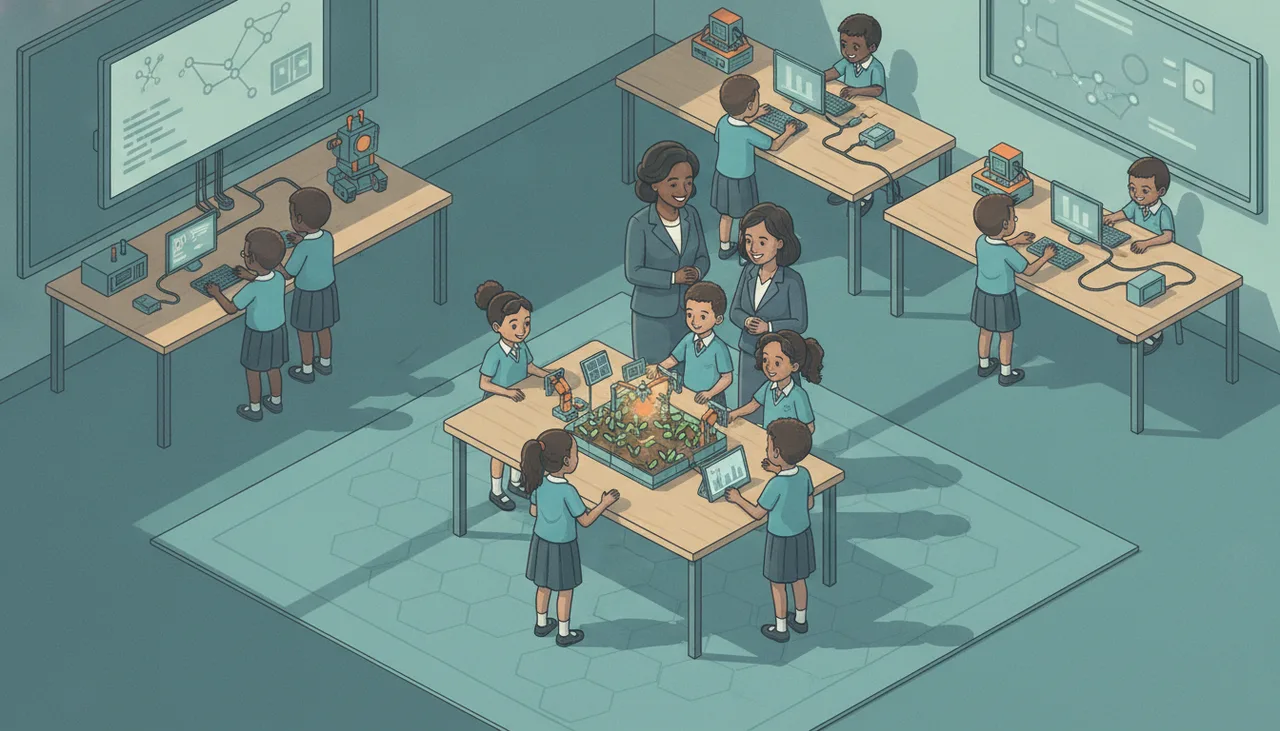
At the May 2026 MICTSETA 4IR Symposium and IoT Hackathon, students built a smart farm and pitched it to the Minister of Higher Education. What that moment means for schools.
At the MICTSETA 4IR Symposium and IoT Hackathon in May 2026, a team of students did something most policy conversations only talk about: they built a working smart-farm solution and presented it directly to South Africa's Minister of Higher Education. It is a small moment with an outsized signal. When learners can put a sensor-driven prototype in front of the person who shapes the country's skills budget, the distance between a 4IR strategy on paper and what a teenager can actually make gets a lot shorter.
This is commentary, not a scoop. Below is what the moment tells schools, teams and parents about where 4IR skills momentum is heading, and what you can practically do with it.
What happened
The facts are simple. At the May 2026 MICTSETA 4IR Symposium and IoT Hackathon, students built a smart-farm solution and presented it to the Minister of Higher Education. MICTSETA is the Media, Information and Communication Technologies Sector Education and Training Authority, the body that runs skills programmes for the ICT sector. A hackathon under its banner therefore sits close to the levers that actually fund training. The hackathon format compresses the whole build cycle into a day or two: pick a problem, prototype a solution, and show it working before time runs out.
Smart farming is a natural fit for that format. The problem is concrete, the sensors are cheap, and the payoff is easy to demonstrate on a table. It also connects a screen skill to something South Africa cares about deeply, which is food, water and land.
Why hackathon-to-policy visibility matters
Most 4IR discussion happens in slide decks. A student prototype in front of a minister does three things a slide deck cannot.
- It makes the pipeline visible. Policymakers hear a lot about skills shortages in the abstract. A working device built by school-age learners is proof that the talent exists early, and that the constraint is access and support, not ability.
- It shortens the feedback loop. When the people who allocate training budgets see what learners can already do with modest kit, the case for funding more of it stops being theoretical.
- It reframes who does 4IR. A student, not a consultant, standing behind the build tells every other learner in the country that this door is open to them too.
None of this guarantees a policy change. But visibility is how momentum starts, and a hackathon is one of the few settings where a fifteen-year-old and a decision-maker end up looking at the same running prototype.
What a smart-farm build actually teaches
Strip the buzzwords and a smart-farm project is a tidy bundle of transferable skills. Whatever the students demonstrated, this is the general shape of the work.
- Sensing: reading soil moisture, temperature or light, and learning to trust or question the number.
- Control: turning a pump or fan on when a threshold is crossed, then off again.
- Data: logging readings over time and spotting a trend rather than a single value.
- Communication: getting a reading off the device and onto a phone or dashboard.
That last step is where the IoT in the hackathon's name lives. Connecting a farm sensor to a cloud dashboard is the same pattern behind a home security prototype or a factory monitor, so the skill travels far beyond agriculture. At our academy that connectivity pattern is what a platform like sheenIoT exists to teach, and a hydroponic or smart-farm build is one of the friendliest on-ramps because you can watch the plant respond to what your code decides. The point is not the specific kit. It is that a learner can hold all four skills in one project they understand end to end.
What schools, teams and parents can do about it
A symposium headline fades fast. The useful response is to turn the visibility into practice.
- Enter a team, not a hero. Hackathon smart-farm builds reward a mix of skills, so pair the coder with someone who can wire sensors and someone who can present. Everyone learns more.
- Pick a local problem. A tunnel that dries out over a long weekend, or a tap left running, beats a generic demo. Judges and ministers remember problems they recognise.
- Prototype ugly, present clean. Breadboard and tape are fine for the build. Spend the last hour making the story clear: what it senses, what it decides, what it does.
- Keep the artefact. A working prototype photographs well and reuses well. It becomes a portfolio piece, a school open-day exhibit, and the seed of next year's project.
- Follow the funding. SETAs and events like this one publish programmes and calls. A teacher who tracks them can route learners toward real bursaries and placements, not just certificates.
If your school wants a lower-stakes place to start, a holiday workshop is a gentler version of the same loop: build something small, show it, iterate. The hackathon is just that loop with the pressure and the audience turned up.
Takeaway
The story worth carrying out of the MICTSETA 4IR Symposium is not that one team impressed a minister. It is that the shortest route from a 4IR policy goal to a real skill runs through a table with a running prototype on it. Schools do not need to wait for a symposium invitation to build that table. A local problem, a handful of sensors, and a team willing to present is enough to start, and every build makes the next one easier.