Is coding still worth learning for kids now that AI writes code?
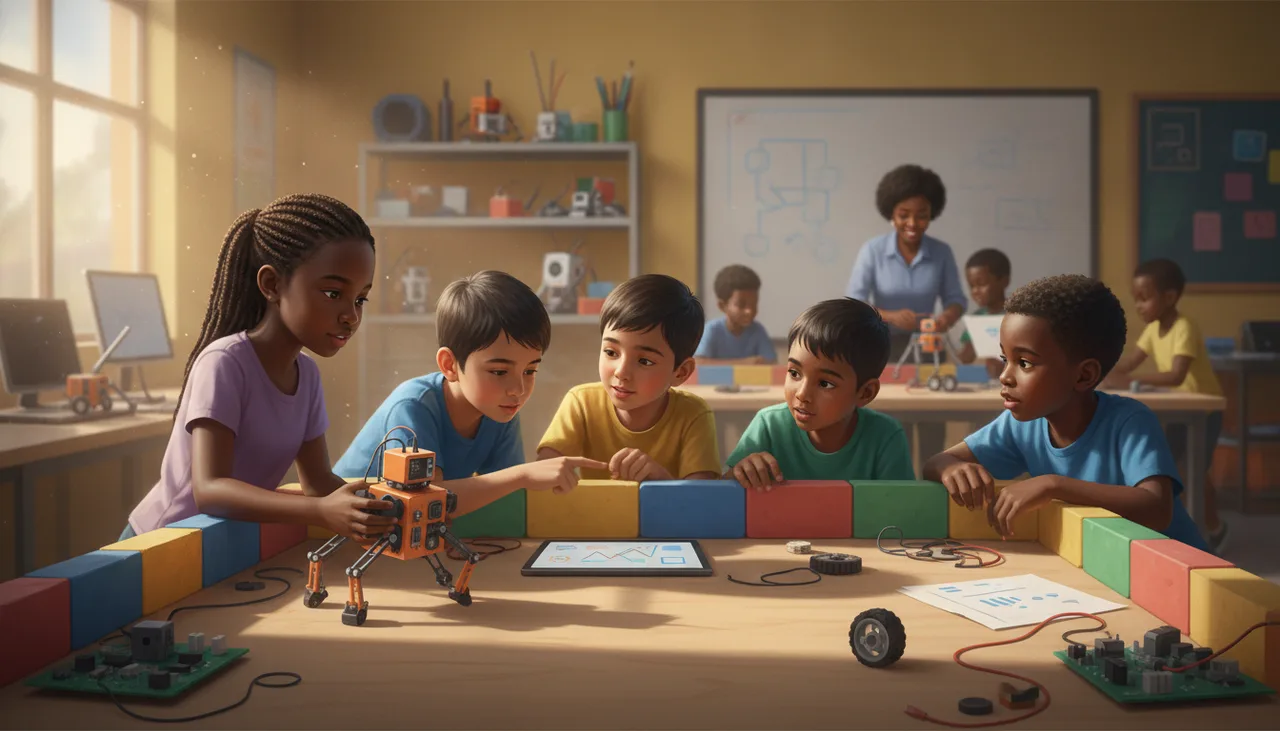
Yes. AI writes code, but it can't decide what to build or fix a robot that hit a wall. Kids need computational thinking, physical debugging and the judgement to direct AI. Robotics teaches all three.
TL;DR
- Yes, coding is still worth learning for kids, but the goal has changed. Typing syntax was never the point. The durable skills are computational thinking, debugging real systems, and knowing how to direct and verify AI. Those become more valuable as AI writes more of the code, not less.
- AI can generate code, but it cannot decide what is worth building, judge whether a result is actually correct, or fix a robot that just drove into a wall. Children need deliberate practice at exactly those things.
- Robotics is the most AI-resilient form of coding education because the feedback loop is physical. A chatbot answer can merely look right; a robot either completes the task in front of you or it does not.
- Screen-only coding apps are the format most exposed to AI, and children often lose interest in them fastest. If you choose one path, choose one where the code meets the physical world.
- Start with block coding around age 6 to 8, then move to text (Python) when blocks feel limiting. Platforms that run both on the same hardware make that transition painless.
The fear every parent is voicing right now
If you searched "is coding still worth learning for kids", you are not alone and you are not being paranoid. The doubt is everywhere, including among parents who write software for a living.
"I see these parents putting kids in software coding classes at a very young age. I definitely don't support that. Most of that will be taken over by AI anyways."
Professional developers, the people best placed to judge, are torn too:
"I can't go through a day without reading another article about how AI... is replacing coders at Microsoft...This makes me really question what I am doing."
"I can't shake the feeling that I am setting my kid on a path that leads directly into a solid brick wall."
And parents who do still want to teach their kids are finding the existing options stale:
"AI has completely changed how I personally code... and all of the existing courses/curriculums for kids just feel a bit archaic"
— Ask HN: How are you teaching your kids programming in 2025?, Aug 2025
"They've done some code.org, but it becomes boring quickly."
So the question is fair. If AI writes code, why pay for coding classes? Answering it honestly means looking at what those classes were ever supposed to teach.
Why this doubt exists, and where it is partly right
AI really did change professional programming
Dismissing the fear would insult your intelligence. Developers now spend a large share of their day specifying work for AI tools, reviewing what comes back, and correcting it. The mechanical act of typing out code is worth less than it was five years ago. Any coding class still selling syntax memorisation as the product is selling the part that got automated.
Most kids' coding curricula predate AI
The people teaching this subject say so themselves. In the 2025 CSTA/Kapor survey of 2,882 PK-12 computer science teachers, 81% said AI should be foundational to CS education, but only 42% felt equipped to teach it. That gap is exactly what parents are sensing when a course "feels archaic": the field agrees AI belongs in the curriculum and has not yet rebuilt the curriculum around it.
The old sales pitch was wrong anyway
"Learn to code and a job is guaranteed" was always a shaky promise, and AI has now broken it publicly. But that pitch was never the real reason to teach children to code. The real cargo was computational thinking: breaking a big problem into small ones, forming a hypothesis about why something fails, testing it, and persisting through the loop. The Raspberry Pi Foundation made the same argument in its 2025 position paper "Why kids still need to learn to code in the age of AI", written in direct response to this doubt. AI automates the typing. It does not automate the thinking, and it raises the price of not having it.
Screen-only formats confuse output with learning
When the deliverable is code on a screen, an AI can now produce that deliverable instantly, so both the child and the parent reasonably ask what the exercise was for. Learning lives in the struggle-and-feedback loop, and puzzle apps have a weak one. That is why children burn through them and drift away.
What actually works in 2026
Whatever platform or vendor you pick, these decision rules hold up:
- Optimise for thinking, not typing. Ask any provider: what does my child practise when the code is wrong? If the answer is "the app shows the solution", keep looking. Diagnosis is the skill; solutions are now cheap.
- Choose a physical feedback loop. A robot that drives into a wall cannot be faked by a pasted LLM answer. The fault might be in the code, the wiring, a sensor, a flat battery, or the way the wheels were mounted. Working through that stack is genuine engineering judgement, and it is the part AI cannot do for a child standing next to a real machine.
- Treat AI as an instrument to master, not a temptation to ban. Good ground rules: the child asks AI for hints rather than finished solutions, predicts what the code will do before running it, and must explain why a fix worked before moving on. A child who can direct and verify AI is learning the actual job of the next decade.
- Sequence blocks to text without a hardware cliff. Blocks remove syntax friction for a 6 to 8 year old. Text (usually Python) becomes appropriate when the child starts fighting the blocks. Prefer platforms where both run on the same hardware, so progression does not require a new purchase and a new ecosystem.
- Spend nothing until the child is hooked. With ZAR budgets under pressure, the right order is: free browser tools first, a trial class second, hardware last. A bored child with an expensive kit is the worst outcome on the list.
- Watch for real learning signals. Can the child explain what broke and why the fix worked? Do they come back to a project without being told to? Those two signals matter more than any certificate.
How we apply this at sheen robotics
Our approach follows the rules above, and you can test it without spending anything. sheen academy in Cape Town teaches coding and robotics from age 6, and the first class is a free trial. The sheenbot∞ board runs block coding and MicroPython on the same hardware, so a child graduates from blocks to text without changing devices. Its on-board AI features, such as voice and vision, are used as learning material, and the built-in AI helper is designed to guide with hints rather than write the solution. The board also works fully offline, with no account, subscription or cloud dependency, which matters in South African schools where connectivity and load shedding are daily realities. Before buying any hardware at all, a child can code a simulated robot in real MicroPython in the free browser simulator at sheen verse.
The honest caveat: classes and hardware cost more than a free puzzle app. That is exactly why the simulator-first, trial-class-second route exists.
Screen app vs robotics kit vs AI-native robotics: what does the child actually practise?
| Option | What the child actually practises | Where AI fits | Honest drawbacks |
|---|---|---|---|
| Screen-only coding app (code.org, tablet apps) | Sequencing and logic puzzles in a closed environment; output is an on-screen animation. Free or cheap, and a fine first taste. | AI can complete most exercises instantly, so it tempts shortcuts more than it builds judgement. | Engagement often fades fast; no physical debugging; the format most directly devalued by AI. |
| Self-study with an AI chatbot | Prompting and reading generated code. Free and always available. | AI is the whole experience, with no independent check on whether the child understood anything. | No verification loop; copy-paste without comprehension is the path of least resistance; no peers or mentor. |
| Generic robotics kit (LEGO Education, VEX, micro:bit + chassis) | Building, mechanics, block coding, and real physical debugging. Mature ecosystems with huge tutorial libraries. | Most curricula predate AI; AI is generally neither taught nor integrated into the learning path. | Strong kits are expensive in ZAR; some ecosystems tie features to companion apps; block-to-text progression varies by platform. |
| AI-native robotics learning (sheenbot∞ with sheen academy, or similar) | The full loop: build, code in blocks or Python on the same board, debug a physical robot, and study AI features such as voice and vision with hint-based AI help. | AI is part of the syllabus: the child learns to direct it and verify it, and the helper gives hints, not answers. | Costs more than a free app; a newer ecosystem with fewer third-party tutorials than LEGO or VEX; in-person classes are location-dependent (Cape Town for us), though the browser simulator is free anywhere. |
FAQ
Is coding still worth learning for kids now that AI writes code?
Yes. The value has shifted from writing syntax to computational thinking: decomposing problems, debugging, and verifying what AI produces. AI makes those skills more important because someone still has to decide what to build and judge whether it works. The Raspberry Pi Foundation's 2025 position paper argues the same in direct response to this fear.
What age should a child start coding and robotics?
Around age 6 is a sensible start, using block coding so that reading and typing skills are not a barrier. sheen academy takes children from age 6. Text-based coding such as Python usually fits once the child is comfortable with blocks and starts finding them limiting, often somewhere between 9 and 12, though readiness varies more than age.
Are robotics classes worth it for my child?
They are worth it if they deliver what an app cannot: physical debugging, structure, peers, and a mentor who asks the child to explain their reasoning. They are not worth it if the class does the thinking for the child. Test cheaply before committing: try the free browser simulator, then a free trial class, and only then decide about hardware or a term of classes.
Block coding vs Python for kids: which should come first?
Blocks first. They remove syntax errors so the child spends attention on logic, which is the part that transfers. Switch to Python when the child starts hitting the limits of blocks rather than at a fixed age. Platforms that run both on the same hardware, such as micro:bit or sheenbot∞, make the switch a small step instead of a restart.
Will there still be programming jobs when my child grows up?
Nobody can promise what the job market looks like in 15 years, and you should distrust anyone who does. That is precisely why the safer bet is skills rather than a job title: problem decomposition, debugging real systems, and directing AI transfer to engineering, science, medicine, farming and business. Robotics education is a thinking investment, not a career wager on one occupation.
Can my child try robotics coding without buying any hardware?
Yes. sheen verse is a free in-browser 3D robotics simulator that runs real MicroPython with no hardware, no account and no subscription; start at /verse-try/en-us, or try the block editor at /canvas-try/en-us. If your child enjoys it, a free in-person trial at sheen academy is the next low-risk step.