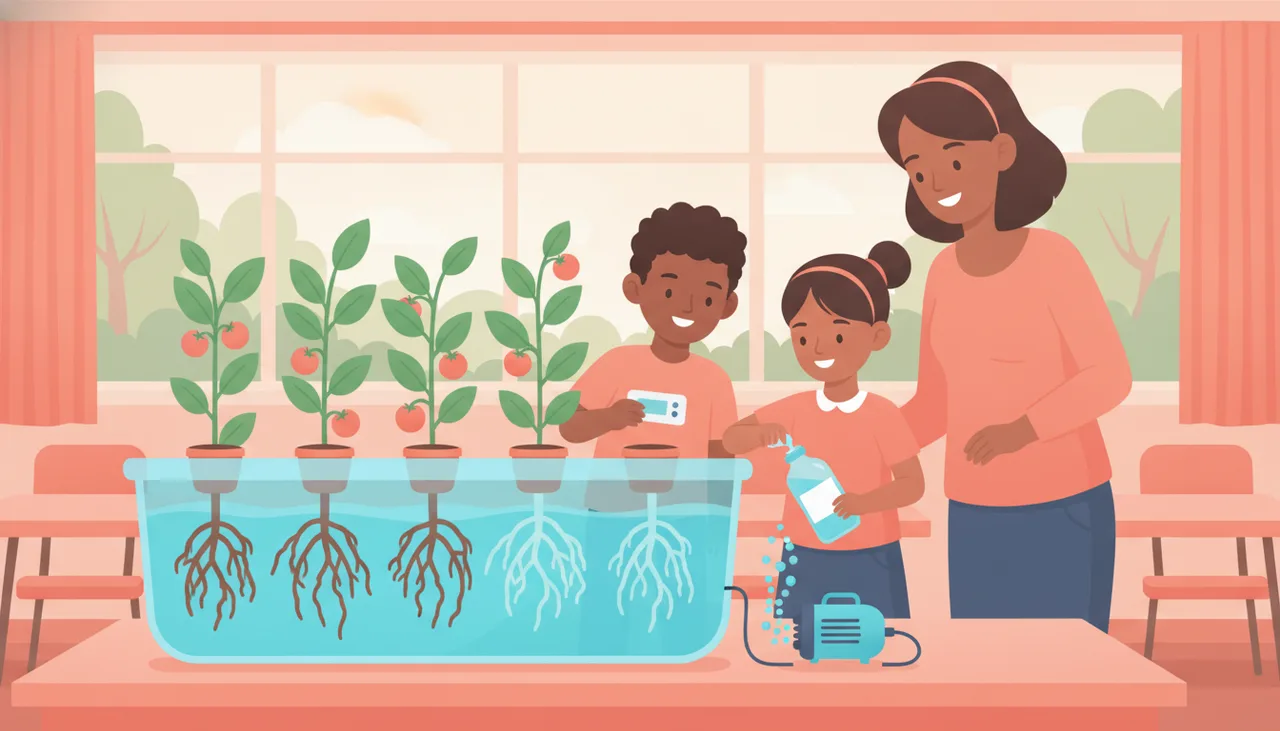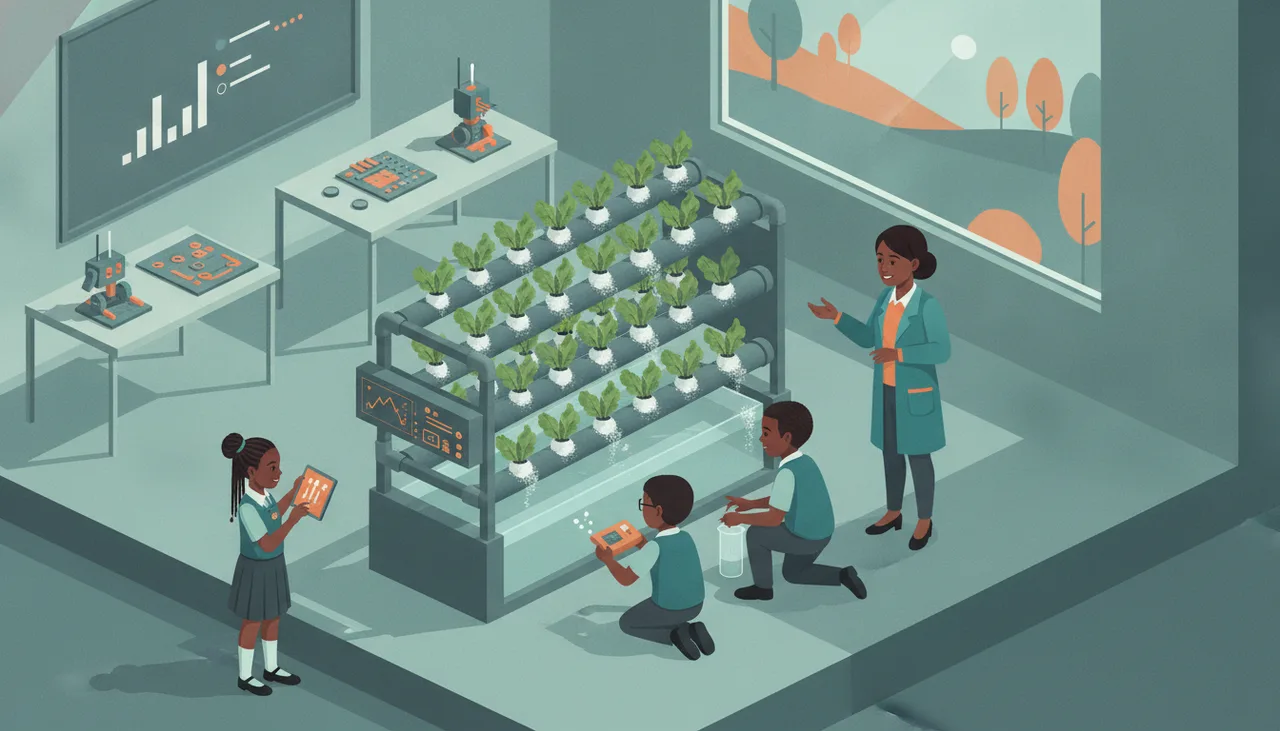
Why did our classroom hydroponics plants die over the holidays?
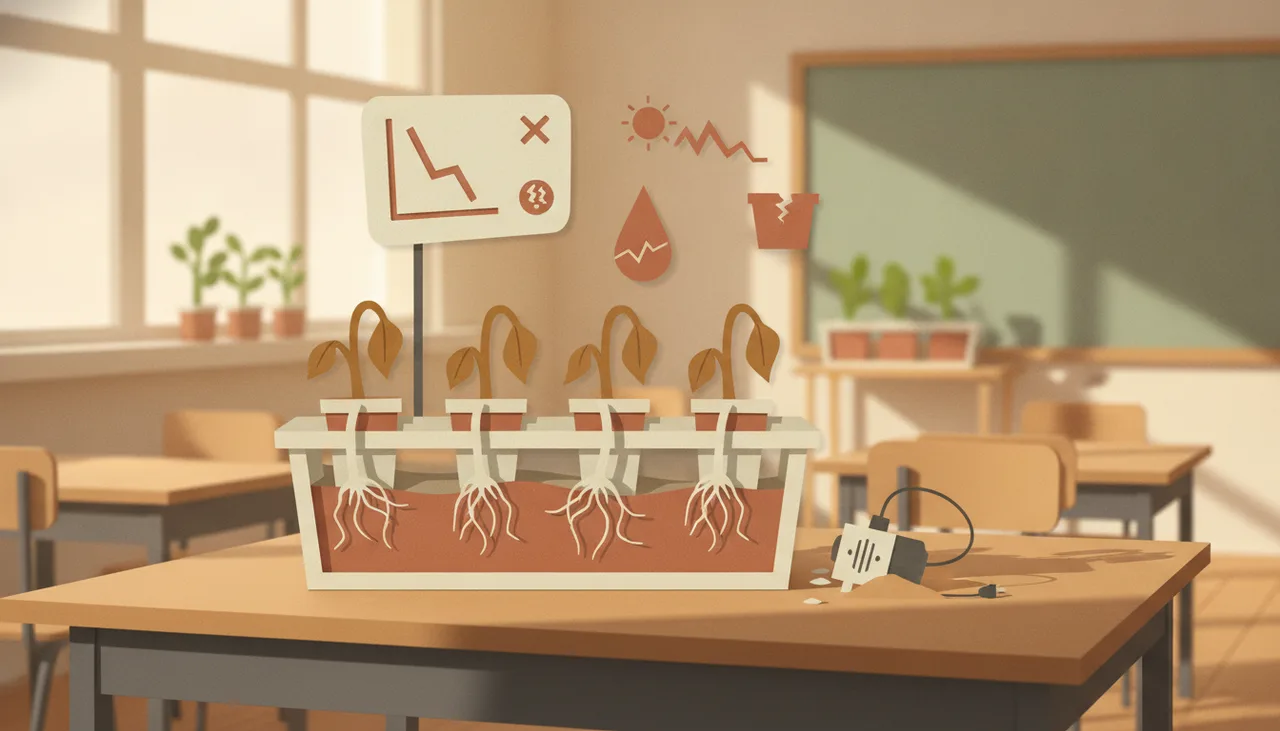
Evaporation concentrates nutrients, pH swings, pumps run dry: a two-week break completes the chain. Compare Kratky, consumer appliances and sensor-based automation with remote alerts.
TL;DR
- Classroom hydroponics dies over the holidays because nobody tops up the reservoir. Water keeps leaving, the nutrient salts stay behind and concentrate, pH swings out of range, and the pump runs dry or the roots rot. A two-week break completes the chain.
- Cheap pH and TDS pens make it worse. Some store their calibration in RAM, so a battery change silently wipes it and you dose the tank against false readings.
- Passive Kratky setups survive breaks with no pumps and no power, but they suit fast leafy crops only and cannot be adjusted mid-cycle.
- Consumer appliances carry cloud risk: AeroGarden announced its shutdown in 2024-25 with app access promised only until March 2026, and Gardyn gates features behind a membership of roughly $39 per month.
- For year-round classroom growing, the dependable route is sensing plus automation with remote alerts that do not rely on the school's WiFi, backed by battery or solar where power is unreliable.
"Plant care on school holidays": the constraint every teacher names
Read any teacher thread about classroom hydroponics and the holiday problem appears before anyone mentions nutrients or grow lights. A system that wants daily attention has to live inside a calendar designed around leaving it alone.
"Got a few points I have to think about: - cost has to be as low as possible … - plant care on school holidays"
— secondary teacher, r/Hydroponics, Mar 2025
A teacher with a $1,400 grant to spend put the whole requirement set in one sentence:
"I would like something that has longevity, ability to purchase replacement parts, and ability to leave over a long weekend."
That same 2023 thread bundles the trifecta teachers keep asking for: survives breaks unattended, no dependence on school WiFi, parts stay purchasable. When those conditions are not met, a school-garden education blog describes the result:
"The students are gone. The teachers are taking a well-earned break. And the garden? Well… it's left to fend for itself… By the time fall rolls around, the garden looks abandoned—or worse, completely dead."
Why a two-week break kills a hydroponic system
1. The failure chain: evaporation, concentration, pH swing, dry pump
A reservoir loses water through the plants and to the air, but the dissolved nutrient salts stay behind. As the level falls, the solution gets steadily stronger, and uneven nutrient uptake pushes pH out of the range where nutrients stay available. Once pH leaves that band, plants can starve in a tank full of food. The falling level then exposes the pump intake: the pump runs dry and fails, or roots that relied on circulating water sit in stagnant, oxygen-poor solution and rot. None of these steps needs more than a few days. A fortnight completes the chain comfortably.
2. Cheap meters give you false confidence before you leave
Most teachers do the responsible thing before a break: test the water, adjust it, and leave the system "safe". The instruments make that harder than it sounds.
"I ordered 2 meters from Amazon (TDS & PH) and I had no idea how complicated the calibration of them would be!"
Worse, some budget pens do not keep their calibration at all:
"The calibration values are stored inside ram and not non volatile memory … whenever you replace the batteries, you loose calibration."
If a battery swap quietly reset your meter, the "safe" pH you dialled in before locking the classroom was never correct, and the failure chain starts from a worse position than you thought.
3. Appliance gardens outsource the problem to a vendor's cloud
Countertop appliances promise to remove the maintenance burden, and day to day they largely do. But if the monitoring and alerts live in a phone app, they live on the vendor's servers. AeroGarden announced its shutdown in 2024-25, with app access for WiFi models promised only until March 2026. Gardyn keeps key features behind a membership of roughly $39 per month. A classroom tool that stops working when a company changes strategy is a real procurement risk, especially for equipment bought on a one-off grant.
4. School infrastructure fights you
School WiFi is usually locked down: captive portals, device approval, passwords that change every term. The same threads asking about holidays also ask for systems that avoid the school network entirely. Over breaks, buildings may be powered down, and in South Africa load shedding adds scheduled outages on top. A pump timer that loses power, or a WiFi-only alert system on a network IT switched off for the holidays, fails silently. You find out in the new term.
What actually works: three strategies and a pre-holiday checklist
The decision rule is simple. Match the strategy to the length of unattended time and to what you want the system to teach.
- Short breaks, leafy crops, minimal budget: go passive (Kratky).
- Zero setup tolerance: buy an appliance, but check the exit doors first.
- Year-round growing plus real data for lessons: sensors, automation and remote alerts.
Strategy 1: Go passive with Kratky
Kratky is hydroponics with the failure points removed: a deep reservoir, no pump, no power. As the plant drinks, the falling level leaves an air gap the roots adapt to. Nothing can be unplugged, tripped or load-shed. The honest limits: it suits lettuce, herbs and other fast leafy greens; large or fruiting plants outdrink a sealed reservoir; and there is no mid-cycle adjustment, so whatever you mixed on the last day of term is what the plants get. Size the container generously and treat each crop as a one-shot batch.
Strategy 2: Buy an appliance, with your eyes open
Plenty of teachers want exactly this. One school post asks explicitly for no DIY: something easy to set up and manage, bought on a grant, justified to admin. Fair enough. Before committing grant money, ask three questions: does the unit keep pumping, lighting and dosing if the app or cloud disappears? Is any function behind a subscription? Are pumps, sensors and pods sold individually, or only as bundles? The AeroGarden shutdown is the cautionary tale: hardware that outlives its cloud is only useful if it was designed to run without it.
Strategy 3: Sensors, automation and alerts that reach you at home
For a system that runs across terms and teaches real data skills, automation with remote monitoring is the workable answer. The shopping criteria that matter, regardless of vendor:
- Local-first control. Dosing, top-up and light schedules must run on the device, not in the cloud, so an internet outage degrades monitoring rather than killing the plants.
- Calibration stored in non-volatile memory, for the battery-swap reason above.
- Alerts that reach your phone off-campus without the device joining the school's WiFi.
- Power resilience: battery or solar backup where outages or load shedding are a reality.
- Individually purchasable parts, so one failed probe does not strand the whole system.
The pre-holiday checklist
- Replace the nutrient solution completely rather than topping up, so you leave at a known concentration.
- Fill the reservoir to maximum and record the level.
- Change meter batteries first, then calibrate, then log the readings.
- Add reservoir capacity if you can: a float valve fed from a top-up tank buys days.
- Put grow lights on a timer and confirm the schedule survives a power cycle.
- Harvest or thin the biggest plants. Less leaf area means slower water loss.
- Test that a remote alert actually reaches your phone at home, before you rely on it.
- Arrange one keyholder who can respond to an alert, and show them the top-up routine.
- Photograph the system and log the baseline so problems are diagnosable later.
How our systems handle the holiday problem
This failure chain is what our hydroponics range is built around. The systems come in four sizes, from aeroponic towers down to a desktop teaching kit, with temperature, humidity, light and water sensing, nutrient dosing, grow-light scheduling and a time-lapse camera. Data graphs on the device and syncs to the sheenIoT dashboard, so a teacher at home sees the same readings the class sees, and alert rules can flag a falling level before the pump is at risk. Connectivity does not depend on joining the school's WiFi (the devices bring their own radio and bridge options), and a solar plus battery backup option covers load shedding. Replacement sensors and parts are sold individually in our store, and teacher training is available through our school service. The honest trade-off: it costs more than a Kratky tub, and automation still needs commissioning and testing before the first break, which is what the checklist above is for.
Comparison: four ways to run classroom hydroponics
| Option | Survives a 2-week break? | Power and WiFi needs | Parts and running costs | Honest cons |
|---|---|---|---|---|
| Kratky (passive) | Yes, for leafy crops in a well-sized reservoir | None | Lowest; containers and nutrients only | Leafy greens only; no mid-cycle adjustment; one-shot batches; no data for lessons |
| Consumer appliance (AeroGarden, Gardyn class) | Usually, if pumps and lights run locally | Mains power; app features need vendor cloud | Proprietary pods; Gardyn membership around $39/month | Cloud shutdown risk (AeroGarden app support promised only until March 2026); parts often bundled, not individual |
| DIY sensor build (hobby boards plus budget meters) | Only as good as the build and the person maintaining it | Mains power; alerting depends on school network access | Cheap hardware, expensive in teacher time | Calibration drift; some cheap pH pens lose calibration on battery change; no vendor support; hard to hand over to the next teacher |
| Turnkey automated with remote alerts (e.g. sheen hydroponics) | Yes; sensing, dosing and alerts are designed for unattended stretches | Solar and battery backup option; does not require joining school WiFi | Individually sold sensors and spares; no subscription for core function | Higher upfront cost than Kratky or DIY; still needs commissioning and an alert test before the first break |
FAQ
Why did our classroom hydroponics plants die over the school holidays?
Almost always the same chain: the reservoir was not topped up, so evaporation and plant uptake concentrated the nutrient solution, pH drifted out of range, and the pump ran dry or the roots sat in stagnant water and rotted. Two weeks unattended is enough for all of it. The fix is either a passive design with no pump, or automation that tops up, doses and alerts you remotely.
Is Kratky good enough for a school hydroponics project?
For lettuce, herbs and other fast leafy greens, yes, and it is the cheapest holiday-proof option because there is nothing to unplug or power. Its limits are real: no mid-cycle adjustment, one-shot batches, and no live data for lessons. Many teachers run Kratky for resilience and add sensors later when they want the data.
Why is my cheap pH pen suddenly reading wrong?
Budget pens drift and need regular recalibration against reference solutions, which surprises most first-time buyers. Some models also store calibration in RAM rather than non-volatile memory, so replacing the batteries erases it. Change batteries first, then calibrate, then log the values, and prefer probes that keep calibration through a power loss.
Do classroom hydroponics systems need to be on the school's WiFi?
Not if you choose for it. School networks are locked down and often off during holidays, which is why teachers explicitly ask for systems that avoid them. Look for devices with their own radio or bridge path to the internet, and confirm that pumps, dosing and lights keep running locally even with no connectivity at all.
Are app-controlled smart gardens safe to buy for a classroom?
Only if the hardware works without the app. AeroGarden announced its shutdown in 2024-25 and promised app access for WiFi models only until March 2026, while Gardyn gates features behind a membership of roughly $39 per month. Before spending grant money, confirm the unit runs standalone, has no subscription for core functions, and sells replacement parts individually.