WRO RoboMission vs Future Innovators: Which Category to Enter First
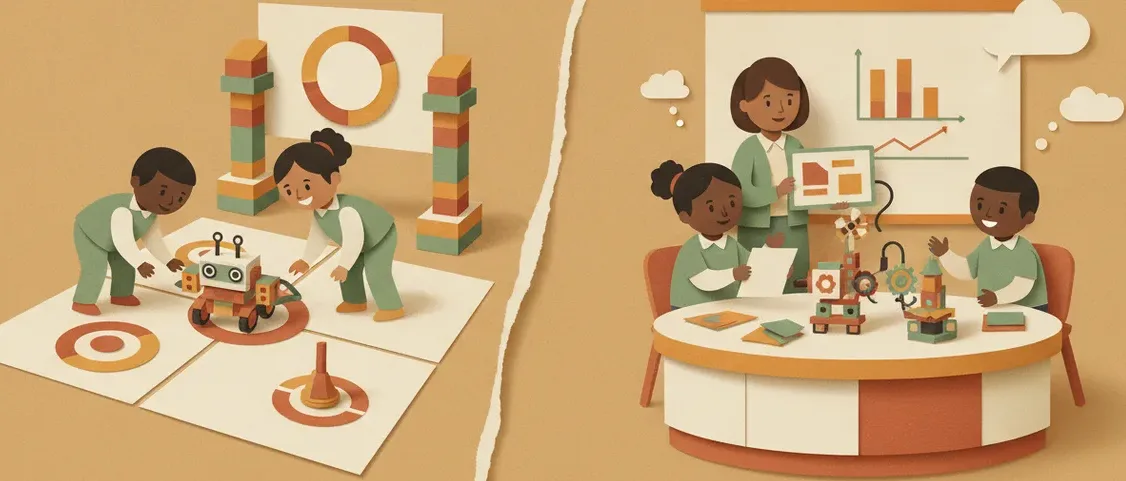
Choose RoboMission if your team needs concrete rules, objective scoring, and standard Lego hardware. Choose Future Innovators if you lack a regulation mat or have multi-disciplinary makers who excel at research and pitching.
If your school is entering the World Robot Olympiad (WRO) for the first time, your choice comes down to a fundamental trade-off: RoboMission tests algorithmic precision within tight, objective physical rules; Future Innovators tests open-ended problem solving, research, and presentation skills against a global theme.
For most schools with a dedicated robotics kit (like LEGO Education SPIKE Prime) and a coach with some programming background, RoboMission is the simpler starting point organisationally because the target is unambiguous: score points by moving game elements on a mat. However, if your school lacks standard kits, has limited floor space for regulation tables, or has learners who lean more toward science-fair invention and presentation than iterative control loops, Future Innovators provides a significantly more accessible technical runway.
The Core Difference: Closed Table vs Open Booth
Understanding what each category actually demands on competition day clarifies the coaching load:
- RoboMission (formerly Regular Category): Teams build and program an autonomous robot to solve a specific, predetermined challenge on a 2.37m × 1.15m vinyl mat within a 2-minute run. Scoring is purely arithmetic and objective: an object moved to the correct zone yields points; a wall penalty deducts points. On competition day, a surprise rule or modified layout is introduced, requiring on-the-spot programming adjustments without coach intervention.
- Future Innovators (formerly Open Category): Teams design, build, and present an original robotic project aligned with the annual WRO theme (such as sustainable agriculture, ocean logistics, or emergency response). The team sets up a 2m × 2m booth, produces an academic report, delivers an oral pitch to a judging panel, and demonstrates a working prototype.
Comparing Costs, Hardware, and Infrastructure
Cost and physical space often dictate what is practical in a South African school context, especially when factoring in secure storage and transport.
| Factor | RoboMission | Future Innovators |
|---|---|---|
| Allowed Hardware | Strictly limited to specific controller ecosystems (typically LEGO Education SPIKE Prime or MINDSTORMS). | Completely open. Arduino, Raspberry Pi, micro:bit, ESP32, 3D prints, recycled materials, and custom electronics are all permitted. |
| Physical Setup Costs | High upfront kit cost + annual game mat and challenge element pack + full-sized wooden table or floor border. | Variable. Can be built affordably using low-cost microcontrollers, sensors, and sheet materials. |
| Storage & Space Requirements | Requires a flat, permanent or collapsible 2.4m table space for continuous practice and sensor calibration. | Requires project storage space and a standard display board, but practice does not require a fixed arena. |
If your school already owns class sets of SPIKE Prime or EV3 kits, RoboMission lets you use that capital directly. But if you have an ad-hoc collection of micro:bits, single-board computers, and scrap materials, Future Innovators allows you to build a competitive entry without buying into an expensive proprietary ecosystem.
Time Commitment and Coaching Demands
Both categories require serious time, but the failure modes and coaching demands are entirely different.
RoboMission: High Iteration, Deterministic Debugging
In RoboMission, ninety percent of the work is debugging. Learners write code, test it on the mat, watch wheel slip or lighting changes ruin a line-follow turn at the 40-second mark, and re-tune their proportional-integral control or colour sensor thresholds. The coaching role here is technical: teaching solid mechanical building (gear ratios, centre of gravity, structural rigidity) and modular coding practices (functions, state machines, sensor calibration).
The hidden hurdle is environment variance. A robot calibrated in an air-conditioned, carpeted classroom on battery power will behave differently on competition day under bright halogen lights with a drained lithium pack. Managing this variance requires disciplined testing.
Future Innovators: Project Management and Communication
In Future Innovators, the robot does not need to complete a fast 2-minute run without human intervention. Instead, it must demonstrate a coherent solution to a real-world problem. The challenges here are scope creep, project delivery, and presentation stamina.
Coaching Future Innovators resembles mentoring an engineering thesis. You will spend as much time guiding literature reviews, interview questions for industry experts, poster designs, and public speaking rehearsals as you will debugging sensor code. A technically brilliant machine with a poorly articulated report or a nervous, unprepared pitch will score lower than an accessible, well-explained prototype with rigorous research behind it.
Judging Criteria: Scoreboard vs Panel
How your learners handle evaluation should influence your choice:
- RoboMission judging is binary and transparent. The referee records the score on a tablet, the team signs the scoresheet, and the ranking is immediate. For learners who get anxious about subjective assessment or public speaking, RoboMission offers clear, unemotional feedback: the robot either completed the task or it did not.
- Future Innovators judging is holistic and multidimensional. Judges assess innovation, project feasibility, engineering design, software architecture, teamwork, and presentation clarity. Learners must be prepared to answer tough questions on the spot, justify their engineering trade-offs, and defend their code to professional engineers and educators.
Which Category Fits Your School?
Use this diagnostic framework to decide your entry path for the upcoming season:
Enter RoboMission first if:
- You already have regulation Lego robotics hardware.
- You have a dedicated room where a 2.4m practice table can stay assembled.
- Your learners are motivated by puzzles, mechanics, and algorithmic problem-solving.
- Your coaching team wants a structured, objective benchmark to build core robotics fundamentals.
Enter Future Innovators first if:
- You do not own proprietary kits and want to build with Arduino, micro:bit, or open-source hardware.
- You lack floor space for competition mats and practice arenas.
- Your team includes learners with mixed talents: researchers, designers, coders, and speakers.
- Your school wants to showcase community-focused, local problem-solving (e.g. water security, smart farming, fire detection).
If you are establishing your school's robotics programme from scratch and need structured training for your coaches on mat strategies or hardware integration, explore our School Services or consult the competition pathways in the Sheen Academy.