What South Africa’s Coding and Robotics Curriculum Actually Requires of Your School
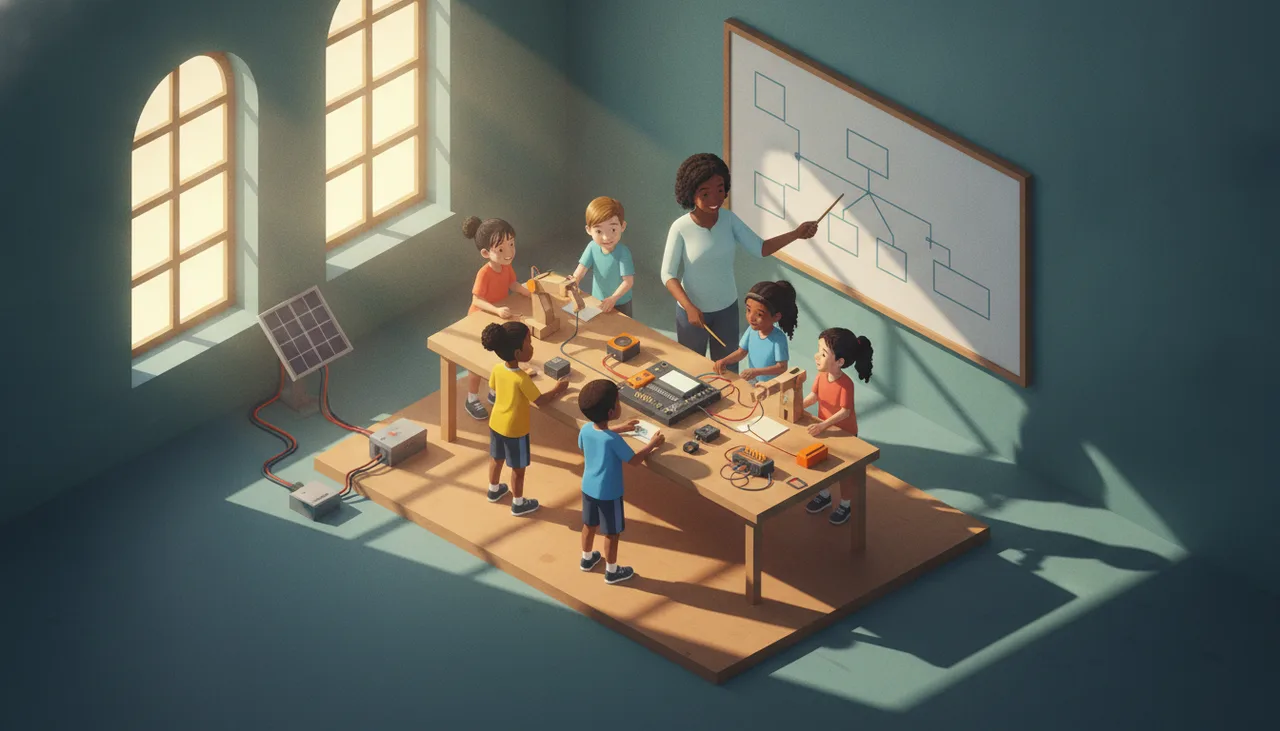
You do not need R10,000 robot kits or a 1:1 laptop ratio to pass a CAPS audit. The draft curriculum can be delivered using offline, open-source tools and affordable microcontrollers, even in classrooms facing load-shedding and limited connectivity.
The draft CAPS Coding and Robotics curriculum can read like a wish list compiled by a Silicon Valley tech firm. On paper, it demands that schools introduce learners to algorithms, internet technologies, digital citizenship, and mechanical systems. To a school head or governing body, this sounds like an immediate invoice for hundreds of thousands of Rands in high-end laptops, proprietary robotics kits, and fibre upgrades.
But the policy document and the classroom reality are two very different things. When you strip away the buzzwords, the actual pedagogical requirements of the curriculum are highly adaptable. You do not need to over-buy. In fact, the schools that spend the most on proprietary educational toys often see the lowest return on investment because the equipment is too complex for teachers to integrate into a standard 45-minute period.
The Phase-by-Phase Breakdown
The curriculum is structured across three distinct phases, and the hardware requirements do not become serious until Grade 4. Here is what is actually required to meet the learning outcomes:
| Phase | Key Focus Areas | Practical Hardware Required | Approximate Cost per Learner Group |
|---|---|---|---|
| Foundation (R-3) | Unplugged coding, pattern recognition, basic digital literacy. | None. Paper grids, floor mats, and physical cards. | R0 - R200 (DIY materials) |
| Intermediate (4-6) | Visual programming (Scratch), basic microcontrollers, input/output devices. | Affordable microcomputers (like the BBC micro:bit) and free offline software. | R500 - R800 per pair |
| Senior (7-9) | Text-based coding (Python/HTML), basic electronics, algorithms, and systems. | Microcontrollers with basic sensor kits (resistors, LEDs, breadboards). | R800 - R1,200 per pair |
In the Foundation Phase (Grades R to 3), the curriculum is almost entirely "unplugged". The focus is on computational thinking—teaching children how to break a problem down into sequential steps. You can teach this perfectly using a grid drawn on a classroom floor, where one learner acts as the "robot" and another writes the "code" using paper arrows. Buying expensive, rechargeable floor robots for Grade 1s is a luxury, not a curriculum requirement.
In the Intermediate Phase (Grades 4 to 6), learners transition to screen-based block programming. The standard tool here is Scratch, which is completely free and has an offline editor. For the robotics component, the curriculum introduces microcontrollers. A simple BBC micro:bit costs roughly R500 to R600. It features built-in light sensors, temperature sensors, and an LED matrix. It does not require a complex chassis or wheels to teach the core concepts of inputs, processes, and outputs.
In the Senior Phase (Grades 7 to 9), the transition to text-based programming (typically Python) and basic electronics begins. Here, learners need to understand how components like resistors, light-emitting diodes (LEDs), and ultrasonic sensors interact. Again, this can be achieved using basic electronics kits rather than pre-assembled, proprietary robot chassis that cost thousands of Rands.
The Over-buying Trap
The biggest mistake South African schools make is purchasing closed-ecosystem robotics kits. These kits, often costing between R8,000 and R15,000 per box, are designed for extracurricular competition teams, not 40-learner classrooms.
"When a school buys proprietary hardware, they are not just buying the plastic; they are buying into a licensing ecosystem that often requires high-speed internet, expensive replacement parts, and proprietary software that won't run on older school laptops."
If a single proprietary sensor breaks, replacing it can cost hundreds of Rands and take weeks to ship. If you instead use open-source hardware, a replacement sensor costs less than a cup of coffee and can be sourced locally. Furthermore, open-source platforms ensure that the skills learners acquire are transferable to real-world engineering, rather than being limited to a single toy brand's interface.
The 40-Learner, 1-Laptop Reality
How do you implement this when you have a large class and a single laptop trolley? The answer lies in rotation and pair programming.
You do not need a 1:1 ratio of devices to learners. In the software industry, "pair programming" (two developers sharing one screen) is a standard practice that improves code quality and collaboration. In a classroom of 40, 20 devices is the functional limit for a single teacher to manage. If you have fewer devices, you must structure your lessons around rotation stations: Group A works on unplugged algorithmic puzzles, Group B works on the laptops writing code, and Group C works on physical circuit assembly.
At Sheen Robotics, we design our school implementation services to help schools map their existing infrastructure to the CAPS requirements, ensuring that no school buys hardware they cannot realistically use in a standard classroom layout.
The Infrastructure Filter: Load-Shedding and WiFi
Any curriculum plan that relies on a constant, high-speed internet connection will fail in the average South African school. School WiFi networks, particularly those using WPA2-Enterprise security protocols, frequently block the ports required by educational microcontrollers to flash code from web-based editors.
To build a resilient coding programme, your tools must meet three criteria:
- Offline capability: Software like Scratch Desktop and offline Python IDEs (like Thonny) must be installed locally on the machines.
- Low power draw: Microcontrollers like the micro:bit can be powered directly via a laptop's USB port or a simple AA battery pack. They do not require mains power to run.
- Battery-backed laptops: If your computer lab relies entirely on desktop PCs, a single load-shedding block will wipe out your teaching time. Laptop trolleys that can charge during school hours and run on battery during blackouts are the only reliable option.
The CAPS coding and robotics curriculum is highly achievable if you ignore the marketing hype. Start with unplugged computational thinking, scale up to free offline software, and use affordable, open-source hardware when you transition to physical computing. Your budget, and your teachers, will thank you.