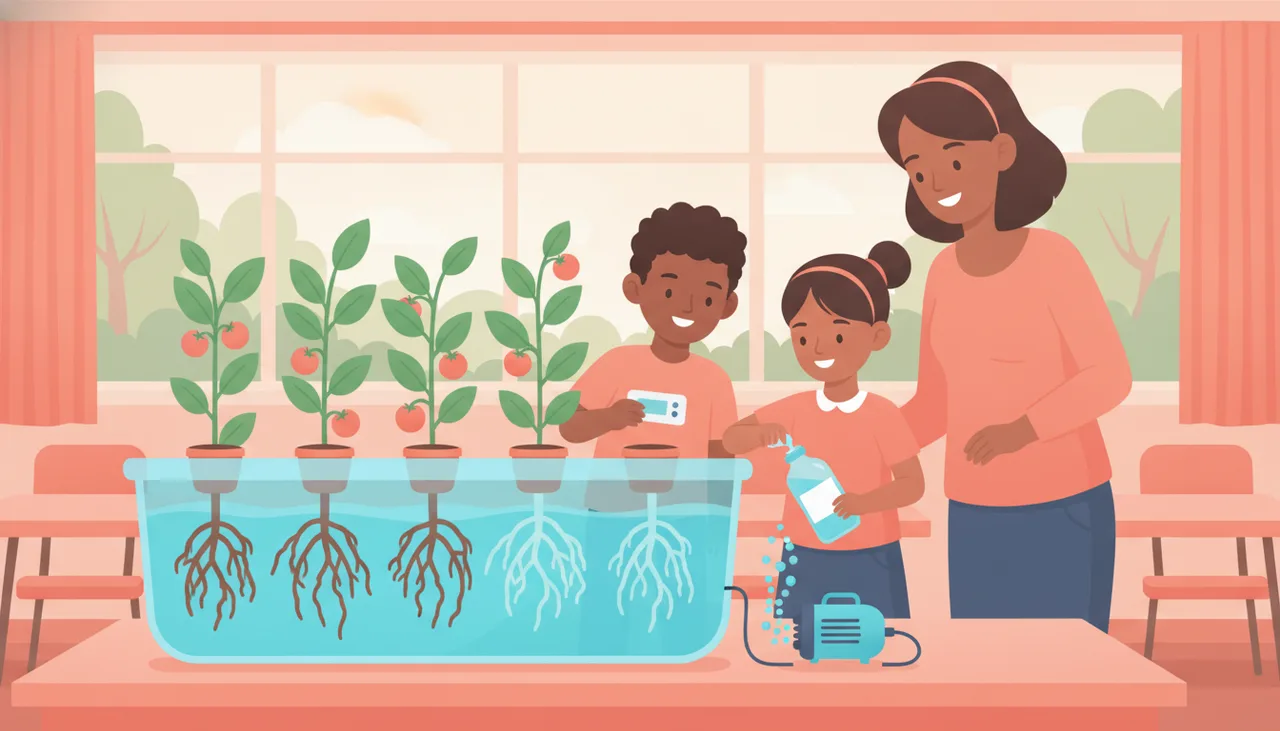
Why Your Classroom Hydroponic Flowers Drop Without Setting Fruit
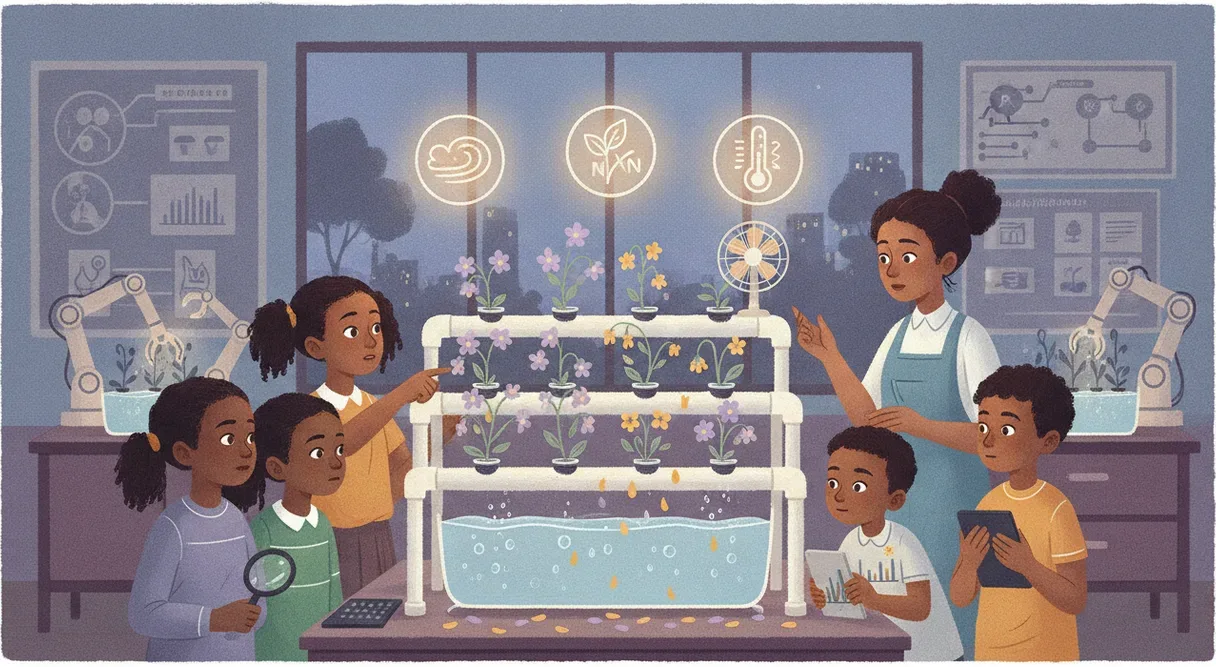
Indoor hydroponic flowers drop because of three distinct bottlenecks: absent air movement preventing self-pollination, excess nitrogen locking the plant into vegetative growth, or light-induced heat stress.
Flowers drop from classroom hydroponic plants—a process botanists call abscission—for one of three distinct reasons: the pollen was never physically dislodged to reach the female stigma, the nutrient solution carries too much nitrogen for reproductive growth, or enclosed grow lights have driven canopy temperatures above 30°C, rendering pollen sterile. In nine out of ten classroom systems growing self-fertile crops like dwarf tomatoes, sweet peppers, or chillies, the immediate culprit is the simplest one: the classroom is completely still, and nobody is shaking the flowers.
1. The Mechanical Bottleneck: Why Indoor Pollen Stays Trapped
Crops most frequently chosen for school hydroponic systems—tomatoes, chillies, and peppers (members of the Solanaceae family)—have perfect flowers. That means every individual bloom contains both male (anther) and female (stigma) reproductive structures. They do not require a honeybee to carry pollen across the room from another plant. However, their pollen is held tightly inside a narrow tube of fused anthers.
Outdoors, two forces release that pollen: constant wind agitation and the sonic vibration of visiting carpenter or bumblebees ('buzz pollination', typically vibrating at roughly 100 to 400 Hz). Inside a sealed classroom, there is no wind, and beneficial insects are entirely absent. A flower that blooms under quiet, steady indoor air will remain unfertilised. After roughly three to five days without fertilisation, the plant forms a small corky abscission zone at the pedicel joint (the 'elbow' of the flower stem), and the yellowing blossom snaps off cleanly.
2. The Nitrogen Bias: The Vegetative Trap
If your plants have enormous, dark green leaves and thick stems, but their flowers yellow and drop as soon as they appear, the nutrient reservoir is often the problem. Classroom hydroponics projects frequently rely on a single all-purpose nutrient mix intended for leafy greens such as lettuce and spinach. These formulations are heavily weighted toward nitrogen (N).
Nitrogen encourages vigorous cell division and vegetative biomass. When a plant transitions from vegetative growth to reproductive flowering, its demand for nitrogen drops significantly, while its requirement for phosphorus (P) and potassium (K) surges. Sustained high nitrogen levels signal to the plant that conditions favour leafy expansion over seed production. Under this hormonal bias, the plant treats developing flowers as low-priority sinks, aborting them in favour of growing more leaf surface.
| Symptom | Likely Cause | Immediate Corrective Action |
|---|---|---|
| Flower stem turns yellow at the joint; bloom falls whole | Unpollinated bloom or high nitrogen | Vibrate flower clusters; drop nitrogen ratio |
| Flowers drop rapidly while small; leaves look curled and leathery | Heat stress (>30°C canopy) or low humidity | Raise light fixture; run an intake fan |
| Blossom end turns black and rots after setting | Calcium deficiency or fluctuating pump cycles | Check EC, water delivery, and root aeration |
3. Canopy Microclimates: The Heat Trap Under Lights
Enclosed grow lights create localized thermal stress that rarely registers on a wall-mounted classroom thermometer. In South Africa, classrooms built with corrugated iron roofs or large single-glazed north-facing windows routinely experience ambient room temperatures reaching 28°C on clear spring and summer afternoons. Beneath an LED or fluorescent luminaire hung 15 cm above the canopy, the microclimate at flower level can easily sit 4°C to 7°C higher.
When tomato and pepper flowers experience sustained temperatures above 30°C—or when nighttime temperatures fail to fall below 24°C—the pollen grain becomes sticky or completely sterile. Even if mechanical vibration occurs, non-viable pollen cannot germinate on the stigma, and the bloom aborts. Over a closed school weekend without cross-ventilation or when load-shedding disables exhaust fans during the hottest hours of the day, an entire truss of open flowers can be rendered sterile in an afternoon.
A 90-Second Daily Routine for Learners
Fixing blossom drop does not require expensive commercial hormone sprays. It requires a systematic classroom duty that learners can execute during morning registration. Tomato and pepper pollen releases best between 09:00 and 11:30, after ambient humidity has dropped slightly from its early morning peak.
- The Stem Flick (Grade R–3): Direct learners to lightly flick the main flowering truss just behind the open flowers with an index finger twice. If the light angle is correct, learners will visibly see a tiny cloud of pale yellow dust exit the bloom.
- The Electric Toothbrush Method (Grade 4–9): Keep a cheap battery-operated electric toothbrush beside the system. Learners gently touch the vibrating back of the brush head (not the bristles) to the support stem or top of the flower cluster for one to two seconds. The high-frequency vibration mimics a bumblebee's flight muscles perfectly and empties the anthers in a fraction of a second.
- The Fine Brush Protocol (Peppers and Cucurbits): For chillies and bell peppers, where pollen can be stubborn, learners can lightly swirl a size-0 soft artist paintbrush into the centre of each open bloom, carrying pollen directly onto the central sticky stigma.
Assigning two learners to mechanical pollination duty every morning between 09:00 and 10:00 turns a botanical failure into a daily lesson in plant reproduction and mechanics.
Calibrating the System for Fruit Set
If daily pollination routines do not resolve the issue within ten days, evaluate the water and air environment directly. Check that the light fixture sits at least 25 to 30 cm above the highest flowering truss to avoid scorching the reproductive tissues. If the classroom smells earthy and warm, install a simple 12V desk fan connected to your hydroponic timer to keep air moving across the foliage for ten minutes out of every thirty.
Finally, check your reservoir. If you have been topping up a single batch of nutrient solution for weeks without a complete drain and refill, nutrient salts will have drifted out of balance. Dump the tank and refill it with a balanced bloom formulation designed with a lower nitrogen-to-potassium ratio. If your school is establishing automated production beds or integrating agricultural automation into your curriculum, you can find calibrated classroom hardware and agricultural sensors at Sheen Robotics Hydroponics.
A dropped flower is not a dead end; it is a clear diagnostic signal that either the physical movement of the classroom or the chemistry of the reservoir needs an intentional adjustment.