Raspberry Pi Foundation says kids still need to code. Here is the stronger version of that argument
The Raspberry Pi Foundation is right that kids still need to code in the age of AI. The stronger version of the case is physical computing: code that has to move something real.
In 2025 the Raspberry Pi Foundation published a position paper called "Why kids still need to learn to code in the age of AI". Its core claim is correct: teaching children to code is really about teaching them to think clearly, and a tool that writes code for you does not remove the need to understand what good code does. That case is right, but it is modest. The stronger version of the argument is about physical computing, which is code that has to move a motor, read a sensor, and survive contact with the real world.
What the paper said, and why it landed
The Foundation, which makes the small Raspberry Pi computers used in classrooms around the world, put its name to a simple position: coding is still a foundational skill for children, even now that AI systems can generate code on demand. That is worth noting because the opposite view has become common in staffrooms and at dinner tables. If a machine can write the program, the thinking goes, why should a ten-year-old learn to.
The honest answer is that producing text which looks like code and understanding a system are two different skills. A child who can prompt an AI but cannot read the result is not a programmer; they are a person hoping the machine is right. The paper's value is that it says this plainly at a moment when a lot of schools are quietly wondering whether to cut coding from the timetable.
The standard case, steelmanned
Strip the argument down and it holds up well.
- Reading beats writing. The scarce skill in an AI world is not typing code from scratch; it is reading unfamiliar code and judging whether it is correct, safe and doing what was asked. You only learn that by writing plenty of your own first.
- Debugging is thinking. Working out why a program does the wrong thing is a transferable habit of mind. Form a theory, test it, narrow it down. That skill outlives any particular language.
- An assistant needs a competent operator. AI coding tools are fastest in the hands of someone who already knows what a good solution looks like. Give the same tool to a novice and it produces confident nonsense the novice cannot catch.
None of this is controversial. It is also not quite enough on its own, because every point above can be taught with a screen and a text editor, and screens are exactly where AI is most persuasive and most slippery.
The stronger version: make the code move something
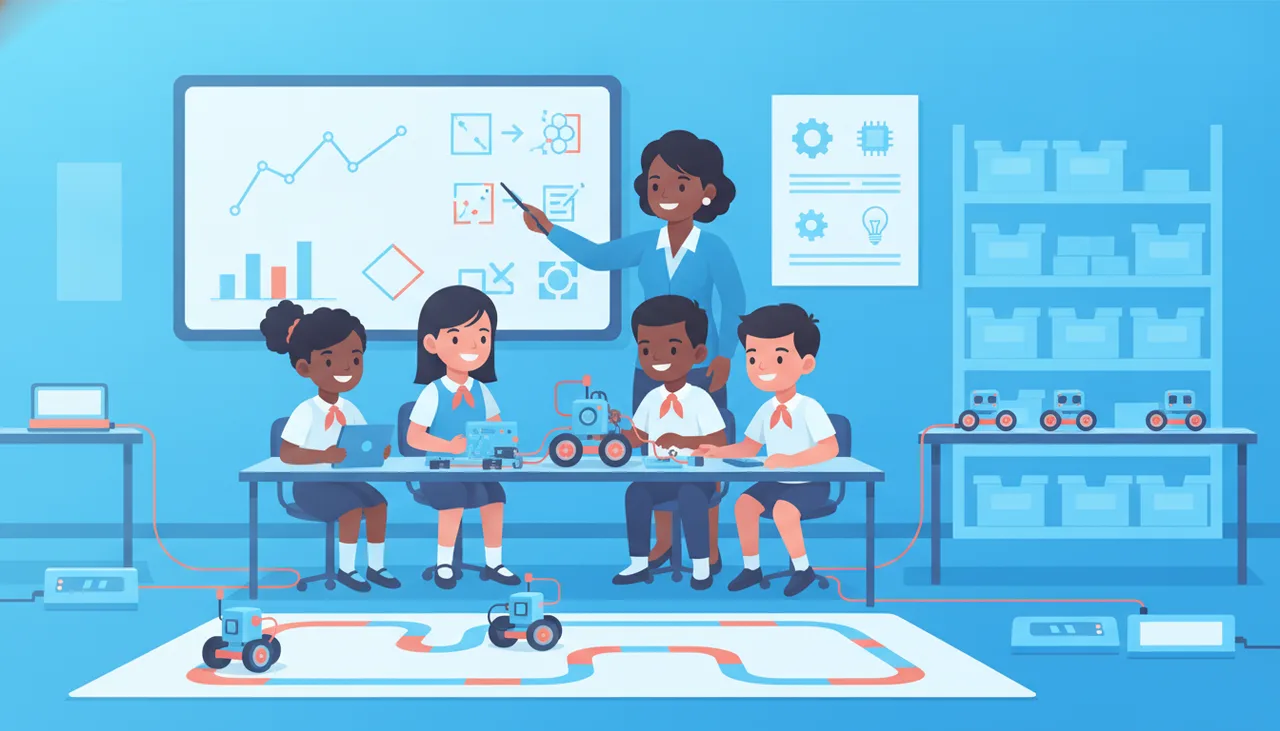
Here is the extension the paper hints at but does not push hard enough. The most AI-resilient way to learn to code is to make the code control something physical. When a program only prints to a screen, the feedback is soft. The output looks plausible, and a confident wrong answer is hard to spot. When the same program is supposed to spin a wheel, flash an LED in a pattern, or stop a robot before it hits the table, the feedback is honest. The robot either moves or it does not. There is no hallucinating your way past a motor that will not turn.
This is the quiet advantage of physical computing. A large language model can produce an explanation that sounds right for almost anything. A sensor reading cannot be argued with. Children working with hardware get ground truth for free, and ground truth is the one thing an AI assistant cannot fake for them. They learn to trust the world over the confident paragraph.
Why this matters for South African classrooms
For schools here the practical stakes are specific. Budgets are tight, teacher time is tighter, and there is real pressure to chase whatever sounds modern. It would be easy to read the AI moment as permission to replace hands-on coding with a few lessons on prompting. That would be a mistake, and an expensive one, because the children who only learn to prompt will end up with the shallowest and most replaceable version of the skill.
The better reading is the one the Foundation is pointing at: keep teaching real coding, and anchor it in something a child can hold. This is also more robust than a curriculum that assumes a live cloud AI in every lesson. A battery-powered board on a desk keeps working when the Wi-Fi does not, which matters in a country where load shedding still interrupts the school day.
What to do about it
If you run a classroom, a code club, or a household trying to make a good call, a short checklist.
- Keep the writing, don't skip to prompting. Children should write and debug plenty of their own code before an AI assistant is allowed to help. The assistant is a power tool for people who already have the basics.
- Add a physical target. Choose projects where code drives real hardware, so mistakes show up as things that do not move rather than answers that only look wrong. A programmable board like our sheenbot∞ gives that instant feedback loop, and a class set of ten kits covers a small group.
- Use AI as a tutor, not an author. It is genuinely useful for explaining an error message or suggesting a next step. It is a poor substitute for the child doing the thinking.
- See it in person before you commit. One project that actually works beats a term of theory. A single trial lesson at our Cape Town academy is enough to tell whether a child takes to it.
Takeaway
The Raspberry Pi Foundation is right that kids still need to code in the age of AI, but the case is stronger than thinking skills alone. The version worth building on is physical: give children code that has to move something real, and you give them a form of understanding an AI cannot hand them and cannot fake. That is the skill that will still be worth having when the tools change again. For more of how we think about this, see our newsroom.