
Can You Connect an ESP32 to School Enterprise Wi-Fi?
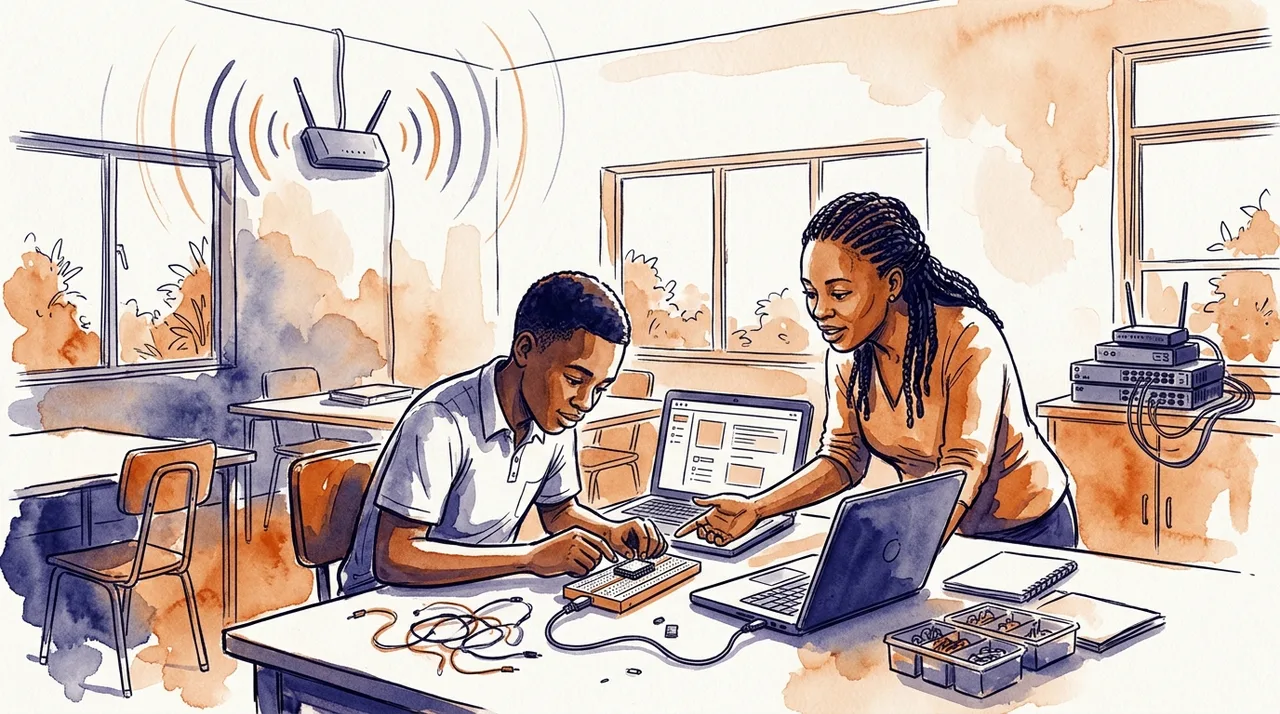
Yes, the ESP32 supports 802.1X WPA2-Enterprise, but flashing student credentials onto microcontrollers is a security risk. A segregated IoT network is almost always the right answer.
Yes. The ESP32 natively supports WPA2-Enterprise (802.1X PEAP/MSCHAPv2) at both the ESP-IDF and Arduino framework levels. However, standard microcontroller Wi-Fi sketches will fail immediately, and configuring the board to authenticate against a school's RADIUS server introduces operational and security risks that make it the wrong choice for a classroom.
For a maker working on a personal project, authenticating to an enterprise network is a solvable coding exercise. For a teacher managing thirty learners in a robotics lab, asking IT for an isolated IoT SSID is almost always the only reliable, secure way forward.
Why Standard ESP32 Wi-Fi Code Fails on School Networks
Most home and consumer Wi-Fi networks use WPA2-PSK (Pre-Shared Key). When you write WiFi.begin(ssid, password) in the Arduino IDE, the ESP32 uses a four-way handshake against an access point where every device shares the same secret passphrase.
South African schools, universities, and commercial institutions generally deploy WPA2-Enterprise (IEEE 802.1X). In this architecture, there is no shared network password. Instead:
- The access point acts as an authenticator, passing connection requests upstream to a RADIUS server (such as FreeRADIUS, Microsoft Network Policy Server, or a cloud directory tied to Google Workspace or Microsoft 365).
- Authentication occurs via an Extensible Authentication Protocol (EAP) method—most commonly PEAP-MSCHAPv2.
- The client must provide an identity, a username, and a user password, and should validate the RADIUS server's Root Certificate Authority (CA) to prevent man-in-the-middle attacks.
Because the default WiFi.begin() implementation cannot negotiate an 802.1X outer identity, phase-two authentication, or TLS handshake, the network drops the connection before an IP address can ever be assigned via DHCP.
How the ESP32 Connects to WPA2-Enterprise
To authenticate an ESP32 against a school's enterprise access point, you must include the native Espressif WPA2 library (esp_wpa2.h) and configure the enterprise credentials before calling WiFi.begin().
In the Arduino core for ESP32, the configuration follows this sequence:
#include "WiFi.h"
#include "esp_wpa2.h"

const char* ssid = "School_Enterprise_WiFi";
#define EAP_IDENTITY "learner_id"
#define EAP_USERNAME "learner_id@school.co.za"
#define EAP_PASSWORD "NetworkPassword123"

void setup() {
    WiFi.disconnect(true);
    WiFi.mode(WIFI_STA);

    // Initialise 802.1X authentication
    esp_wifi_sta_wpa2_ent_enable();
    esp_wifi_sta_wpa2_ent_set_identity((uint8_t *)EAP_IDENTITY, strlen(EAP_IDENTITY));
    esp_wifi_sta_wpa2_ent_set_username((uint8_t *)EAP_USERNAME, strlen(EAP_USERNAME));
    esp_wifi_sta_wpa2_ent_set_password((uint8_t *)EAP_PASSWORD, strlen(EAP_PASSWORD));

    WiFi.begin(ssid);
}
Technically, this works. The ESP32 completes the PEAP tunnel and negotiates an IP lease. But in an educational environment, writing this code creates serious practical failures.
The Operational Pitfalls in a School Lab
Getting one development board online at your desk does not mean the system will work across a class term. Classroom enterprise connections fail for three specific reasons:
1. Credential Security on Flash Memory
An ESP32 stores its compiled binary and constants in unencrypted external SPI flash. When a learner hardcodes their school domain username and password into a sketch, anyone with physical access to the board can run esptool.py read_flash over a USB cable and extract those network credentials in minutes. If learners use personal Active Directory accounts that also grant access to their Google Classroom, email, or internal school portals, a lost or shared micro-controller compromises their entire identity.
2. Password Resets and Maintenance Rot
Most institutional directory systems enforce 60- or 90-day password expiration policies. Every time a learner updates their network password, their IoT project stops functioning until the code is modified, recompiled, and re-flashed. For class sets that remain stored in component bins between terms, this adds hours of dead administrative overhead.
3. The Load-Shedding Reconnection Stampede
School networks in South Africa face unique stability issues during power interruptions and inverter transitions. When power restores after a two-hour load-shedding block, an entire room of ESP32 boards will boot simultaneously. An 802.1X PEAP negotiation requires multiple cryptographic round-trips between the access point, switch stack, and RADIUS server. If thirty microcontrollers attempt EAP exchanges at the same instant while campus switches are still converging, the RADIUS server frequently throttles the requests or times out, stranding the boards in endless reconnect loops.
The Professional Solution: An Isolated IoT SSID
Enterprise IT administrators do not want unmanaged, unpatched microcontrollers authenticating against their primary user directories. Rather than forcing the ESP32 into 802.1X, the proper architectural solution is to request a segregated IoT network.
When speaking to your school network administrator, ask for:
- A Dedicated SSID: Configured with standard WPA2-Personal (PSK) or WPA3-Personal, using a single pre-shared key kept internal to the robotics lab.
- A Segregated VLAN: The SSID should map to a distinct virtual local area network that has no routing paths into the administrative network, student information databases, or staff shared drives.
- Client Isolation: Enabled at the access point level, ensuring that individual ESP32 boards cannot scan or attack other microcontrollers or teacher laptops on the same subnet.
- Strict Firewall Outbound Rules: Allow outgoing traffic only on port 443 (HTTPS) and port 8883 (MQTTS), blocking internal RFC1918 traffic entirely.
School IT teams almost invariably agree to this arrangement because it improves network security rather than compromising it. It isolates learner hardware from the corporate directory and allows microcontrollers to use standard, lightweight WiFi.begin(ssid, psk) routines that reconnect instantly without RADIUS overhead.
If you are deploying hardware across multiple classrooms and need help structuring robust lab environments, Sheen Robotics provides direct infrastructure guidance through our school service programmes.
Summary
You can connect an ESP32 to school enterprise Wi-Fi using the esp_wpa2.h framework, but you should avoid doing so for standard teaching. Flashing personal 802.1X directory credentials onto unencrypted microcontrollers creates a significant security vulnerability, and load-shedding restarts will regularly break classroom connectivity. Work with your IT department to establish a segregated, firewalled IoT VLAN on a standard pre-shared key instead.