Belts vs Roller Chain: Which Drive Belongs on Your Robot's Intake and Lift?
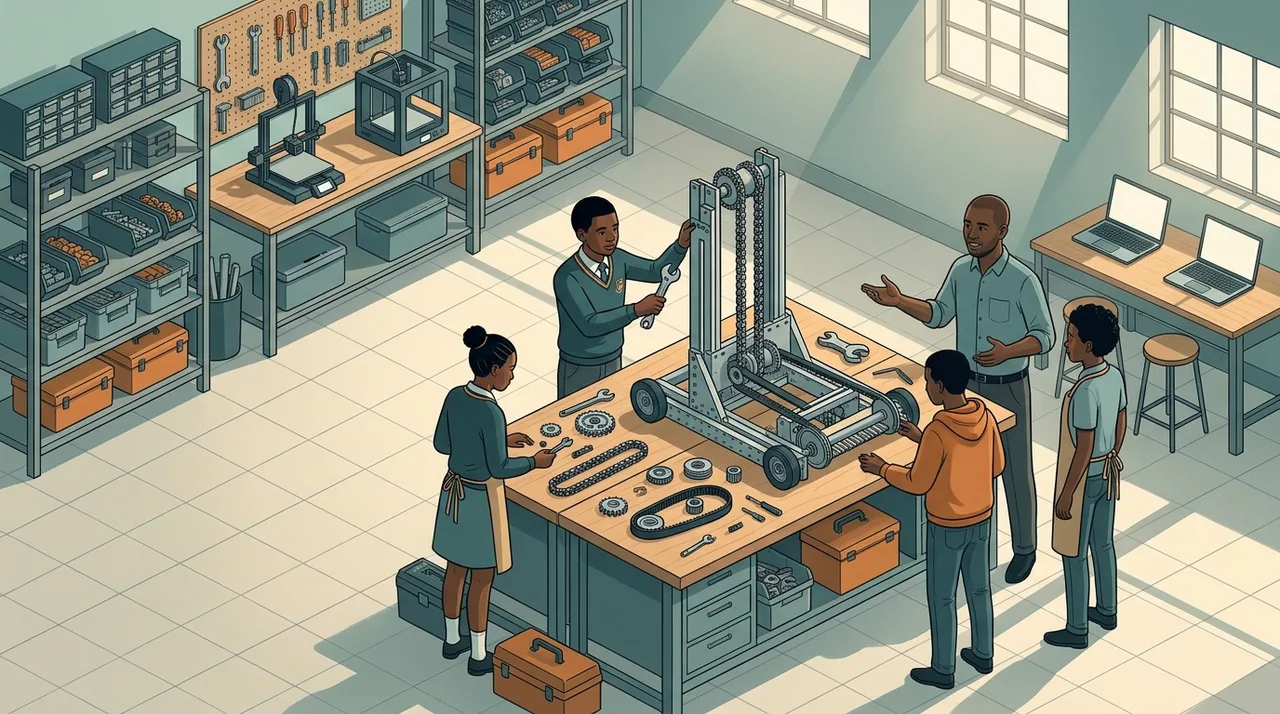
For high-impact intakes and high-load cascade lifts, #25 roller chain offers far more forgiveness against shock loads and structural deflection than timing belts. Here is why belts skip teeth and how to choose the right drive.
For external intakes and vertical lifts on competition robots, #25 roller chain is almost always the more reliable choice for high school teams. While HTD timing belts are lighter, cleaner, and more mechanically efficient, they demand rigid shaft parallelism and precise centre-to-centre tolerances that typical student builds struggle to maintain. When an intake smashes into a perimeter wall or a lift bottoms out, belts ratchet across pulley teeth or walk off flanged wheels, whereas chain absorbs the shock, tolerates moderate axle deflection, and keeps running.
The Pitch Dilemma: What Belongs on a Robot?
Before comparing performance, it helps to eliminate the drives that do not belong on competition mechanisms:
- GT2 2mm pitch: Ubiquitous in 3D printers, but useless for manipulators. The tooth profile is too shallow (less than 1mm deep), and torque from even a modestly geared planetary motor will rip teeth straight off the fiberglass core under load.
- HTD 3mm / GT2 3mm: Viable for ultra-compact, high-speed, low-torque mechanisms such as flywheel shooters or internal feeder wheels. They should never be used on primary lifts or exposed intakes.
- HTD 5mm (9mm or 15mm wide): The standard belt choice for competition robotics. Curvilinear teeth offer solid engagement and good resistance to shear, provided tension and wrap angle are strictly maintained.
- #25 Roller Chain (1/4-inch pitch): The standard chain for mid-scale mechanisms (such as FTC and light FRC manipulators). It weighs roughly 0.14 kg per metre, handles working loads upwards of 60 kg, and can be broken and sized link-by-link without buying dedicated closed loops.
- #35 Roller Chain (3/8-inch pitch): Rarely necessary except for heavy full-robot drivetrains or brutal arm pivots on large robots. For intakes and cascading slides, the rotational inertia and weight of #35 sprockets simply penalise your motor response times.
Why Student-Tensioned Belts Skip Teeth During Sudden Jams
Teams often switch from chain to belts because belts never require lubrication, run silently, and look professional. Then the robot hits the field, the intake grabs two game pieces simultaneously, and an awful machine-gun ratcheting sound echoes across the arena. Why does this happen?
Timing belts rarely slip because the tension cords stretch like elastic bands. Modern timing belts use glass-fibre or Kevlar tensile cords that stretch by less than 1% before failure. Instead, belts ratchet because of structure deflection and inadequate tooth engagement.
When an intake roller stalls instantly, peak torque spikes through the motor shaft. If that shaft is cantilevered from a single 3mm aluminium plate—a very common build error—the force pushes the motor shaft and intake shaft toward each other by a fraction of a millimetre. That microscopic reduction in centre-to-centre distance loosens the belt. At the same moment, the tight side of the belt undergoes extreme tensile load, riding up the ramps of the pulley teeth. If fewer than six teeth are fully meshed in the driven pulley, the belt climbs over the crests.
A belt drive is not just a belt and two pulleys; it is an unyielding structural loop. If your chassis plates flex under impact or stall torque, your belt tension vanishes precisely when you need it most.
Roller chain, by contrast, sits deep inside sprocket pockets. Under a jam, chain exerts pure radial and shear forces against steel or aluminium sprockets. A chain drive will stall a motor, trip an overcurrent breaker, or snap a master link before it skips a sprocket tooth on an intact shaft.
Impact Resistance: Why Intakes Favour Chain
Intakes are the most abused subsystem on any competition robot. They protrude past the frame perimeter, strike field barriers at full speed, and collide with opposing robots.
When an intake arm takes an off-axis hit, the supporting plates twist. Belts are notoriously intolerant of angular misalignment—even one or two degrees of twist forces the belt hard against the pulley flanges, causing the belt edge to fray, roll over, or pop off the pulley entirely. Because replacement timing belts must be slipped over the end of the shaft, fixing a derailed belt in the queueing lane often requires stripping an entire bearing block.
A #25 chain drive tolerates reasonable axle misalignment without climbing out of the sprocket. If a steel linkage bends slightly mid-match, the chain continues to articulate. Furthermore, chain tension can be recovered quickly using floating chain tensioners (like Delrin blocks or zip-tied sprockets) without having to drill slotted motor adjustment mounts.
Lifts and Cascades: When Belts Actually Win
Lifts present a different trade-off. In a continuous or cascading linear slide, weight at the top of the carriage directly compounds your centre of gravity and slows lift extension. Here, belts have a decisive advantage:
| Mechanism Requirement | #25 Roller Chain | 5mm HTD Timing Belt (15mm) |
|---|---|---|
| Linear Weight | Heavy (~140g/m) | Light (~45g/m) |
| Backlash / Slop | Moderate (accumulates at pin joints) | Near-zero (continuous tension) |
| Tension Adjustment | Discrete half-link steps + idlers | Continuous linear slide clamping |
| Tolerance to Shaft Flex | High | Low (requires rigid trussing) |
| Catastrophic Failure Mode | Broken master link (repairable) | Sheared teeth or snapped cord |
For a vertical lift housed completely inside the robot frame, where shafts are supported on both ends by bearings in rigid box extrusion or dual plates, HTD 5mm belt is exceptional. It eliminates the chordal vibration (the cyclic speed variation caused by chain wrapping around small polygonal sprockets) and removes significant dead weight from the stage carriages. Clamping open-ended HTD belt to an elevator carriage with an aluminium tooth plate is clean, light, and repeatable.
However, if your lift uses cantilevered standoffs or single-shear axles, stick with #25 chain. The friction penalty of chain is trivial compared to the risk of an elevator stalling 20mm shy of a junction because a belt slipped teeth on an unbraced axle.
Practical Rules of Thumb for the Build Season
If your team is finalising mechanism architecture, apply these three engineering constraints:
- Rule 1: Never cantilever a belt pulley under load. If you cannot support both ends of the axle with bearings housed in rigid plates, use #25 chain.
- Rule 2: Respect minimum pulley sizes. For HTD 5mm, never drop below 18 teeth (roughly 28mm pitch diameter) on high-torque joints. Running smaller pulleys reduces tooth engagement to three or four teeth, virtually guaranteeing tooth shear on stalls.
- Rule 3: Orient your master links correctly. If using chain, the closed end of the spring clip must always face the direction of forward chain travel. An inverted clip will catch a guide or piece of debris and pop off mid-match.
For teams building hardware for the local circuit, exploring our competition-ready drive components and brackets at Sheen Robotics FTC resources can help narrow down your mounting geometry. If you need standard sprockets, idlers, or timing accessories in local stock, you can source them directly from the Sheen Robotics store.
Make the choice early: design rigid, double-supported structures if you want the lightness and speed of 5mm HTD belts; rely on #25 chain whenever the mechanism lives on the outside of the robot where impact, dust, and deflection are guaranteed.