
The DeepSeek moment: what cheap AI means for teaching kids about it
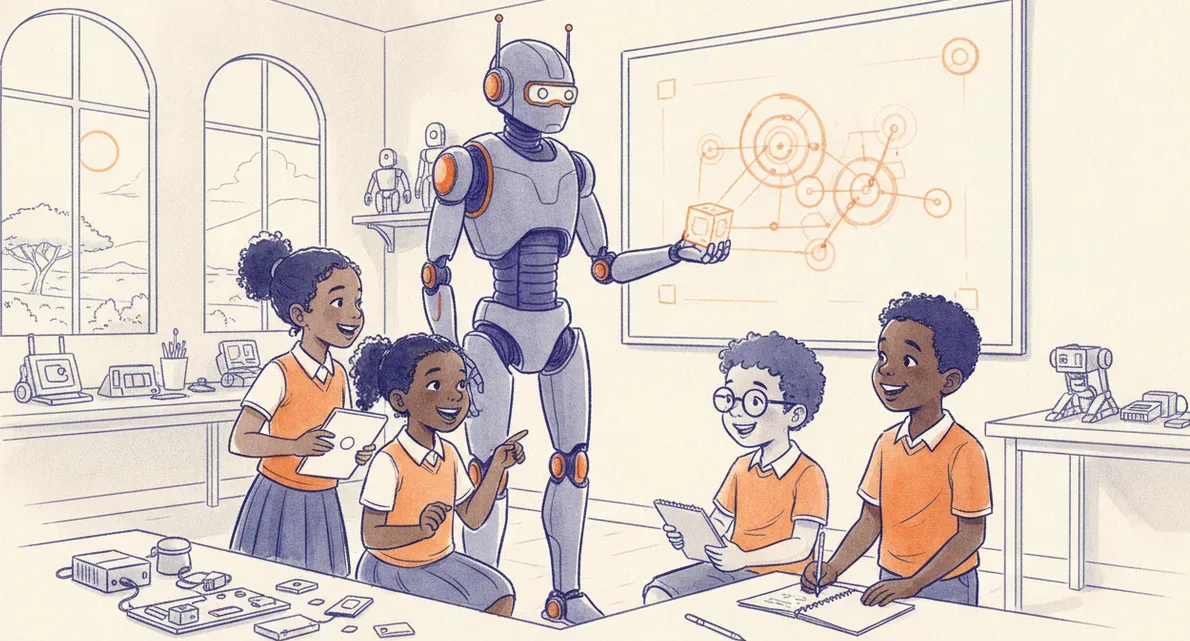
In early 2025 a small lab showed capable AI can be cheap and open. The lesson for schools is that AI literacy now belongs with the basics, for every child, not just future engineers.
In late January 2025 a lesser-known lab called DeepSeek released an AI model that reasoned about as well as the best systems from far larger, far better-funded companies. Two things made people sit up. It was released openly, and it appeared to have been built without the enormous budgets everyone assumed such a model required. Tech stocks lurched, and the settled story about who gets to build strong AI cracked in a week.
For parents and teachers the lesson is not really about markets. It is this. Capable AI is getting cheap and widely available fast, so understanding it is no longer a niche skill for future engineers. It is closer to reading a map or handling money, something every child benefits from learning early. And the entry point has never been lower.
What actually happened
DeepSeek's model was not the first capable AI, and it was not magic. What made it a moment was the pairing of two claims. The first was performance: on the reasoning tasks used to rank these systems, it held its own against models from the biggest names in the field. The second was efficiency: the team said it trained the model without the vast compute spend that was assumed to be the price of entry.
Just as important, the model was released openly, so others could download it, run it, and study how it worked. Put those together and a long-standing assumption gave way. Strong AI had looked like something only a few very rich companies could produce. Suddenly it looked like something a smaller team, in another part of the world, could produce too. Markets reacted fast, but the deeper signal was about direction of travel. The cost of capable AI is falling, and access is spreading.
Why cheap, open AI changes the classroom question
For a few years the worry in education was access. Would only well-resourced schools get to use these tools? The DeepSeek moment points to the opposite problem. When capable AI is cheap to run and free to download, it ends up everywhere: in phones, in homework helpers, in the apps children already use. The question stops being whether a child will have access to AI and becomes whether they understand what it is doing.
That is a different skill. Using AI is easy, and a six-year-old can hold a conversation with a chatbot. Understanding it is not automatic. Knowing when to trust it, spotting when it is confidently wrong, and grasping that it predicts likely words rather than looking up facts all have to be taught, the same way we teach children to read an advert critically or check a source.
What AI literacy actually means for a child
AI literacy is not a coding qualification, and it is not fear. For most children it is a handful of durable ideas they can carry into any tool, whichever company or model is in fashion:
- It is prediction, not knowledge. These systems generate the next likely words. They can be fluent and wrong at the same time.
- Inputs shape outputs. Clear, specific instructions get better results, which is a thinking skill rather than a trick.
- Always check. Treat an AI answer as a first draft to verify, not a final answer to copy.
- Your data is not free. What you type may be stored or reused, and some things do not belong in a chatbox.
- It has limits and biases. A model reflects the material it learned from, including its gaps and its slants.
None of that needs a computer science degree. It needs the curiosity and healthy scepticism good teachers already build every day.
Where to start, at school and at home
The quickest way to demystify AI for a child is to let them build things that behave a little like it. When a child writes a few lines of code that make a robot respond to light, sound, or a button press, the mystery drains out of the word intelligent. They see that a machine following rules can look clever, and they start asking sharper questions about the bigger systems too.
This is why coding and robotics are such a natural on-ramp to AI literacy. At the sheen academy in Cape Town, children program physical devices before they ever worry about neural networks, so the abstract ideas land on top of something concrete. The sheenbot∞ board is built for this kind of hands-on start: sensors in, code in the middle, behaviour out. If you want to see whether it suits your child, a trial class is a low-commitment way to test the water.
You do not need a kit to begin, though. Here is a checklist any parent or teacher can use straight away:
- Sit with your child while they use an AI tool once, and ask them to find one thing it got wrong.
- Turn a homework task into checking the AI rather than using it to produce the answer.
- Agree one rule, at home or in class, about what personal information never goes into a chatbot.
- Rewrite a vague prompt into a clear one together, and compare the two results.
- Talk about where an answer might have come from, and who might be missing from it.
Keeping hype and fear in proportion
Every AI headline swings between two extremes, that it changes everything or that it ends everything. Children pick up on both. A calmer message serves them better. The tools are useful and getting cheaper. They are also flawed, and they are made by people with interests of their own. Learning to hold both ideas at once is the real literacy, and it will outlast any single model or company.
The takeaway
The DeepSeek moment did not change what children need to learn. It changed the urgency. Capable AI is on track to be cheap, open, and everywhere, which puts AI literacy with the basics rather than the specialist electives. Start small, start with curiosity, and let children build enough to understand what they are looking at. For more of our writing on teaching AI and robotics, the newsroom is a good place to carry on.
Common questions
Is my child too young to learn about AI?
Probably not, as long as you match the idea to the age. A young child does not need to know how a model is trained. They can understand that a computer is guessing, and that guesses need checking. The concepts scale up as they grow.
Do I need to be technical to teach this?
No. The core habits, verify before trusting, protect your data, and ask where an answer came from, are judgement skills rather than engineering ones. If you can teach a child to question an advert, you can teach them to question a chatbot.