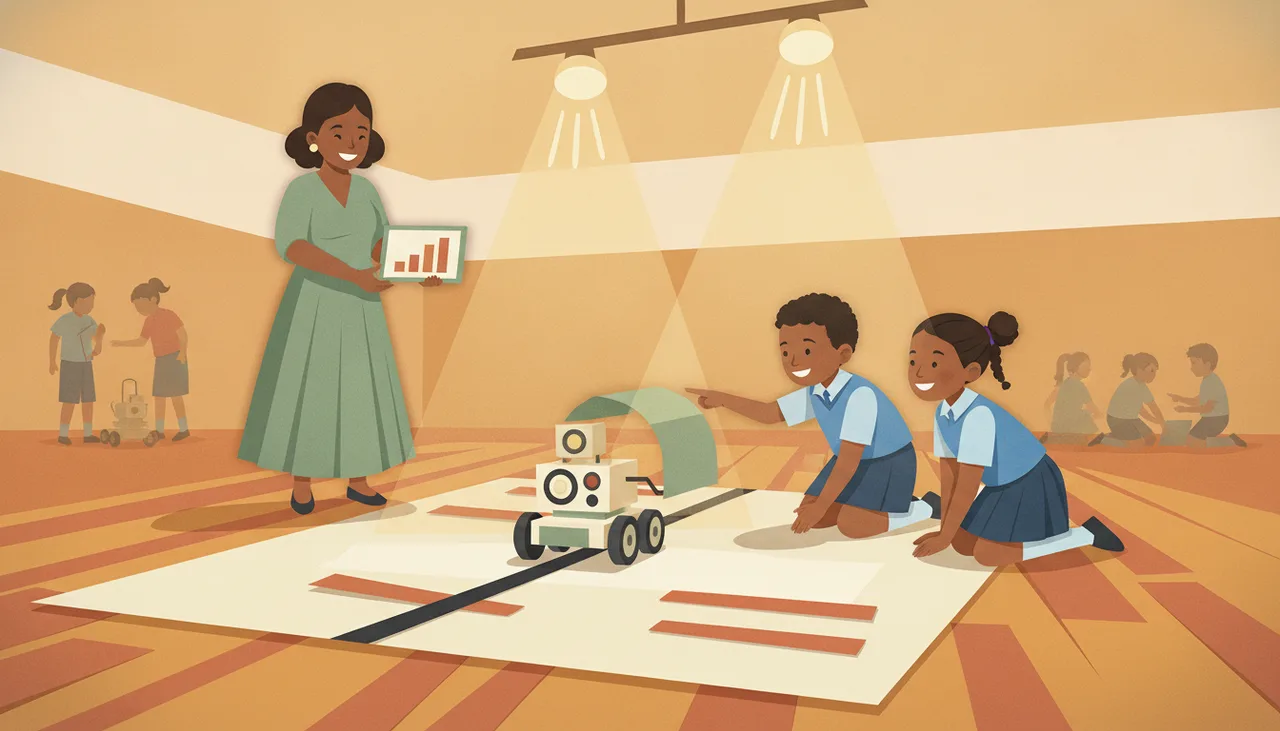
How to Practise for Robotics Competitions Without a Full-Sized Field
You do not need a dedicated room or a R20,000 budget to prepare a competitive robot. Here is how to use tape, simulators, and partial elements to build a high-performing team.
An official FIRST Tech Challenge (FTC) or school robotics competition field is a luxury. A full FTC field requires a flat 3.6m by 3.6m space, a rigid perimeter, and specialised foam tiles. In South African schools, where classrooms are shared, multi-purpose halls are booked for exams, and budgets are constrained by rising equipment costs, setting up a permanent field is often impossible.
The good news is that you do not need one to win. Most successful teams do not do their primary development on a full field. By breaking down your practice into targeted, low-cost alternatives, you can build, program, and test a highly competitive robot in a standard classroom or even a home garage.
1. Tape-on-Floor Geometry (Cost: R100 – R300)
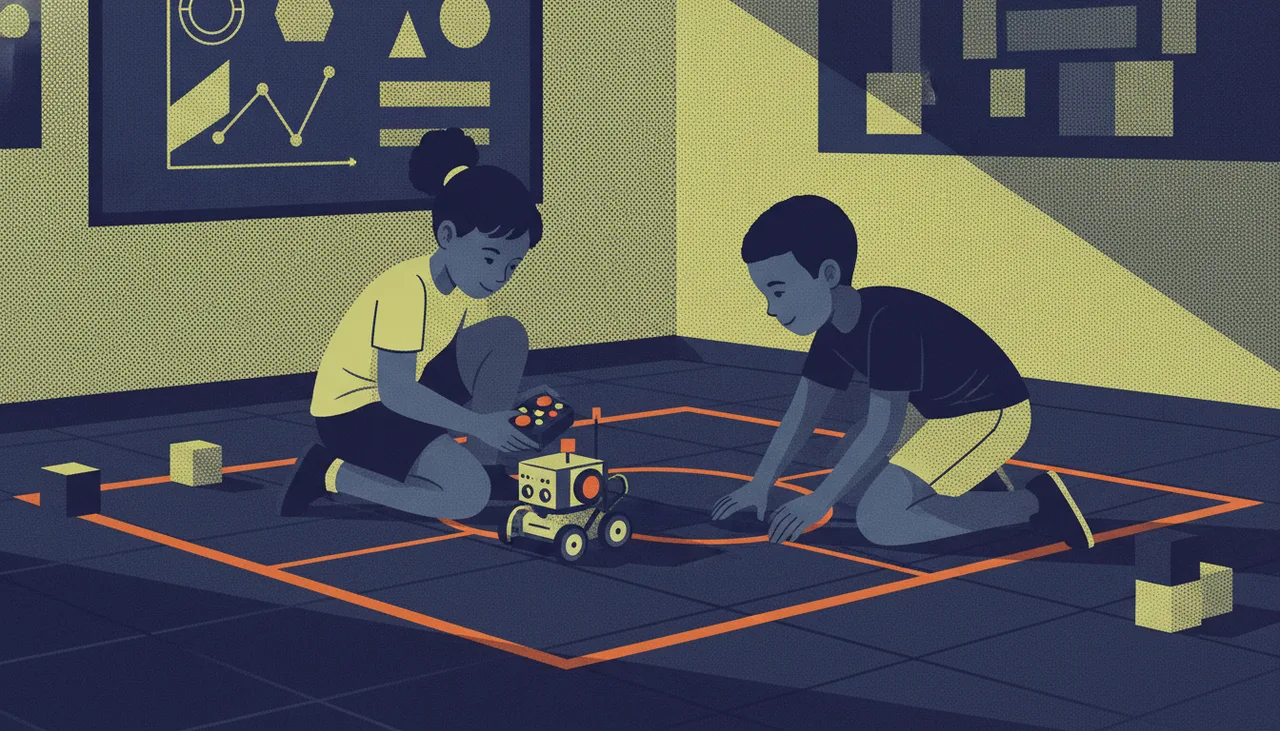
The cheapest and most space-efficient alternative is to map out key field coordinates directly onto your classroom floor using high-visibility masking tape or electrical tape. You do not need to tape the entire 13 square metres; focus only on the critical lines, starting positions, and target zones.
- What it prepares you for: Measuring exact wheel travel, calibrating turning angles, testing chassis footprint clearance, and teaching drivers how to navigate tight spaces.
- What it misses: Physics and traction. Standard school linoleum, parquet, or thin commercial carpets have vastly different friction coefficients compared to official soft-foam tiles. A robot that turns perfectly on smooth tile will slip or draw more current on foam. Furthermore, tape provides no physical resistance; your drivers will not learn how the robot behaves when slamming into a rigid perimeter wall.
2. Simulation and Virtual Playgrounds (Cost: R0)
When physical space is unavailable—or during load-shedding when school workshops are dark—virtual simulation is the most efficient way to write and test autonomous code. Platforms like FTC Sim allow programmers to run their code against virtual robot models in real-time.
- What it prepares you for: Testing logic, sensor algorithms, state machines, and encoder mathematics. Programmers can debug their autonomous paths without waiting for a physical battery to charge or wearing down mechanical gears.
- What it misses: Real-world variability. Simulators assume perfect grip, consistent battery voltage, and zero mechanical slop. In reality, as your battery drains from 13.5V to 11.5V, your robot's physical trajectory changes. Driver practice on a simulator also rarely translates to physical driving, as screen-based depth perception is entirely different from standing at the physical field alliance station.
3. Modular Partial Field Elements (Cost: R500 – R3,000)
Instead of buying a complete field kit, purchase or build only the specific game elements that your robot must interact with. If the season's game involves scoring elements into a high bucket, build just that single bucket assembly out of cheap plywood, PVC piping, or corrugated plastic. To make this effective, purchase a small pack of four to six official soft-foam tiles to place directly underneath the target element.
- What it prepares you for: Tuning your intake mechanisms, calibrating outtake heights, and practicing precise driver alignment. Testing your intake on official tiles is vital because the way game elements slide or roll on foam determines whether your intake will grab them or push them away.
- What it misses: Full-field cycle testing. You cannot easily practice high-speed transitions from one side of the field to the other, nor can you simulate traffic and defensive play from opponent robots.
4. Shared Regional Fields and Collaboration (Cost: Travel / Time)
Many rookie teams overlook the local robotics community. Established teams, university engineering departments, and local hubs often have full-sized fields set up and are willing to share. Organising weekend scrimmages or joint practice sessions with nearby schools is a standard practice globally.
- What it prepares you for: Authentic driver practice, sensor calibration under actual venue lighting, and realistic cycle-time measurements. It also exposes your team to different robot designs and strategies before competition day.
- What it misses: Convenience. You cannot rely on a shared field for daily debugging. Use your home space for building and basic testing, and use the shared field strictly to validate your completed systems.
How to Structure Your Practice Space
| Method | Primary Use Case | Space Required | Approx. Cost |
|---|---|---|---|
| Tape-on-Floor | Chassis footprint & basic pathing | Flexible (2m x 2m) | < R200 |
| Simulators | Autonomous logic & programming | Desk space | Free |
| Partial Elements | Intake & scoring mechanism tuning | 1.2m x 1.2m | R500 - R3,000 |
| Shared Field | Driver training & match strategy | Full 3.6m x 3.6m | Travel costs |
If you are navigating the complexities of setting up a new team, managing tight budgets, or preparing for your first local tournament, we can help. Explore our FTC South Africa support resources for technical guides, local scrimmage schedules, and equipment advice tailored to South African schools.