NFT or Dutch Buckets: Which Survives a South African School Summer?
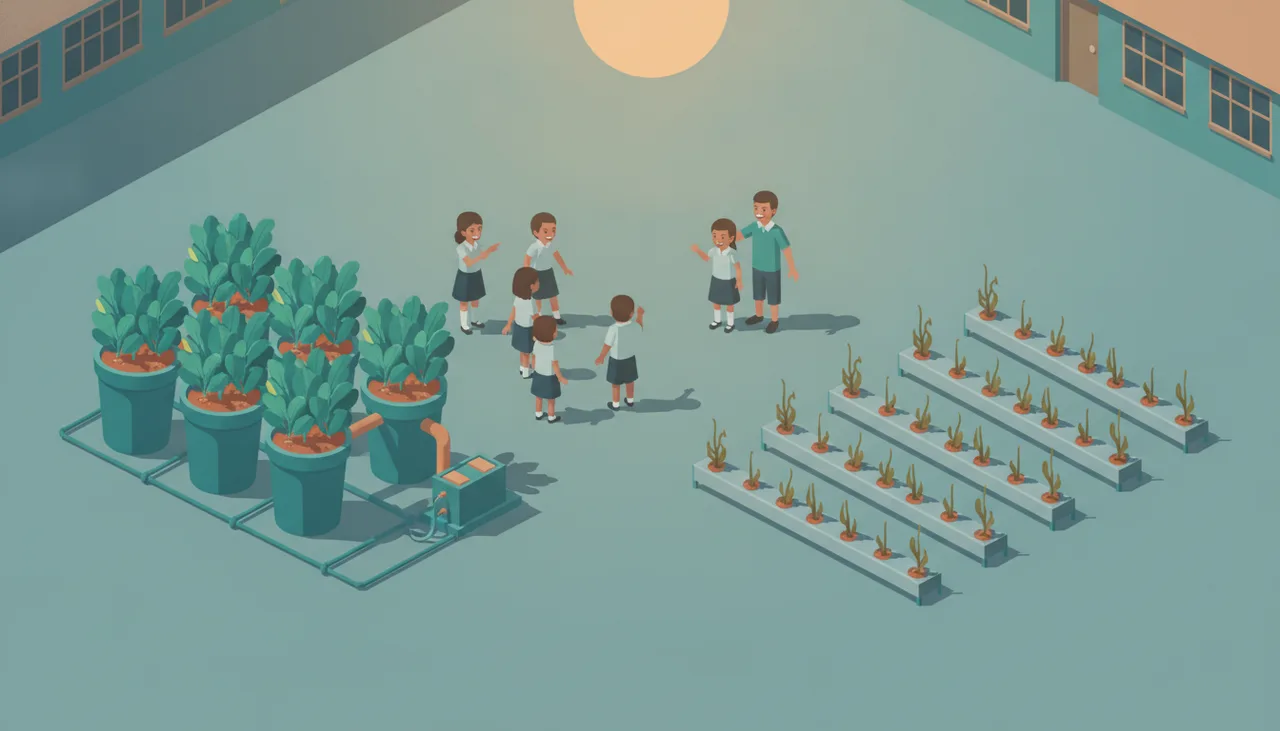
Dutch buckets survive a South African school courtyard in December; shallow NFT gullies do not. The combination of root-zone overheating and two-hour power cuts will kill NFT crops within an afternoon.
If your school is installing a hydroponics system in an open courtyard or under standard 40% shade cloth, choose Dutch buckets over Nutrient Film Technique (NFT). A commercial greenhouse with industrial evaporative cooling, automated generators, and dedicated full-time technicians can make NFT work through a Highveld heatwave or a Swartland dry spell. A school courtyard with a brick perimeter, 35°C ambient air, two-hour load-shedding slots, and a skeleton maintenance crew over the December holidays will turn an NFT gully into a root cooker.
The Physics of the Gully vs the Bucket
To understand why one system survives while the other fails, look at the root zone rather than the foliage. Plants can tolerate astonishingly hot air if their roots remain cool and hydrated. The disaster begins when root-zone temperatures exceed 24°C.
NFT works by trickling a continuous, paper-thin stream of water over bare root mats suspended inside enclosed plastic channels. In an exposed school courtyard, three physical realities work against this design:
- Thermal mass: The volume of water inside an NFT channel at any given second is tiny. Thin PVC or uninsulated polypropylene gullies have virtually no thermal inertia. As sun beats down on the gully, the nutrient film rapidly equilibrates with the ambient air and the radiant heat of surrounding brickwork or paving.
- Dissolved oxygen: Warm water holds substantially less dissolved oxygen than cool water. When water temperatures climb toward 30°C, dissolved oxygen plummets. Roots begin to suffocate, predisposing them to opportunistic pathogens like Pythium (root rot).
- Immediate drainage: NFT channels are built on a continuous slope (typically 1:30 or 1:40) to keep water moving. The moment the pump stops, the water drains out into the catchment sump within sixty seconds.
A Dutch bucket (often called a Bato bucket) operates on the opposite principle. Each bucket—typically 11 to 15 litres in volume—is filled with an inert, porous substrate, most commonly pure horticultural perlite or a 70/30 perlite-and-cocopeat blend. At the base of the bucket, an internal siphon elbow maintains a permanent 2- to 5-centimetre reservoir of water (roughly 1.5 to 2 litres) that never drains out completely, even when the pump is off.
The Two-Hour Power Cut Failure Mode
In South Africa, power instability is not a hypothetical edge case; it is an operating parameter. Consider what happens during a standard two-hour power interruption on a clear afternoon in early February when courtyard ambient temperatures reach 34°C.
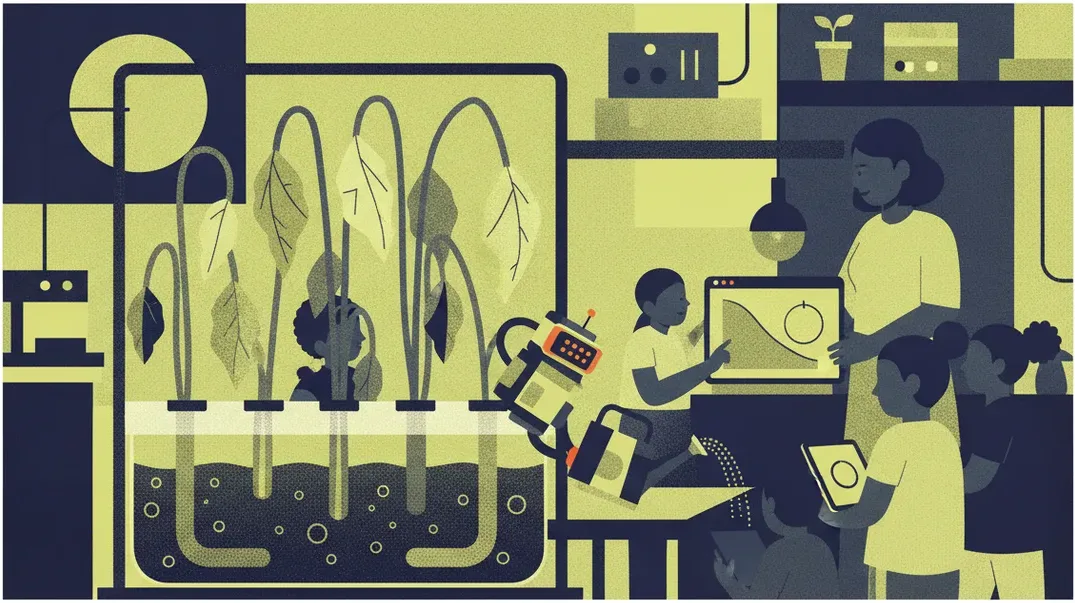
In an NFT system, the pump cuts out. The thin film drains in under a minute. The root mat is left hanging in empty, hot plastic channels. The air inside the closed gully reaches 40°C within twenty minutes as radiant solar heat turns the plastic tube into a convection oven. Without a protective sheath of moisture or media, fine root hairs desiccate rapidly. By the time the pump restarts two hours later, the vascular tissue of delicate greens is permanently scorched. The plants wilt from the bottom up and rarely recover.
Now look at the Dutch bucket in the same courtyard. The pump cuts out. The irrigation drippers stop. However, the plant's taproot is submerged in the bottom reservoir, while the lateral roots are encased in damp perlite. Perlite is an expanded volcanic glass filled with microscopic air pockets; it is, quite literally, a thermal insulator. It shields the root core from radiant heat while wicking moisture upward through capillary action. Two hours without active circulation is trivial for a Dutch bucket—in fact, a mature tomato or pepper plant in a perlite bucket can comfortably survive four to six hours without power in direct sunlight before showing signs of stress.
| Operational Factor | NFT Gully System | Dutch Bucket System (Perlite) |
|---|---|---|
| Buffer against pump failure | 15–30 minutes before root scorch begins | 6–24 hours of passive hydration |
| Root-zone thermal insulation | Negligible (thin plastic wall only) | High (bulk porous perlite substrate) |
| Suitable crops | Small greens, herbs, loose-leaf lettuce | Heavy feeders: tomatoes, peppers, cucumbers, brinjals |
| Sensitivity to nutrient temperature | Critical; requires inline chilling above 26°C | Moderate; substrate dampens rapid spikes |
| Holiday survival factor | Fails instantly if water level drops or timer jams | High tolerance for intermittent or gravity-fed cycles |
The Holiday Problem: 45 Days Unattended
Every school garden faces the December cliff. From early December to mid-January, learners are absent, staff are on leave, and garden maintenance falls to an overburdened estate manager or groundskeeper who may only check the courtyard once every three or four days.
Running an NFT system over a South African summer break is an exercise in anxiety. If algae clogs an individual feed microtube, or if a single breaker trips during a thunderstorm, eight channels of butter lettuce die by sunset. Furthermore, leafy greens—the only crops realistically suited to standard NFT profiles—reach maturity in 35 to 45 days. If they are not harvested on schedule in late December, they bolt, turn bitter, and succumb to mildew in the heat.
Dutch buckets are designed for indeterminate, fruiting vine crops: tomatoes, bell peppers, brinjals, and chillies. These plants have deep, robust root architectures and a months-long production cycle. A Dutch bucket system planted out by Grade 7 or 8 learners in September hits peak fruiting in December and January. With a sufficiently large central reservoir (such as a 200-litre drum sunk partly into the ground to keep the water cool) and a simple 12V timer running off a basic battery-and-panel arrangement, Dutch buckets can feed themselves autonomously for weeks.
Where NFT Still Has a Place
NFT is not a bad technology; it is simply misapplied in outdoor classrooms. It belongs indoors, under LED grow lights, inside an air-conditioned laboratory or classroom where water temperatures can be held steadily between 18°C and 21°C. In that controlled environment, NFT is magnificent for teaching nutrient uptake curves, EC/pH titration, and rapid crop cycles without the mess of handling granular media.
For schools designing outdoor production beds, courtyard installations, or sensory gardens, the Dutch bucket is the practical standard. If you are planning an educational food system or setting up an automated school garden, our guides and hardware designs at Sheen Robotics Hydroponics focus specifically on systems that survive real South African infrastructure.
Building for Resilience
If you already have Dutch buckets or are planning a build before the next term, three practical decisions will improve your summer survival rate:
- Sink or insulate your reservoir: Do not leave a black 200L polyethylene drum in direct sunlight. Paint it white, wrap it in foil insulation, or bury it halfway into the soil. If the base reservoir reaches 30°C, even Dutch buckets will struggle.
- Use pure coarse perlite or a coarse perlite/coco mix: Avoid fine media that packs down and restricts drainage. The internal elbow depends on rapid gravitational drainage to pull fresh oxygen down into the pore spaces after every feeding cycle.
- Run short, frequent irrigations rather than long floods: Set your timer for three minutes every hour during the heat of the day (10:00 to 15:00) rather than a single twenty-minute soak at noon. This continuously refreshes the oxygenated reservoir without wasting water through the overflow manifold.
A school garden should teach biological resilience and technical competence, not leave learners returning in January to a graveyard of dried roots and scorched plastic. Choose the system with built-in thermal mass and passive water storage. In a South African courtyard, that means buckets, not gullies.