What do kids actually learn in a robotics class? (It is not what you think)

Beyond the plastic chassis and flashing lights, robotics teaches children how to negotiate with messy physical data, isolate variables systematically, and manage real-world failure.
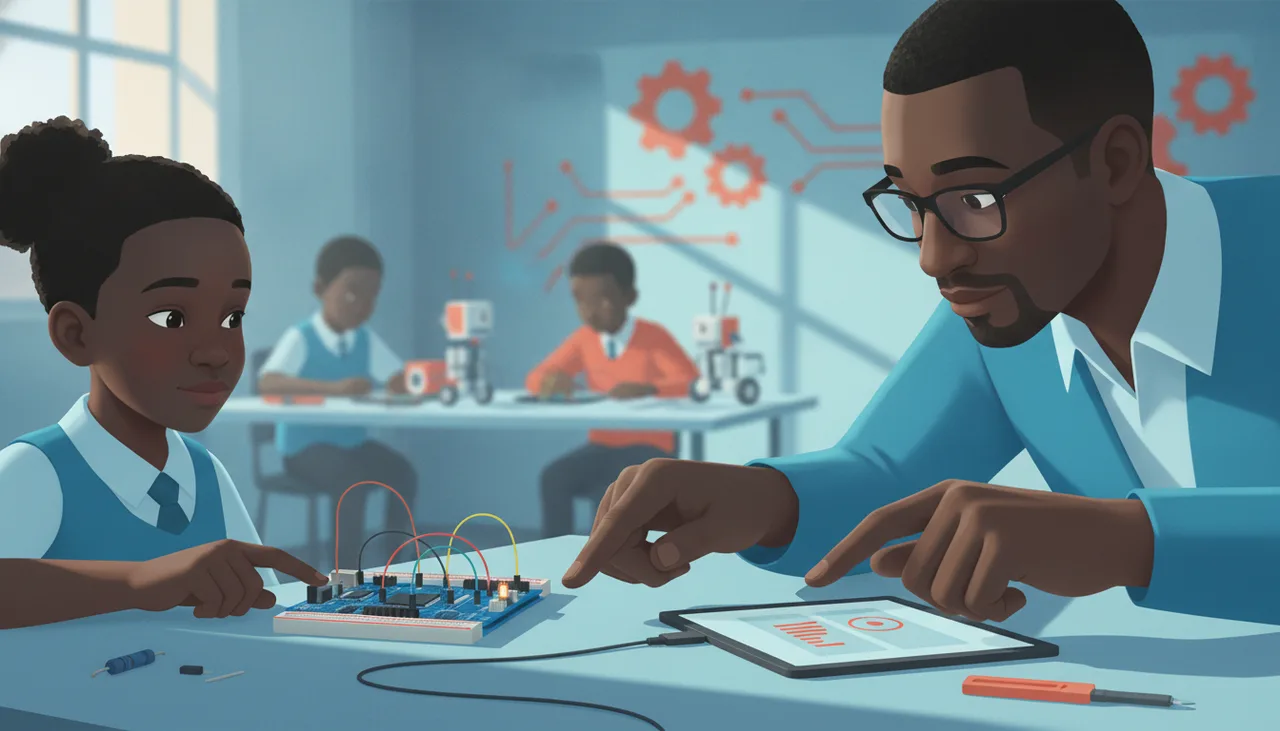
When parents and school leaders look into a robotics classroom, they often see children assembling plastic chassis, plugging in jumper wires, and watching a small machine move across a table. The easy assumption is that these children are learning "how to build a robot" or preparing for a highly specific career in mechatronics.
The truth is far more practical. A child in a robotics class is actually learning how to negotiate with physical reality using logic. In a world where software is increasingly abstract, robotics is one of the few disciplines where bad logic has immediate, physical consequences: the robot crashes into a wall, spins in circles, or refuses to move at all.
To understand what is actually being learnt, we have to look past the marketing buzzwords like "21st-century skills" and look at the actual friction points of a project. Let us walk through a standard robotics challenge—building a simple line-following robot—and look at the transferable skill acquired at every stumble.
The Stumble: The Sensor Reads Noise
To follow a black line on a white floor, a robot uses infrared (IR) sensors that detect reflected light. The naive assumption is that black will always read as a low value (say, 10) and white will read as a high value (say, 90).
The Reality: The class starts at 14:00. By 15:00, the afternoon sun is shining directly through the classroom window. Suddenly, the "white" floor reads entirely differently because of the ambient infrared light from the sun. Or, the school's fluorescent lights flicker at a frequency that interferes with the sensor. The robot spins out of control.
The Real Skill: Data Calibration and Normalisation. The learner cannot simply hardcode a single number into their program. They have to learn how to calibrate their sensors dynamically, taking ambient readings at the start of a run and calculating a threshold relative to the environment. They learn that real-world data is noisy, inconsistent, and context-dependent. This is the foundation of data science, signal processing, and statistical thinking.
The Stumble: The Robot Overshoots
Once the sensors can detect the line, the student programs the motors with a simple logical statement: "If you see black, turn left; if you see white, turn right."
The Reality: The robot does not follow the line smoothly. Instead, it begins to violently oscillate back and forth, shaking like a washing machine on a spin cycle, before eventually losing the line entirely and heading under a cupboard. This is the classic "drunk walk" of simple feedback systems.
The Real Skill: Control Theory and Feedback Loops. The learner discovers that binary (on/off) decisions lead to unstable, over-correcting systems. To fix this, they must transition to proportional control—making the steering angle proportional to how far off-centre the robot actually is. They learn how to manage delay, momentum, and system inertia. This is the exact same logic used in industrial thermostats, autopilot systems, and economic inflation adjustments.
The Stumble: Total System Failure
The robot was working perfectly five minutes ago. Now, it does not move at all.
The Reality: In a panic, the learner is tempted to change three things at once: rewrite the code, swap the batteries, and plug the wires into different ports. The robot still does not work, and now nobody knows why because the baseline has been lost.
The Real Skill: Isolation of Variables (Debugging). In a structured environment, we teach learners to treat a dead robot like a scientific experiment. They must test one hypothesis at a time. Is the battery outputting the correct voltage? (Test with a multimeter). Is the microcontroller receiving power? (Check the onboard LED). Is the code actually running? (Add a simple serial print statement). Only when one variable is ruled out do they move to the next. This disciplined troubleshooting is the core of any engineering, medical, or diagnostic career.
The Stumble: The Shared Kit Constraint
In a typical South African classroom, learners share kits. A group of three might have one microcontroller, one chassis, and a single laptop to share during a 45-minute period, often complicated by the looming threat of local load-shedding.
The Reality: One learner wants to add a mechanical arm; another wants to speed up the motors; the third is trying to fix a loose wheel. Without coordination, they overwrite each other's code and physically dismantle each other's work.
The Real Skill: Resource Management and Technical Debt. They learn that physical design constraints limit software choices, and vice versa. They must document their wiring diagrams and write clean, commented code so their partner can understand it when they swap roles. They learn to negotiate, divide labour, and manage a shared technical asset under a tight deadline.
The Educational Translation
When we translate these daily classroom struggles into educational outcomes, the contrast between marketing speak and actual technical learning becomes clear:
| What the brochure says | What the learner actually does |
|---|---|
| "Problem Solving" | Isolating a loose ground wire from a syntax error when the motor stops spinning. |
| "Critical Thinking" | Realising that afternoon sunlight changes the infrared threshold of a line-sensor. |
| "Collaboration" | Negotiating who writes the code and who tests the chassis without overwriting work. |
| "Resilience" | Watching a robot fail on the 14th consecutive run, and systematically changing one variable at a time. |
This is why we focus heavily on these friction points in our curriculum. Whether a child is attending a free trial session at our Cape Town academy or working through our advanced Infinity curriculum, we do not step in to fix the robot for them. The learning is not in the working robot; the learning is in the struggle to make it work.