
Which Vegetables Can Learners Plant and Harvest in a Single School Term?
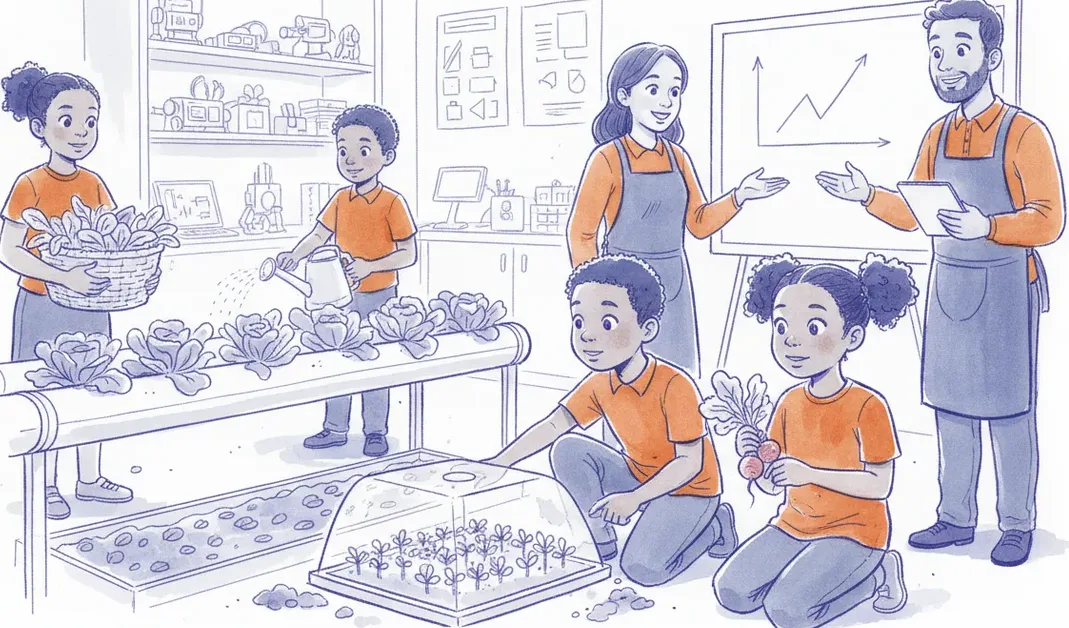
To beat the 10-week school term and avoid holiday shutdowns, choose crops that mature in under 50 days: microgreens, radishes, loose-leaf lettuce, and baby spinach.
Learners can reliably harvest microgreens (7–14 days), radishes (21–28 days), baby Asian greens like bok choy (30–35 days), and loose-leaf or butterhead lettuce (35–45 days) within a single South African school term. Long-season staples such as tomatoes, sweet peppers, and standard carrots require 75 to 120 days from seed, meaning they will inevitably mature during the school holidays when grounds are locked, irrigation stops, and learners are at home.
The Arithmetic of the 10-Week School Term
A standard South African public school term runs between 10 and 11 calendar weeks. On paper, that looks like 70 to 75 days of growing time. In a classroom, it is closer to 45.
Week 1 is lost to timetabling, stationery distribution, and administrative settling in. Actual sowing rarely happens before Week 2. At the other end of the calendar, Weeks 9 and 10 are consumed by assessments, exam timetables, marking, and final clean-ups. Once the final bell rings on the last Friday of term, the school gate is locked for two to four weeks. During that shutdown, unattended plants face municipal water pressure cuts, load-shedding outages on automated pumps, or simply zero watering from absent groundstaff under midsummer heat or midwinter frost.
The mathematical rule for classroom agriculture is straightforward: any crop that cannot go from dry seed to edible plate in 50 days or fewer will fail the educational objective. The learners who sowed it will never eat it.
Why Tomatoes, Peppers, and Carrots Fail the Classroom
When well-meaning school garden projects fail, the culprit is almost always seed packet optimism. Seed catalogues routinely market tomatoes, sweet peppers, cabbages, and carrots to schools because they are recognisable household foods. None of them fit the term model.
- Tomatoes and Peppers: Indeterminate tomatoes require 75 to 90 days from transplanting simply to show their first ripe fruit, and transplants take 4 to 6 weeks in a nursery tray before they can even be planted out. Sown from seed in February, a tomato plant will set its first green fruit just as learners leave for the April holidays. By the time they return, the fruit has either rotted, dropped, or succumbed to red spider mites and neglect.
- Carrots: While some baby carrot varieties advertise maturity in 65 days, germination alone takes 14 to 21 days in unconditioned soil, requiring daily, delicate surface moisture that classroom rosters rarely maintain. By Week 10, learners pull up thin orange taproots the size of matchsticks.
- Pumpkins and Squashes: These need 90 to 120 frost-free days and extensive ground coverage. Sown in Term 1, they are abandoned in April; sown in Term 3, they hit December school closures before curing.
The Sub-50-Day Roster: Crops That Actually Work
To deliver the psychological win of growing food—where learners connect sowing, tending, measurement, and consumption—you must select plants with compact vegetative cycles. You want crops harvested for their leaves, stems, or swollen roots, not their botanical fruits, because a plant must build a complete vegetative framework before it even considers flowering and fruiting.
| Crop | Days from Seed to Harvest | Classroom Reliability | Educational Value |
|---|---|---|---|
| Microgreens (Radish, Broccoli, Pea shoots) | 7–14 days | Near 100% (indoors on windowsills) | Germination rates, biomass increase, multi-cycle experiments |
| Salad Radish (Cherry Belle, French Breakfast) | 21–28 days | Very high | Root development, thinning trials, rapid nutrient response |
| Baby Bok Choy / Tatsoi | 30–38 days | High | Photosynthesis surface-area measurement, culinary trials |
| Loose-Leaf Lettuce (Grand Rapids, Oakleaf) | 35–45 days | High (cut-and-come-again) | Transpiration tracking, staggered harvest economics |
| Baby Spinach / Swiss Chard (leaf harvest) | 40–48 days | High | Soil nitrogen demand, regenerative cutting |
Radishes are the gold standard for Grade 4 to 7 Natural Sciences. A variety like Cherry Belle germinates within 72 hours under warm conditions. By Week 4 of the term, learners are measuring true leaves; by Week 5 or 6, they are washing and eating crisp roots. If a sowing fails due to bad watering over a weekend, you still have time to re-sow and finish before the term ends.
Leafy greens offer another advantage: the "cut-and-come-again" method. Rather than waiting for a head to form as commercial iceberg lettuce does over 70 days, loose-leaf lettuces allow learners to harvest outer leaves from Day 35 onwards while the plant continues growing. Learners can take a bag of greens home in Week 7, another in Week 8, and strip the remaining crop in Week 9 before the holidays hit.
Soil Versus Controlled Hydroponics
In South African schoolyards, outdoor soil beds carry severe hidden risks: variable topsoil quality, weekend desiccation under high evaporation rates, and insect pests that overrun plants between Friday afternoon and Monday morning. A three-day heatwave in February without irrigation can stunt a bed of spinach permanently, stretching a 45-day cycle to 65 days.
Controlled growing environments dramatically compress these timelines. In low-cost indoor or undercover systems, constant nutrient availability and protected root zones shave 20 to 30 percent off the standard seed-packet maturity dates. Loose-leaf lettuce that takes 45 days in variable Western Cape sand or Highveld clay frequently reaches harvestable weight in 32 to 35 days in a recirculating or passive nutrient reservoir. For schools designing deliberate food-technology or STEM modules, running compact hydroponic growing systems guarantees that crops hit their targets within the strict boundaries of the school calendar, regardless of municipal ground-water constraints or weather extremes.
A Reliable 10-Week Term Schedule
To ensure success, build the curriculum backward from the final harvest:
- Week 1: Setup, tray preparation, and baseline soil or nutrient testing.
- Week 2 (The Hard Sowing Deadline): Sow seeds for radishes, loose-leaf greens, and baby spinach. Sowing later than Friday of Week 2 introduces unmanageable risk.
- Week 3: Germination counts, thinning out seedlings to proper spacing, and logging growth metrics in workbooks.
- Week 4–6: Rapid vegetative phase. Sow a quick batch of 10-day microgreens here to demonstrate comparative life cycles.
- Week 7–8: First selective harvests (outer leaves of chard and lettuce; full harvest of early radishes).
- Week 9: Final clearing harvest, mass data logging, taste testing or donation, and system clean-down.
- Week 10: Exam completion and school wrap-up with zero live plants left at risk.
By respecting the term calendar rather than fighting it, teachers can turn classroom agriculture from an untended post-holiday graveyard into a repeatable, scientific success.