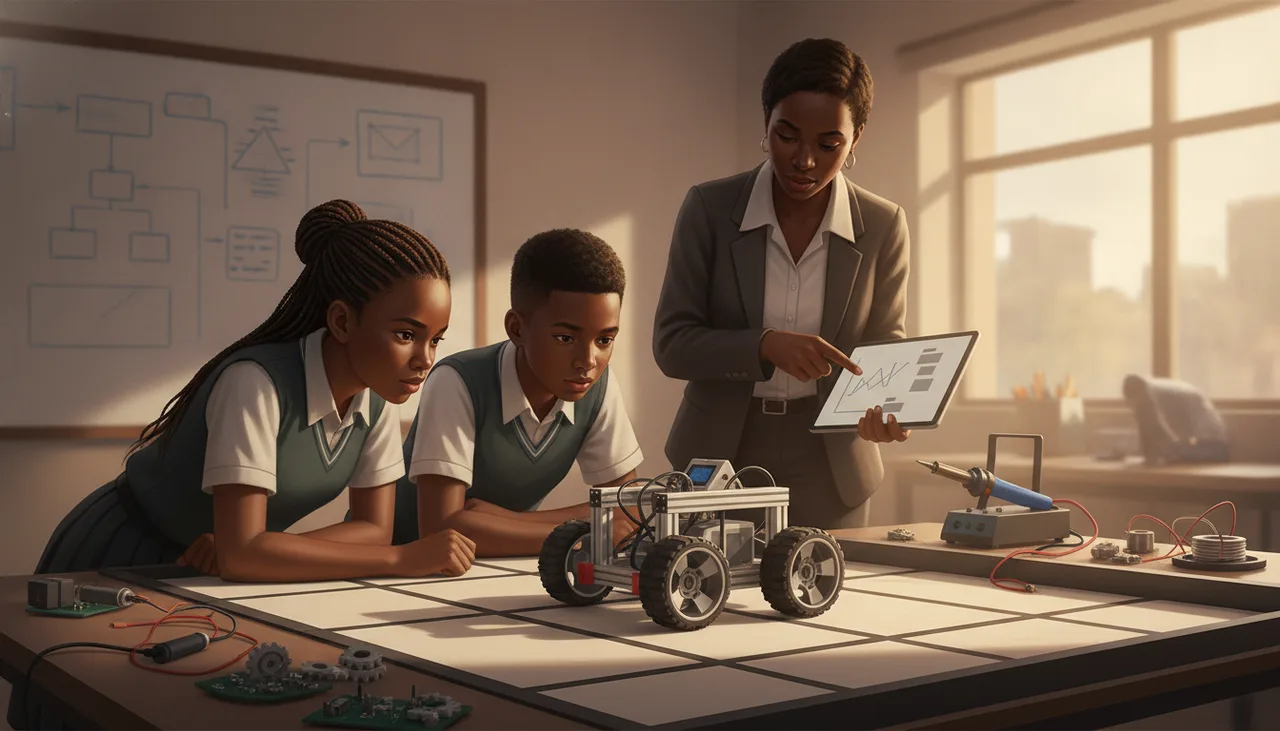
From LEGO to FTC: What the Jump Actually Takes for South African Schools
Transitioning from LEGO robotics to the FIRST Tech Challenge is not a small step—it is a massive structural and technical leap. Here is what it costs, what will break, and how to survive the shift.
If your school has run LEGO Mindstorms or SPIKE Prime teams for a few seasons, you have likely hit a ceiling. Your oldest learners can build a line-follower in their sleep, they are bored of plastic pins, and they are eyeing the FIRST Tech Challenge (FTC).
Let us be completely honest: the transition from LEGO to FTC is not a step up a ladder. It is a leap across a gorge. Moving from snap-together plastic to metal channels, industrial-grade electronics, and text-based Java programming requires a fundamental shift in budget, space, and teaching philosophy.
If you treat FTC like "big LEGO," your team will end up with an expensive pile of stripped screws, dead batteries, and frustrated students. But if you prepare for the structural differences, it is the most rewarding engineering experience a high school can offer. Here is what the jump actually takes.
The Technical Chasm: Plastic vs. Metal
LEGO is designed to fail safely. If a gear jams, the clutch slips or the motor stalls without burning out. If a structure is weak, it bends or snaps apart harmlessly.
FTC robots are heavy, fast-moving machines made of aluminium and steel, powered by 12-volt matrix motors. When things go wrong here, they break permanently. Axles strip, gears shear, and motor gearboxes implode under high torque.
Your students will need to learn real mechanical engineering principles:
- Pattern-based building: You will move to structural systems like GoBILDA or REV Robotics. These use specific grid patterns (like the 8mm grid) and require hex keys, locknuts, and thread-locking fluid to keep from vibrating apart.
- Custom fabrication: Unlike LEGO, FTC allows custom parts. Successful teams quickly realise they need 3D-printed brackets, laser-cut acrylic plates, or custom-machined polycarbonate intake flaps to remain competitive.
- Rigid physics: A 15kg robot travelling at 2 metres per second carries significant momentum. Teams must design for impact, structural rigidity, and centre of mass.
The Control System and Software Shift
In LEGO, the "brain" is a single hub that connects directly to a laptop via Bluetooth or USB. The programming is usually Scratch-based blocks.
The FTC control system is a dual-device network. The robot is controlled by a REV Control Hub (effectively an Android computer running specialized input/output ports). This communicates via a dedicated Wi-Fi Direct connection to a Driver Station—either a second Android device or a dedicated handheld controller—connected to two USB gamepads.
This architecture introduces real-world IT friction. In a typical South African school environment, WPA2-Enterprise school Wi-Fi networks will actively block or interfere with the Wi-Fi Direct signals. Your team will need to learn how to manage wireless channels, troubleshoot static electricity discharges that freeze the USB modules, and manage firmware updates across multiple devices.
On the software side, while block programming is technically possible in FTC, it is a dead end for competitive teams. To get the most out of the sensors, encoders, and complex drive bases (like Mecanum wheels), students must write real Java. They will need to transition to text-based coding, version control using Git, and integrated development environments (IDEs) like Android Studio.
Comparing the Ecosystems
To understand the scale of the transition, consider how the two platforms compare in practical terms:
| Feature | LEGO Robotics (FLL) | FIRST Tech Challenge (FTC) |
|---|---|---|
| Primary Material | ABS Plastic (Studless LEGO) | Aluminium channels, steel shafts, custom 3D prints |
| Programming | Scratch Blocks / Simple Python | Java (via OnBot Java or Android Studio) |
| Actuators | Up to 4 medium/large servo motors | Up to 8 high-torque DC motors + 12 servo motors |
| Power Source | Small rechargeable Li-ion battery | 12V Slim NiMH or LiFePO4 battery pack |
| Workspace Needed | Standard classroom desk | Dedicated workshop bench and a 3.6m x 3.6m field |
| Typical Entry Cost | R9,000 - R12,000 | R45,000 - R80,000 (including electronics & tools) |
The Realities of the South African Context
Running an FTC team in South Africa introduces specific local constraints that you must plan for:
- Load-Shedding: Unlike LEGO hubs which can charge off a phone charger, FTC uses heavy 12V batteries. The chargers require stable mains power and take hours to balance the cells. If your school does not have an inverter or solar backup, a sudden power cut during a build session can halt testing instantly.
- Supply Chains: You cannot pop down to the local toy shop for a replacement GoBILDA dual-block mount or a replacement REV hub. Almost all specialized FTC hardware is imported. If you strip a critical gear a week before the national tournament, you cannot easily source a local replacement. You must learn to keep a stock of spares.
- The Budget: A competitive rookie season requires a significant capital outlay. Between the starter kit, control electronics, gamepads, tools, and tournament registration fees, you are looking at a starting budget of at least R50,000.
If you are trying to figure out exactly which parts to order to avoid importing the wrong gear, you can look at our curated Sheen Robotics Store where we stock local, competition-legal components and kits to bypass the customs headache.
A Step-by-Step Transition Roadmap
If your school is ready to make the leap, do not try to do it all in one month. We recommend a phased approach over a full academic year.
Phase 1: The Bridging Year
Do not retire your LEGO kits yet. While your senior students are finishing their final FLL season, introduce them to text-based programming. Force them to program their LEGO robots in Python rather than blocks. This teaches them the syntax of object-oriented programming without the complexity of the FTC hardware.
Phase 2: The Tooling Up
Before you buy the robot, buy the tools. An FTC team needs a dedicated workspace. You will need metric hex drivers (specifically 1.5mm, 2.0mm, and 2.5mm), combination spanners, a hacksaw or rotary tool for cutting shafts, a digital multimeter, and a basic 3D printer for custom mounts.
Phase 3: The Chassis Build
Start with a proven drivetrain kit rather than designing from scratch. Building a simple four-wheel Mecanum drive base using a kit of parts allows the students to understand the mechanics of chain, belt, or gear drives before they attempt to design complex intake or lifting mechanisms.
For schools looking for structured guidance through this transition, we offer hands-on training and mentorship programmes specifically designed to help teachers bridge this gap safely at Sheen Robotics FTC Support.
The Verdict: Is It Worth It?
Yes, the learning curve is steep, and yes, the first season will feel chaotic. But the educational payoff is unmatched.
When a student successfully programs an autonomous path using road-runner localization, or designs a custom intake mechanism that they 3D-printed themselves, they are no longer playing with educational toys. They are doing real, industry-standard engineering. If your school has the space, the budget, and a mentor willing to learn alongside the students, the jump to FTC is the best investment you can make in your STEM department.