isiZulu, isiXhosa and code: why mother-tongue matters in STEM
Coding already fills a child's working memory; doing it in a second language adds a tax on top. Mother-tongue support in isiZulu and isiXhosa frees that capacity for the logic.
A child learning to code is already juggling a lot: sequencing, abstraction, cause and effect, and the patience to hunt down a bug. Ask that same child to do all of it in a language they are still learning, and you have stacked a second, invisible task on top of the first. For a large share of South African learners whose home language is isiZulu or isiXhosa, that is the everyday reality of a STEM class taught in English. Mother-tongue support does not lower the bar. It removes a tax that had nothing to do with the logic in the first place.
The two kinds of load in a coding lesson
Working memory is small and easily filled. In any lesson, part of it goes to the actual concept you want a learner to grasp: what a loop is, why a condition branches, how a sensor reading becomes a decision. That is the load worth spending. The rest gets eaten by everything else competing for the same space: a cluttered screen, a rushed explanation, and an unfamiliar language.
When a learner has to decode the sentence before they can even reach the idea, the language becomes the extra load. Two hard things arrive at once. The concept is new, and the words describing it are new. The brain does not get a discount for doing both together; it simply runs out of room, and the concept is usually the part that gets dropped.
What the CAPS reality looks like
Most South African learners start school in their home language and then switch to English as the language of learning and teaching around Grade 4. By the time coding and robotics show up on the timetable, the class is running in English even though the corridor, the taxi and the supper table are still running in isiZulu or isiXhosa. So a learner meets a brand-new subject in a language they are only part-way into. It is not that they cannot think about the logic. It is that they are asked to reach it through a door they do not yet own the key to.
Where localised interfaces help, and where they do not
Block-based coding already strips out a big chunk of language load. There is no keyword to spell, no semicolon to forget. A learner drags a "repeat" block instead of typing a for-loop, so the syntax stops fighting them and the shape of the idea is visible on screen. A localised block palette goes one step further, labelling those blocks in isiZulu or isiXhosa so the youngest learners meet the idea in words they already own.
Be honest about the limit, though. Under the hood, real programming keywords stay English. A localised interface is a bridge, not a final destination. The point is not to hide English forever; it is to let a learner grasp the concept first in a language that costs them nothing, then attach the English term once the idea is secure. Concept first, vocabulary second, is far sturdier than trying to build both on wet ground at the same time.
Translanguaging beats a strict one-language rule
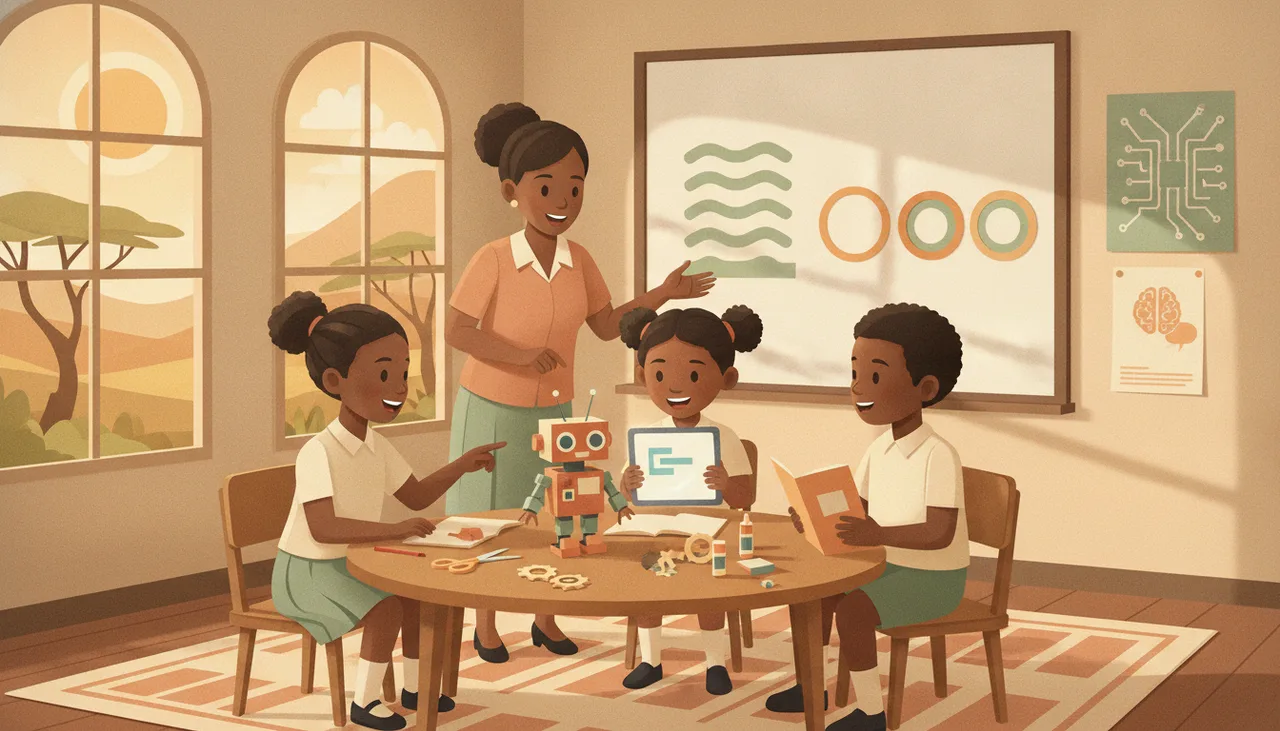
The strongest bilingual classrooms do not pick one language and ban the other. They let learners think and argue in their home language and write code in English, moving between the two without friction. A pair might plan the whole algorithm out loud in isiXhosa, sketch the steps on paper, and only then name the variable and drop the blocks in English. The home language carries the reasoning; English carries the tool. Neither is treated as the lesser one.
This matters for confidence as much as for comprehension. A learner who is allowed to reason in their strongest language will take risks, guess, and self-correct. A learner forced to perform every step in a second language often goes quiet, and a quiet learner is not debugging anything.
Practical strategies for a bilingual classroom
None of this needs a new budget line. It needs a few deliberate habits.
- Introduce each new concept in the home language first, then give the English term and keep both side by side.
- Build a small bilingual glossary on the wall: loop, sensor, variable, condition, each with its isiZulu or isiXhosa equivalent. Add to it as the term comes up, not all at once.
- Let learners discuss and plan in their mother tongue, but keep the coding surface in English so the vocabulary transfers with use.
- Use a localised block interface for the youngest grades, then fade it as reading and confidence grow.
- Pair a stronger English reader with a home-language-dominant partner and let them translanguage freely while they build.
- Read error messages together and translate the meaning, not the words. "It cannot find the thing you named" beats a literal rendering.
- Send a one-line home-language note home so a parent can follow what their child built, even if the parent never coded.
How we handle it at sheen
Our coding tools ship with isiZulu and isiXhosa interfaces, not only English and Afrikaans, so a Grade 3 in Khayelitsha and a Grade 3 in KwaMashu can both start in the language they think in. You can open the block coding canvas in a browser and switch the interface language, and the on-screen sheenbot∞ board in the simulator responds the same way whichever language a learner reads the blocks in. In our academy classes we treat the home language as the working language for planning and reserve English for the code itself, and the curriculum is built to move learners from mother-tongue blocks toward English text as they are ready, not before.
The takeaway
Mother-tongue STEM is not about lowering standards or replacing English. It is about spending a learner's limited working memory on the thing that matters, the logic, instead of burning it on decoding a second language at the very same moment. Give a child their home language for the thinking and English for the tools, and over time both get stronger. The learner who understood a loop in isiXhosa will have no trouble calling it a loop later. The learner who never quite understood it in English will struggle to call it anything at all.