Assigned to Teach Robotics with No Coding Background? Here is Your Term 1 Survival Plan
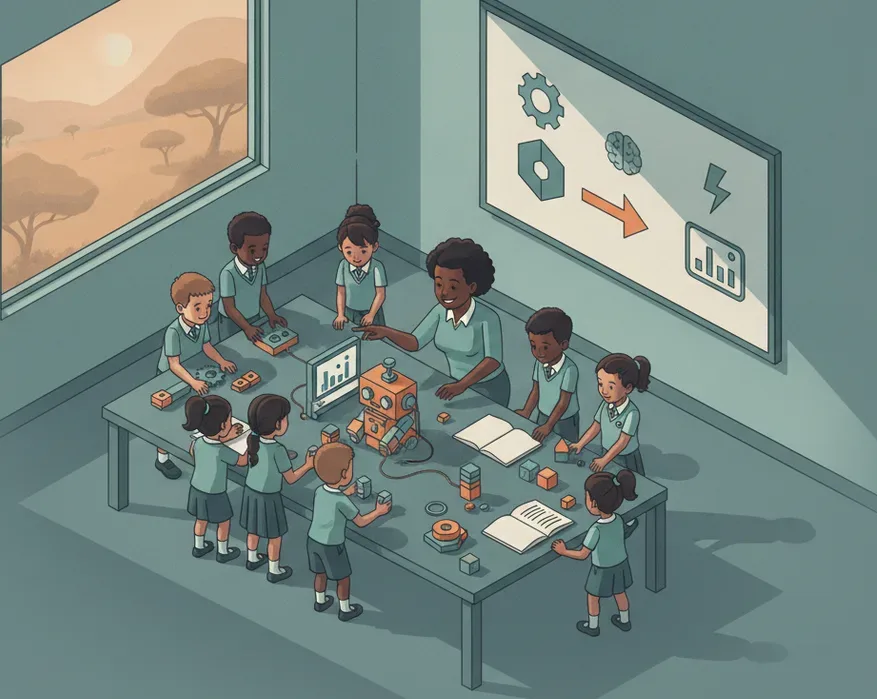
You do not need a computer science degree to teach coding and robotics. By shifting from expert to facilitator and starting with offline activities, you can run a highly successful class while learning alongside your learners.
If you have just been handed a coding and robotics timetable slot with zero formal training, you are not alone. In fact, you are in the global majority. You do not need a computer science degree, a background in software engineering, or even a personal interest in gaming to run a highly successful, engaging robotics classroom. What you do need is a shift in perspective, a reliable first-week plan, and resources that do not leave you stranded when the technology inevitably hiccups.
The scale of this transition is documented globally. According to the 2025 CSTA/Kapor Center report, which surveyed 2,882 educators, 81% of K-12 computer science teachers entered the field with no formal computer science background, and 50% are the sole computer science teacher in their entire school building. On community forums like Reddit's r/Teachers, the sentiment is echoed daily:
I am also being asked to facilitate robotics club and I have no idea how to do that..YET
The secret to surviving and thriving in your first term is simple: stop trying to be the expert. Here is your practical, step-by-step guide to running a classroom where you are not the smartest programmer in the room.
Week 1: The 'Unplugged' Survival Strategy
Do not start your first lesson by handing out expensive hardware kits or trying to log forty learners onto a school Wi-Fi network. That is a recipe for immediate chaos. Instead, start 'unplugged'—teaching the core concepts of computer science using nothing but paper, pencils, and physical movement.
A classic first-week activity is the 'Human Robot'. Divide your class into pairs. One learner is the 'Programmer', and the other is the 'Robot'. The Programmer must write down a precise sequence of instructions (an algorithm) to get the Robot from one side of the classroom to the other, navigating around obstacles like desks and chairs. The rules are strict: the Robot can only execute exactly what is written (e.g., 'Step forward 3 paces', 'Turn 90 degrees right'). If the instructions are vague, the Robot must execute them literally—even if it means walking straight into a wall.
This simple game teaches three foundational concepts without touching a single computer:
- Algorithms: A sequence of step-by-step instructions.
- Debugging: Identifying where the instructions went wrong and fixing them.
- Syntax: Understanding that computers do not interpret meaning; they execute commands exactly as written.
Best of all, this lesson is entirely immune to South African classroom realities like Stage 4 load-shedding or a dropped internet connection.
Shift Your Role: From Expert to Facilitator
In a traditional history or maths class, you are the source of knowledge. In a coding and robotics class, that model will exhaust you. You cannot debug forty different scratch projects or physical wiring configurations in a 45-minute lesson. You must transition from the 'sage on the stage' to the 'guide on the side'.
Implement the 'Ask 3 Before Me' rule. If a learner encounters an error in their code or their physical robot is not moving, they are not allowed to raise their hand to ask you for help until they have asked three of their peers. This completely changes the classroom dynamic. It fosters collaborative problem-solving, builds communication skills, and prevents you from being bottlenecked by minor troubleshooting issues.
When a learner does eventually ask you for help, never take the mouse or keyboard from their hands. Instead, ask guiding questions: 'What did you expect to happen?', 'What actually happened?', and 'Where in your code does that action start?' Often, simply reading their code aloud to you will help them spot their own mistake.
What 'Turnkey' Must Actually Mean
Many schools purchase expensive, complex robotics kits only to have them gather dust in a cupboard because the accompanying materials are too sparse. When selecting a curriculum or platform, do not just look at the hardware. Look for a genuine turnkey solution. A real turnkey programme must provide three things:
- Step-by-Step Lesson Plans: You should not have to spend your Sunday evenings inventing robotics challenges. The curriculum must outline exactly what to say, what to demonstrate, and what the learners should achieve by the end of the hour.
- Complete Answer Keys: You need to know what the working code looks like. If a student's project is failing, you should be able to compare their block code to a visual solution guide to quickly spot the discrepancy.
- A Software Simulator: Hardware fails. Batteries run flat, wires snap, and microcontrollers get misplaced. If your lesson depends entirely on physical hardware, a single broken component can halt a learner's progress. A platform with a built-in digital simulator allows learners to write, test, and run their code on a virtual screen. If the physical kit works, that is a bonus; if it does not, the learning continues uninterrupted.
Navigating South African Classroom Constraints
Teaching this subject in South Africa requires a highly pragmatic approach to infrastructure. Below is a quick-reference guide to common operational hurdles and how to bypass them:
| Classroom Constraint | The Practical Workaround |
|---|---|
| Load-shedding & Power Outages | Keep a folder of 3-4 'unplugged' computational thinking lessons printed and ready to go at any moment. No screens required. |
| WPA2-Enterprise School Wi-Fi | Many educational microcontrollers struggle to connect to secure school networks. Opt for platforms that allow offline programming via USB cable. |
| Large Classes (40+ Learners) | Group learners into teams of 3 or 4. Assign specific roles: the 'Driver' (types), the 'Navigator' (reads the instructions), and the 'QA Tester' (checks for bugs). Rotate roles weekly. |
If you are looking for a structured, stress-free way to implement this subject without the administrative burden, Sheen Robotics provides comprehensive school services that include CAPS-aligned curricula, complete teacher guides, and the physical kit support you need to feel confident from day one.
You Are Learning, Too
Be honest with your learners. Tell them that coding is about trial, error, and persistence. When you do not know the answer to a technical question, do not bluff. Say, 'I don't know the answer to that yet. Let's find out together.' By modeling curiosity and resilience in the face of a technical challenge, you are teaching them the most valuable computer science skill of all.