How to monitor a farm with no mains power and no fibre
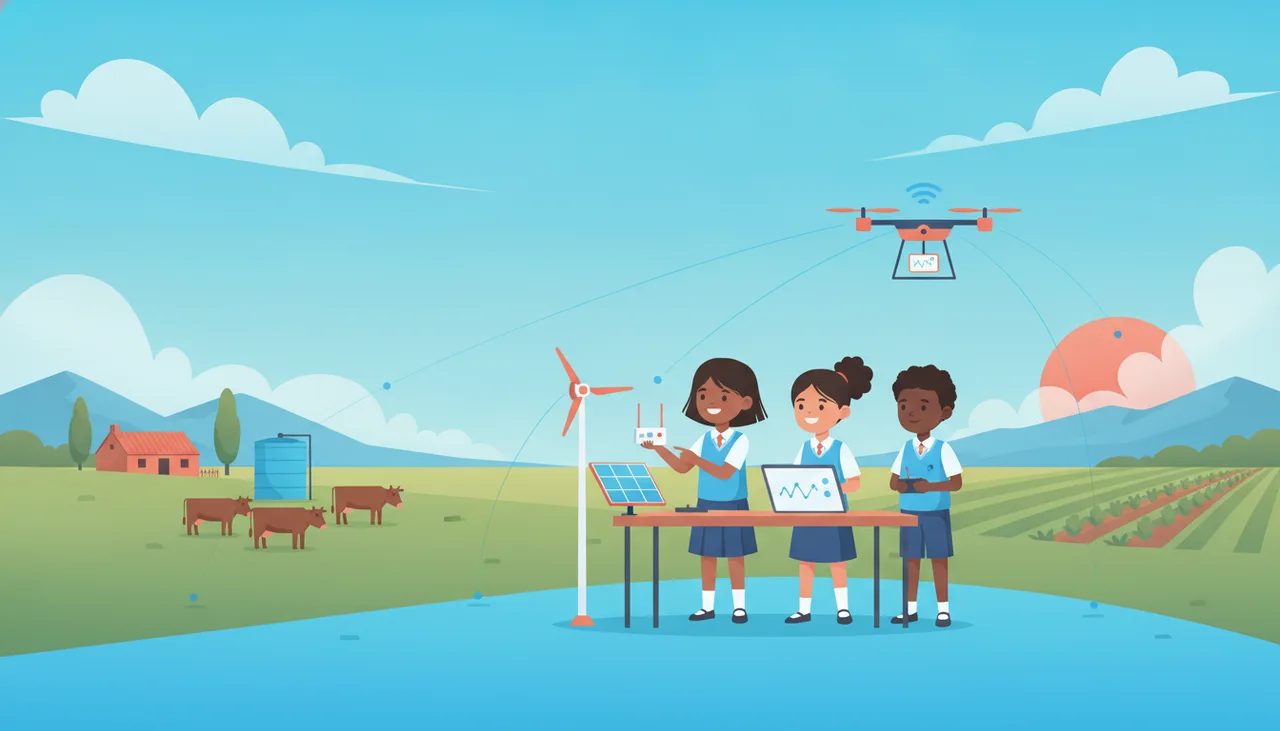
To monitor a remote farm without mains power or fibre, you must design from the power budget backwards, using low-power LoRaWAN telemetry instead of power-hungry WiFi or cellular.
To monitor a farm with no mains power and no fibre, you must abandon the consumer-grade mindset of using WiFi or cellular-based sensors. Instead, the solution lies in building a private, low-power wide-area network (LPWAN) using LoRaWAN technology, run from nodes designed from the power budget backwards.
A successful remote monitoring system does not start with choosing sensors; it starts with calculating how many milliwatts of energy you can harvest and store, and how far that energy can carry a radio signal. By pairing a single solar-powered gateway with ultra-low-power sensor nodes, you can monitor soil moisture, security gates, water levels, and weather patterns across thousands of hectares without a single centimetre of copper wire or a utility connection.
The Power Budget: Why WiFi and Cellular Fail on the Farm
To understand why traditional wireless technologies fail in agricultural environments, we must look at the physics of radio frequency (RF) transmission and the power consumption of different microcontrollers. A standard WiFi connection is designed for high throughput over short distances. To maintain this connection, a WiFi chip must remain active, drawing between 100mA and 240mA of current at 3.3V. Even if programmed to sleep and wake up only to transmit, the process of scanning for an access point, associating, negotiating an IP address via DHCP, and transmitting data takes between two and five seconds. Doing this multiple times a day will deplete a standard 2500mAh 18650 lithium-ion battery in a matter of weeks.
Cellular networks (including NB-IoT and LTE-M) offer better range but suffer from similar power penalties. A cellular modem must negotiate with a base station, which can take up to ten seconds of high-power transmission (often peaking at over 200mA). Furthermore, in South Africa, cellular networks are highly vulnerable to load-shedding. During Stage 4 or higher, local cellular towers frequently lose power once their backup batteries drain, leaving your sensors disconnected precisely when you need them most.
The LoRaWAN Alternative
LoRa (Long Range) operates on sub-gigahertz radio frequencies (868 MHz in South Africa). It uses chirp spread spectrum modulation, which allows signals to be demodulated even when they are below the noise floor. This gives LoRa two massive advantages for farming:
- Extreme Range: A single gateway mounted on a high point (such as a silo or water tower) can easily receive signals from nodes up to 15 kilometres away with direct line of sight.
- Minimal Power Consumption: Because LoRaWAN nodes do not need to maintain a continuous connection with the gateway, they can remain in a deep sleep state drawing less than 5 microamps (µA). When they wake up, they transmit their payload in less than 100 milliseconds and immediately go back to sleep.
The Arithmetic of Sampling Intervals
The lifespan of a battery-powered sensor node is directly proportional to how often it transmits data. In farm monitoring, real-time data is rarely necessary. Soil moisture does not change significantly in ten minutes; a water reservoir does not empty in five. By adjusting the sampling interval, you can extend a node's battery life from months to years.
The table below illustrates the relationship between sampling frequency, average power draw, and expected battery life using a standard, non-rechargeable 3.6V Li-SOCl2 battery (8500mAh capacity) under typical operating conditions:
| Sampling Interval | Daily Transmissions | Estimated Battery Life | Best Suited For |
|---|---|---|---|
| Every 5 minutes | 288 | 8 to 12 months | Critical security gates, pressure lines |
| Every 30 minutes | 48 | 4 to 5 years | Livestock water troughs, weather stations |
| Every 2 hours | 12 | 8+ years (self-discharge limit) | Soil moisture, deep boreholes |
For nodes that require more frequent sampling or power-hungry sensors (such as optical dissolved oxygen sensors or ultrasonic water level sensors), a small 1W solar panel paired with a single 3.2V LiFePO4 battery is sufficient to keep the node running indefinitely, provided the hardware is designed to cut power to the sensor when not in use.
The South African Reality: Grid Independence and Gateway Resilience
While the sensor nodes run on tiny batteries, the heart of your network is the LoRaWAN gateway. The gateway receives the radio signals from all your nodes and forwards them to the internet. Because the gateway must listen continuously, it cannot sleep. A typical outdoor gateway draws between 3W and 5W of continuous power.
In South Africa, you cannot rely on the grid to power this gateway, nor can you rely on local cellular towers to forward the data during extended load-shedding. To build a resilient system, the gateway must be co-located with a solar power supply and a robust backhaul link. A 50W solar panel paired with a 12V 18Ah LiFePO4 battery will keep a 5W gateway running 24/7, even through three consecutive days of heavy overcast weather.
For backhaul (sending the data from the gateway to your phone or computer), if fibre is unavailable, a satellite link like Starlink or a highly directional, high-gain point-to-point wireless link to a nearby town with active infrastructure is the most reliable option. Because the gateway consolidates data from hundreds of sensors into a tiny data stream, even a low-bandwidth, high-latency satellite connection is more than adequate.
Implementing Your System
Designing these systems requires careful matching of sensor interfaces (such as SDI-12, RS-485 Modbus, or analog 4-20mA) with low-power microcontrollers. For agricultural operations seeking to implement robust, off-grid telemetry without the complexity of building hardware from scratch, our team at Sheen Farming Solutions provides pre-configured, solar-ready LoRaWAN gateways and sensor nodes tailored for South African conditions.
By shifting your architecture away from high-bandwidth, high-power consumer protocols and adopting a disciplined, low-power LPWAN design, you can gain complete visibility over your remote agricultural assets without relying on Eskom or commercial telecom operators.