How to Clear Classroom Hydroponic Pests Without Toxic Sprays
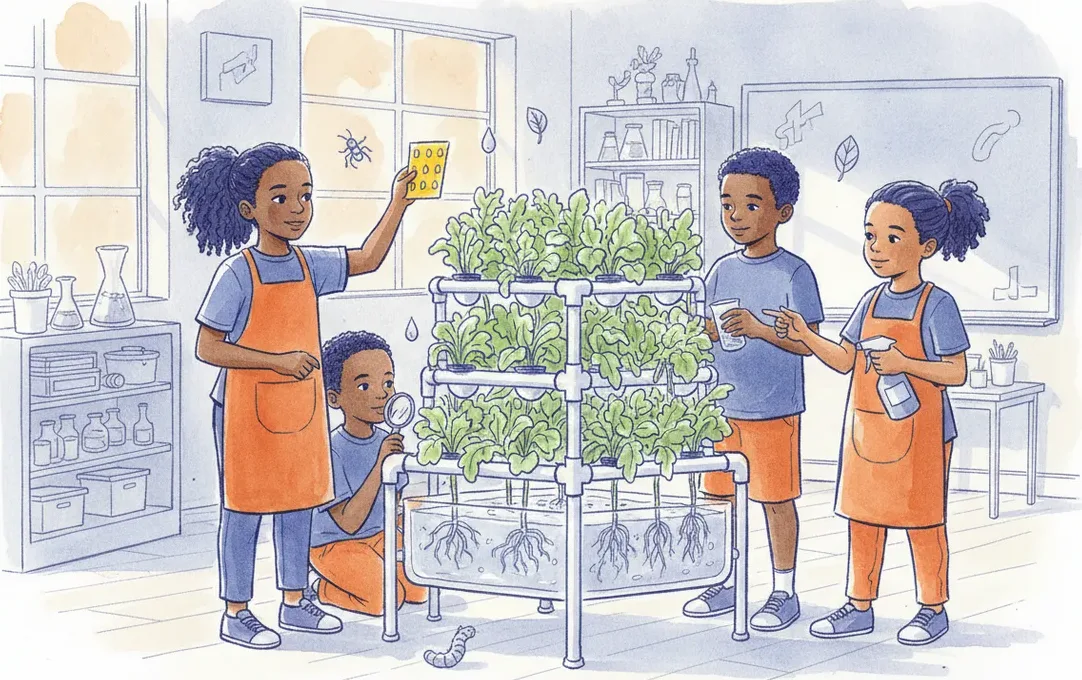
You eliminate classroom hydroponic pests by targeting their lifecycle mechanically and biologically: yellow sticky cards for monitoring, beneficial nematodes for root gnats, potassium silicate to toughen plant walls, and pure potassium soap for leaf-dwellers.
You cannot use synthetic chemical insecticides in a classroom, and you do not need to. School health policies, closed ventilation systems, and proximity to learners rule out pyrethroids, organophosphates, and systemic neurotoxins immediately. Instead, getting rid of classroom hydroponic pests requires an Integrated Pest Management (IPM) sequence: catch adults on physical sticky cards to stop reproduction, deploy microscopic predatory nematodes into the media to hunt larvae, wipe leaves down with dilute potassium soap, and feed potassium silicate to thicken cell walls against future attacks.
The Three Pests That Invade Classroom Systems
Classroom hydroponics systems—whether deep water culture (DWC), nutrient film technique (NFT), or counter-top vertical towers—operate in enclosed, warm indoor environments with no natural outdoor predators. Three pests account for almost every severe infestation:
- Fungus Gnats (Bradysia species): Tiny black flies walking erratically across the net pots or floating on reservoir surfaces. The adults do little damage beyond irritating teachers, but their subterranean larvae feed on tender root hairs and spread root-rot pathogens (such as Pythium).
- Aphids: Clustered colonies of green, black, or translucent soft-bodied sap-suckers under young leaves and around growth tips. They excrete sticky honeydew that colonises black sooty mould.
- Two-Spotted Spider Mites: Microscopic arachnids that proliferate in dry, air-conditioned or winter-heated classrooms. They cause fine yellow stippling on leaf surfaces and leave silky webbing over growing tips when populations spike.
Step 1: Physical Interception and Sticky Cards
Adult insects must be stopped before they lay their next batch of eggs. Hang bright yellow sticky cards directly above the plant canopy and place small horizontal strips flat across the tops of net pots or clay pebbles.
Yellow sticky cards are not merely passive traps; they are diagnostic tools. Checking the cards every Monday morning tells you whether you are dealing with a stray winged aphid that drifted through an open window or an emerging hatch of fungus gnats from moist rockwool cubes. If you notice gnats clustering around the reservoir lid, tape over unsealed grommets, net pot gaps, and tubing entry points. If gnats cannot reach the damp root zone, they cannot lay eggs.
Step 2: Biological Control in the Root Zone (Beneficial Nematodes)
If you see fungus gnats, your problem is beneath the net cup, not in the air. Swatting adult gnats does nothing to stop the hundreds of translucent larvae chewing through root tissue inside the rockwool or expanded clay.
The safest, most decisive intervention for an active fungus gnat infestation in a school is the introduction of beneficial entomopathogenic nematodes, specifically Steinernema feltiae. These are microscopic, naturally occurring roundworms that parasitise soil-borne insect larvae without affecting humans, pets, plants, or earthworms:
- Mix the nematode powder into plain, dechlorinated room-temperature water according to the supplier’s package dilution.
- Drench the top of each net pot, rockwool plug, or coco coir collar directly during a dark period or late afternoon, as ultraviolet light degrades nematodes rapidly.
- The nematodes enter the gnat larvae, release a symbiotic bacterium that consumes the pest internally, reproduce inside the carcass, and emerge to hunt remaining larvae. Within five to seven days, the subterranean population collapses.
Step 3: Food-Safe Soap Washes for Foliar Pests
Aphids and spider mites live on the foliage rather than in the water reservoir. To clear them without synthetic poisons, use mechanical disruption combined with a genuine potassium salt of fatty acids (horticultural insecticidal soap) or unscented pure Castile soap.
Never use commercial dishwashing liquid. Dish detergents contain synthetic surfactants, grease strippers, and artificial fragrances designed to strip oils, which strip the protective waxy cuticle off living plant leaves and cause leaf burn under grow lights.
The procedure is physical:
- Take heavily infested plants out of the system and carry them to a classroom sink. Wash the undersides of the leaves under a steady stream of lukewarm tap water to dislodge the majority of aphids and mite webbing mechanically.
- Mix pure liquid Castile soap at a rate of 5 millilitres per litre of water in a spray bottle.
- Spray the undersides of leaves and leaf axils thoroughly until runoff occurs. Soap works purely on contact by dissolving the waxy protective layer of soft-bodied insects, causing them to dehydrate and suffocate. It carries zero residual toxicity once dry.
- Wait thirty minutes, then mist the plants with fresh water to rinse off excess soap film before placing them back under the grow lights. Repeat this every four days for two weeks to catch newly hatched nymphs.
Step 4: Toughen the Plant with Potassium Silicate
Once an active outbreak is suppressed, you must alter the physical environment so the next pest cannot easily feed. Soft, rapidly growing indoor leaves grown under LED lights with high nitrogen are tender and easy to pierce.
Add a soluble potassium silicate supplement to your hydroponic nutrient reservoir at each water change (typically 0.5 to 1 ml per litre, adjusted according to the manufacturer’s label). Silicon is deposited directly into the plant’s cell walls as solid amorphous silica. This builds a microscopic mechanical barrier inside the leaf tissue that blunts the mouthparts of piercing insects like aphids and thrips, dramatically slowing their reproductive rate and reducing root penetration by pathogens.
Managing the Classroom Environment
Pest outbreaks in schools are usually triggered by environmental vulnerabilities specific to educational buildings:
| Classroom Vulnerability | Operational Consequence | Practical Correction |
|---|---|---|
| Air-conditioners running on dry cooling | Spider mite explosion due to low humidity | Increase airflow with an oscillating fan rather than bone-dry air blasts; mist foliage lightly in early morning. |
| Uncovered reservoir ports or empty net cups | Fungus gnats breed in stagnant nutrient film | Keep all unused holes covered with dark plastic caps or foil; never leave exposed nutrient solution visible to light. |
| Weekend power cuts or load-shedding | Stagnant water in channels; root stress and dieback | Ensure systems have passive drain-down depths so roots stay moist without submerging in un-aerated water. |
| Unmonitored school holidays | Reservoirs run low, stressing roots and drawing pests | Top up and rebalance conductivity before breaks; close all vents and seal reservoir inspection hatches. |
If you are setting up or upgrading your school’s growing space, choosing an enclosed, purpose-built classroom rig like those in our hydroponics collection eliminates many of these issues from day one by integrating sealed root channels, fitted reservoir covers, and stable recirculating pumps that prevent the exposed moisture pockets where pests start.
You do not need toxic chemicals to run a clean, productive growing system in a classroom. With basic physical sealing, biological nematodes in the root zone, and safe contact soaps on the leaves, you can treat pest management not as a biohazard crisis, but as an applied biology lesson that learners can safely manage themselves.