Does High School Robotics Actually Help with SA Engineering Admissions?
South African university engineering faculties admit on cold arithmetic: your Matric APS in Pure Mathematics and Physical Science. Robotics won't rescue a 65% in Maths, but it dramatically changes your odds in bursary interviews and first-year survival.
The short answer is no, not on paper—and then immensely, once you look past the admissions desk. If you are asking whether building robots in Grade 11 will earn your child bonus points on their university application, the arithmetic is unforgiving: South African engineering faculties admit students based on their Admission Point Score (APS) or Faculty Points Score (FPS), calculated almost exclusively from Grade 12 final marks in Pure Mathematics, Physical Sciences, English, and their next best subjects. A national robotics champion with 68% in Pure Mathematics will be rejected in favour of an applicant with 85% who has never touched a circuit board.
However, treating university access as purely a paper cut-off ignores the three arenas where robotics makes a decisive difference: high-stakes corporate bursary interviews, faculty discretionary selection, and surviving the brutal attrition of first-year engineering.
The Cold Arithmetic: How SA Engineering Faculties Actually Select
Engineering faculties at institutions like UCT, Wits, Stellenbosch, and the University of Pretoria process thousands of applications annually for a few hundred seats. To manage this volume impartially, they rely on rigid mathematical formulas.
| University | Primary Metric | Core Weighting | Extracurricular Bonus Points? |
|---|---|---|---|
| University of Cape Town (UCT) | Faculty Points Score (FPS) + NBT | Doubled Pure Maths + Physical Science | None (purely formula-driven in open band) |
| Wits University | Engineering APS | Maths (Level 6/7) + Physical Science (Level 6/7) | None on standard application portal |
| Stellenbosch University | Selection Mark | Maths (min 70%–75%) + Physical Sciences | None for standard BEng streams |
| University of Pretoria (UP) | Faculty APS | Strict minimums in Pure Maths & Science | None |
Furthermore, under the South African curriculum, Coding and Robotics is gazetted only up to Grade 9 (Government Gazette 50767). In the FET phase (Grades 10–12), it does not exist as a designated Matric subject. Even subjects like Information Technology (IT) or Engineering Graphics and Design (EGD)—while useful—are evaluated solely on the percentage achieved, carrying no intrinsic weighting advantage over History or Geography in a standard APS calculation.
Where Robotics Decides the Outcome: Bursaries and Discretionary Pools
The paper score gets you onto the longlist; your practical background gets you funded and noticed. This plays out in two specific settings:
1. Competitive Corporate Bursaries
An engineering degree in South Africa is costly, and the major industrial bursars—such as Sasol, Anglo American, Eskom, and private engineering consultancies—screen hundreds of candidates who all have 80%+ aggregates. When every applicant sitting in the waiting room has seven distinctions, school marks cease to be a differentiator.
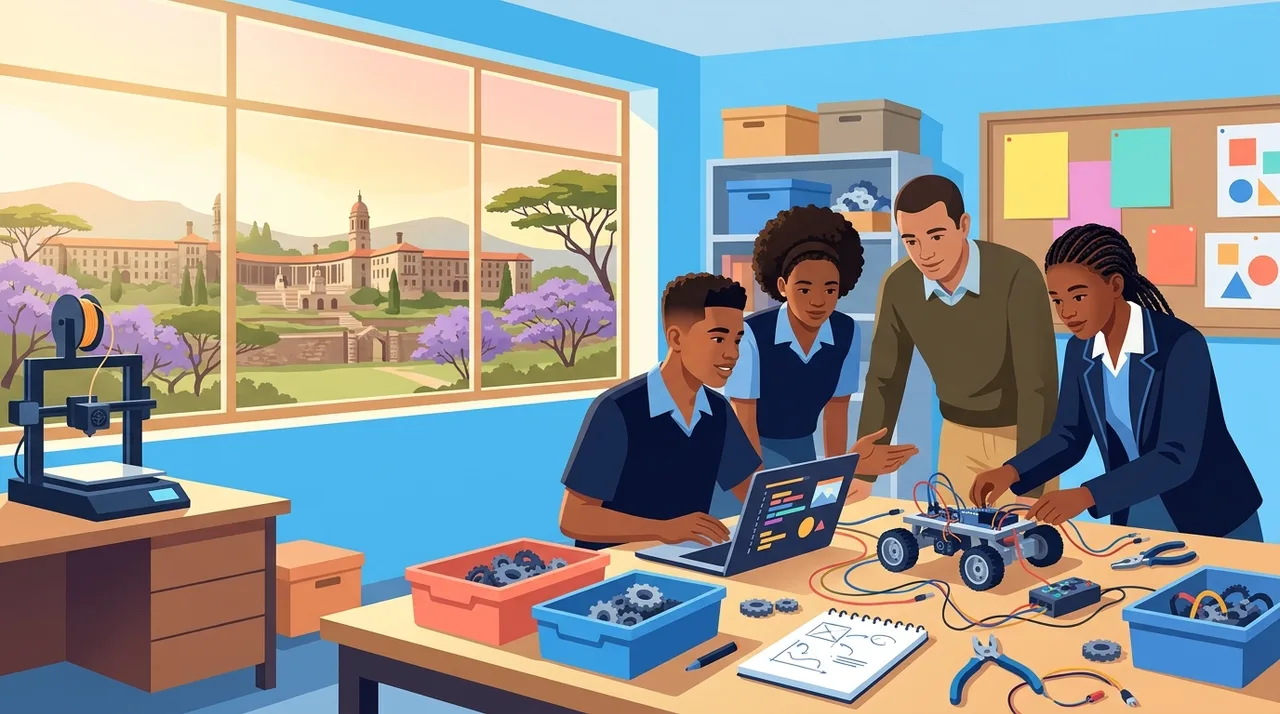
In a 20-minute panel interview, candidates who have spent years debugging serial communication, soldering microcontrollers, or tuning mechanical gearboxes speak an entirely different language from peers whose exposure is purely theoretical. They can explain a failure mode, describe how they resolved electromagnetic interference on an I2C bus, and demonstrate persistence through real diagnostic cycles. For a technical bursary committee, that demonstrated aptitude separates future dropouts from engineers who will actually graduate.
2. Faculty Discretionary and Alternative Access Lists
While the primary admission band is automated, many faculties maintain discretionary admission bands, extended curriculum programmes, or interview-driven access routes for borderline candidates or underrepresented demographics. In these committees, comprehensive portfolios matter. An applicant who can supply documented proof of technical initiative—whether through open-hardware competitions, self-directed IoT projects, or technical leadership—gives admissions deans a tangible reason to exercise discretion.
The Real Crisis: First-Year Engineering Attrition
Getting into engineering is not the hardest part; staying there is. First-year engineering across South Africa suffers from notoriously high failure and dropout rates. The shock is rarely the mathematics alone—it is the sudden demand to synthesise abstract theory into practical execution simultaneously.
A typical first-year BEng or BSc(Eng) timetable hits students with three immediate practical roadblocks:
- Introductory Programming: Usually taught at pace in C, C++, or Python. Students with no prior exposure to logic flow, syntax, arrays, or debugging often sink dozens of hours into simple syntax errors, starving their calculus and physics study time.
- Engineering Design and CAD: Visualising assemblies in three dimensions, reading orthographic projections, and translating physical constraints into software models.
- Laboratory Hardware: Working with oscilloscopes, breadboards, digital multimeters, and microcontrollers.
A learner who has engaged with real robotics enters campus already comfortable with variable types, sensor feedback, mechanical trade-offs, and iterative prototyping. They do not panic when code fails to compile or when a motor driver overheats; they methodically isolate the variable. The technical foundation built in school acts as academic shock-absorption during the highest-attrition semester of their university career.
What Kind of Robotics Actually Counts?
Not all robotics activity builds these competencies equally. If the goal is engineering preparation, the nature of the platform matters as the student matures:
- Grades 8–9: Modular, block-based robotics (such as WRO RoboMission or educational robotics platforms) is excellent for teaching core logic, algorithmic thinking, and structural mechanical design.
- Grades 10–12: To meaningfully prepare for university, learners should transition toward open-hardware microcontrollers (such as ESP32 or Arduino), breadboarding, real electronic schematics, and text-based coding in Python or C++. Designing a custom sensor circuit, managing power budgets during a load-shedding test, and troubleshooting serial code provides direct alignment with university laboratory environments.
If your high school does not offer an advanced practical club, our practical weekend and holiday programmes at the Sheen Robotics Academy are structured specifically to transition high schoolers from closed, block-based kits to industry-standard microcontrollers, circuit analysis, and text-based firmware.
The Advice for Parents and Educators
If you are guiding an aspiring engineer in high school, keep the priorities strictly in order:
- Protect the Matric Pure Mathematics and Physical Science marks first. If robotics participation causes Maths to drop from 82% to 74%, cancel the extracurricular immediately. Without the raw APS threshold, the door simply remains shut.
- Target real engineering skills, not shiny certificates. A portfolio showing a hand-soldered telemetry system that failed twice and was re-engineered is ten times more valuable in a bursary interview than a generic certificate of participation in an elementary workshop.
- Build practical literacy for the degree itself. Treat robotics not as an admissions ticket, but as an insurance policy against failing first year once accepted.
For high schools looking to build technical programmes that reflect real university and industrial requirements rather than toy assemblies, explore our school service options for teacher training, hardware provisioning, and curriculum integration.