
How to Cool Classroom Hydroponics Reservoirs Without an Expensive Chiller
High water temperatures in classroom hydroponics drop dissolved oxygen and trigger root rot. You can keep your reservoir cool during South African summers using passive insulation, shading, thermal mass, and frozen bottles instead of a R10,000 chiller.
In a South African school summer, classroom temperatures can easily climb past 30°C. Inside a hydroponic reservoir, this heat is a silent crop killer. You do not need to spend R10,000 on an industrial water chiller to keep your school's agricultural or STEM projects alive. By understanding the physics of dissolved oxygen and applying a few passive engineering hacks, you can keep your root zones cool, healthy, and productive on a budget of next to nothing.
The Double Threat: Dissolved Oxygen and Root Rot
To understand why warm water kills plants, we have to look at two closely linked factors: dissolved oxygen (DO) and the water mould Pythium, commonly known as root rot.
Water holds gases like oxygen in solution. However, the relationship between water temperature and gas solubility is inverse: as water temperature rises, its capacity to hold dissolved oxygen drops sharply. At an ideal 18°C to 20°C, water can hold enough dissolved oxygen (around 9 mg/L) to keep plant roots actively respiring and absorbing nutrients. Once reservoir temperatures climb past 24°C, DO levels plunge. At 30°C, the water holds barely enough oxygen to keep the roots alive, putting the plants under severe hypoxic stress.
This oxygen depletion triggers the second threat. Pythium is an opportunistic pathogen present in almost all soil and water environments. In a highly oxygenated, cool reservoir, plant roots are strong enough to resist it, and beneficial aerobic microbes keep it in check. But when water temperatures exceed 24°C and oxygen levels drop, Pythium spores activate. Under anaerobic conditions, they attack the stressed, suffocating root systems. Within 48 hours, healthy white roots turn into a brown, slimy, foul-smelling mush. Once root rot takes hold in a classroom system, it is incredibly difficult to cure, often requiring you to dump the crop, sterilise the system, and start over.
Why Commercial Chillers Are Not the Answer for Schools
The standard commercial solution to this problem is an active nutrient chiller. These units work like miniature air conditioners for your water, pumping the nutrient solution through a cooling loop. While highly effective, they are a poor fit for the South African classroom environment for several reasons:
- Prohibitive Cost: An entry-level chiller rated for a small 100-litre reservoir costs between R8,000 and R12,000. For most school budgets, this is equivalent to the cost of several entire hydroponic kits or an entire term's worth of consumables.
- Vulnerability to Load-Shedding: Active chillers draw significant electrical current (often 200W to 500W). During two-to-four-hour load-shedding windows, these units shut down. When the power cuts out during the hottest part of a February afternoon, the reservoir temperature spikes rapidly anyway, defeating the purpose of the expensive investment.
- Complexity and Maintenance: Chillers add extra plumbing joints, require their own feed pumps, and feature delicate cooling fins that clog with dust and salt buildup, demanding regular maintenance that busy teachers rarely have time to perform.
Four Low-Cost Passive Cooling Hacks
Instead of relying on expensive active refrigeration, you can use basic thermodynamic principles to keep your reservoir temperatures stable and cool.
1. The Frozen Bottle Rotation (The Zero-Cost Active Method)
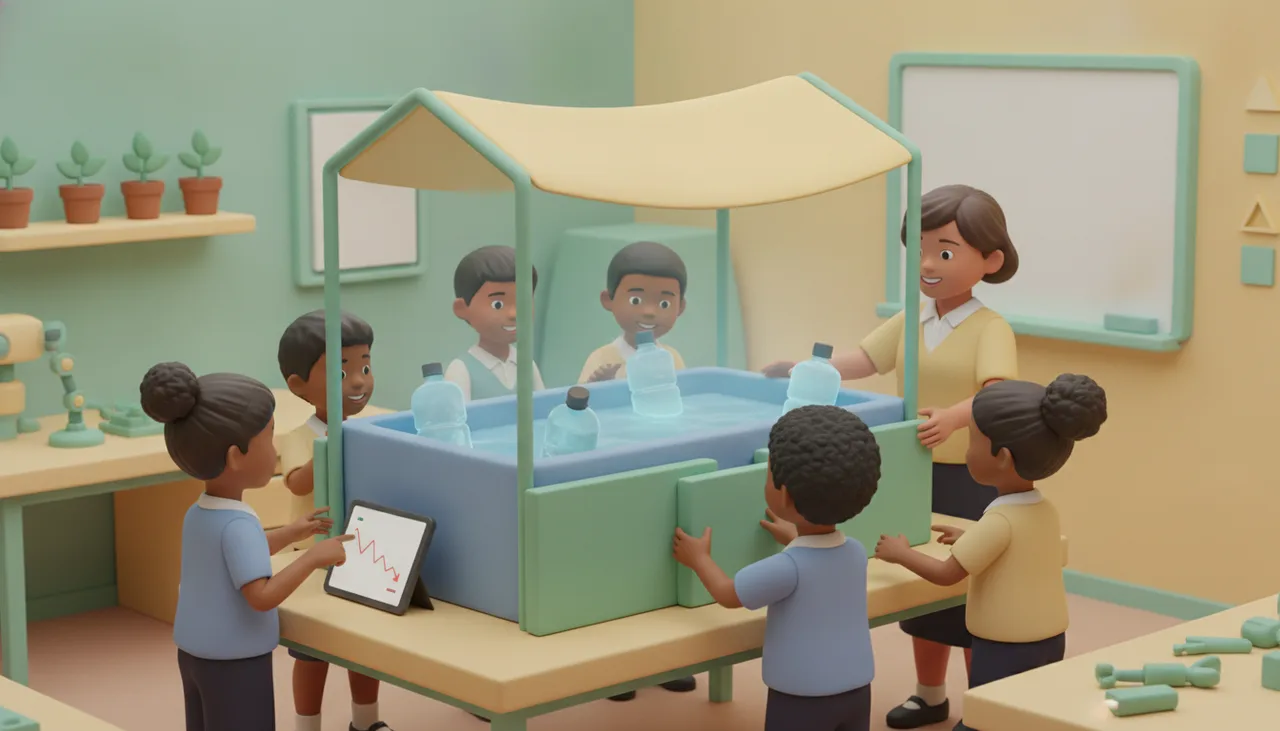
The simplest way to lower water temperature is to introduce thermal mass in the form of ice. Do not pour loose ice cubes directly into your reservoir; this dilutes your nutrient solution and alters the electrical conductivity (EC) and pH levels. Instead, fill two-litre plastic soft drink bottles with water, freeze them solid in the staffroom freezer, and float them directly in the reservoir.
A single frozen two-litre bottle dropped into a 50-litre reservoir at 08:00 can lower the water temperature by 3°C to 5°C and keep it cool through the hottest midday hours. Keep a rotating stock of four bottles in the freezer: two in the reservoir, and two freezing. Swap them out at lunchtime. This method is completely free, highly effective, and teaches students a practical lesson in latent heat of fusion.
2. Insulate the Reservoir
Most school hydroponic systems use dark-coloured plastic tubs for reservoirs. Dark plastic absorbs ambient heat and radiant energy from grow lights or sunlight. You can dramatically slow this heat transfer by insulating the reservoir container.
Wrap the entire exterior of the reservoir in reflective foil bubble wrap (often sold locally under brands like Sisalation or RadenShield). Secure it with heavy-duty duct tape. This reflects radiant heat away from the tank. For even better performance, place the reservoir inside a simple wooden box lined with 20mm polystyrene sheets. This double-layer insulation can keep your water up to 6°C cooler than the ambient room air.
3. Bury the Reservoir (Thermal Sinking)
If your school hydroponics system is located on the ground floor, in a courtyard, or in a greenhouse, you can take advantage of the earth's natural thermal mass. Soil temperatures a metre below the surface remain remarkably stable, usually hovering between 15°C and 18°C even in the heat of summer.
By digging a hole and burying your reservoir tank so that its lid is flush with the ground, you turn the surrounding earth into a massive, passive heat sink. The ground will continuously draw heat away from the nutrient solution. This is the most reliable, maintenance-free cooling method available, and it functions perfectly during power outages.
4. Increase Reservoir Volume
In thermodynamics, thermal mass dictates how quickly an object changes temperature. A small body of water heats up and cools down much faster than a large body of water. If your classroom system uses a small 20-litre reservoir, it will track the ambient room temperature almost hourly.
By upgrading to a 100-litre or 150-litre reservoir, you vastly increase the thermal inertia of the system. Even if the classroom gets hot for a few hours in the afternoon, the sheer volume of water will prevent the temperature from spiking into the danger zone before the cool of the evening arrives.
Designing Systems with Built-In Thermal Protection
When selecting or building a system for your school, thermal management should be part of the initial design, not an afterthought. Choosing light-coloured or white reservoirs reflects light rather than absorbing it. Placing reservoirs on cool concrete floors rather than elevated metal stands also helps conduct heat away from the water.
At Sheen Robotics, we design our educational farming solutions with these real-world South African constraints in mind. Our school-focused systems focus on robust, highly insulated, and high-volume configurations that protect crops against both summer heatwaves and load-shedding. You can explore our climate-resilient setups on our educational farming solutions page.
By combining simple physical insulation, smart reservoir placement, and the simple frozen-bottle trick, you can keep your classroom hydroponic roots white, healthy, and oxygenated all summer long, without spending a cent of your department's budget on active chillers.