Computational thinking vs coding: Which one actually matters in the AI era?
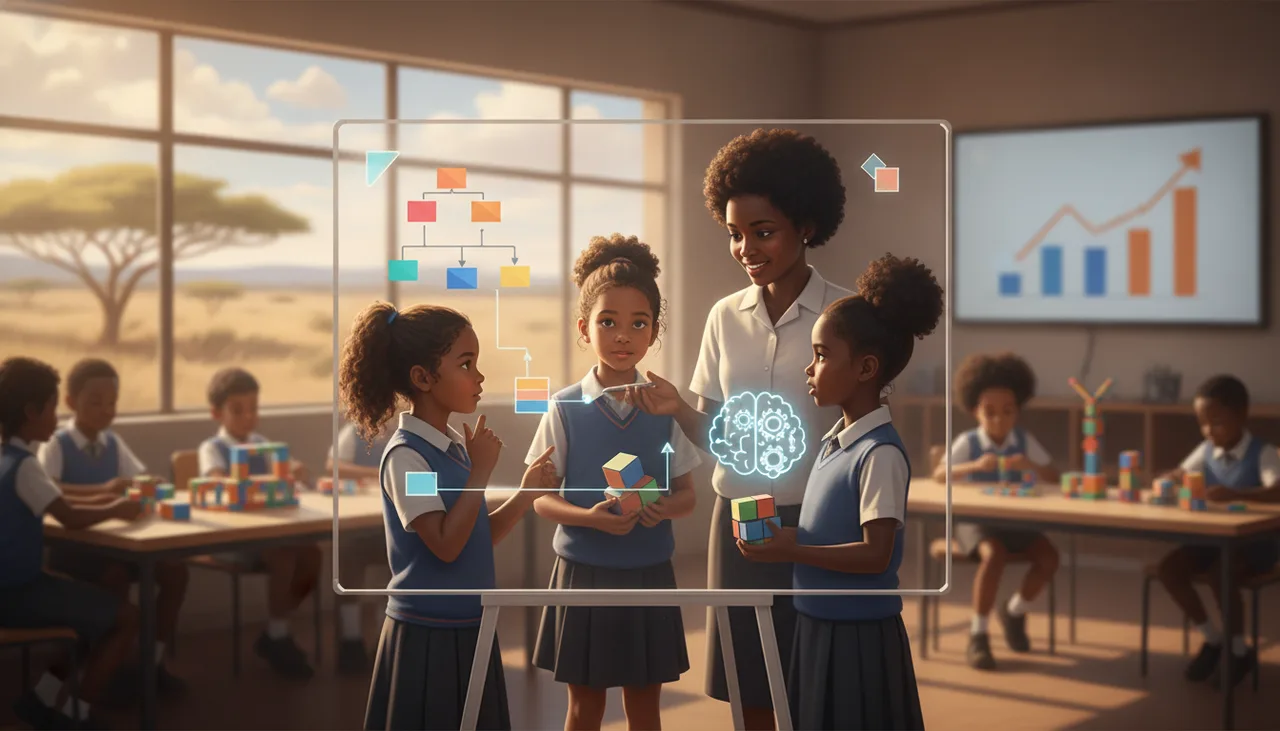
While schools scramble to teach coding syntax, generative AI is making raw coding obsolete. The real value lies in computational thinking—the logical system design that AI cannot replicate.
Computational thinking is the cognitive process of designing solutions; coding is the mechanical task of translating those solutions into a language a computer understands. For years, ICT education treated them as the same thing. But the rise of generative artificial intelligence has split them wide open.
Today, memorising programming syntax is a rapidly depreciating asset. AI can write clean Python, C++, or Scratch code in milliseconds. What AI cannot do is understand a human problem, break it down into logical steps, and decide what needs to be built in the first place. That is computational thinking, and it is the only part of the 'coding and robotics' equation that still guarantees long-term value for South African learners.
The Difference, Without the Jargon
To understand the distinction, consider a practical South African classroom challenge: managing a school's computer lab during Stage 4 load-shedding. The goal is to ensure that 40 learners can save their work and shut down their machines safely before the inverter batteries run flat.
Solving this problem requires computational thinking. You must:
- Decompose the problem: Break the challenge down. How much power do the computers draw? How long do the batteries last? How long does a safe shutdown take?
- Recognise patterns: Notice that younger learners take five minutes to save and log out, while older learners take two.
- Abstract the details: Ignore the brand of the computers or the colour of the desks; focus only on power consumption and time constraints.
- Design an algorithm: Create a step-by-step rule: 'If battery capacity drops to 20%, trigger a visual warning. If it drops to 10%, initiate automatic cloud backup and shut down the terminal.'
Once this logical framework is built, you have solved the problem. Coding is merely the final, clerical step of writing that algorithm in Python or block-based code so the computer lab's management software can execute it. Computational thinking is the architecture; coding is the bricklaying.
Why AI Has Inverted the Value of Both
For the past decade, the global educational narrative has been 'everyone must learn to code.' Bootcamps and schools focused heavily on syntax: memorising where to put semicolons, how to declare variables, and how to write loops. This was always a fragile strategy, but generative AI has made it obsolete.
If you ask a modern Large Language Model (LLM) to write a Python script that monitors battery levels and shuts down a system, it will generate flawless code instantly, for free. The skill of translating a clear instruction into syntax has been automated. Consequently, the economic value of a 'pure coder'—someone who can only translate instructions into code—is collapsing.
Conversely, the value of the person who can formulate the instructions has skyrocketed. To get a useful result from an AI, a developer must precisely define the system's inputs, outputs, constraints, and edge cases. They must think computationally. If you cannot decompose a problem yourself, you cannot prompt an AI to solve it for you.
"Teaching children syntax-first coding in the age of AI is like teaching them long division tables while ignoring what arithmetic is actually for. We are preparing them for a world that no longer exists."
The Reality in South African Classrooms
This distinction is not just academic; it has massive implications for how we implement the Department of Basic Education's CAPS Coding and Robotics curriculum. Many South African schools face severe resource constraints: limited budgets, shared laptop trolleys, unstable internet, and unpredictable electricity.
If a school defines its robotics programme by 'time spent typing code on a screen,' it will struggle. When the power goes off or the Wi-Fi fails, the lesson stops. Furthermore, buying a laptop for every single learner is financially impossible for the vast majority of our schools.
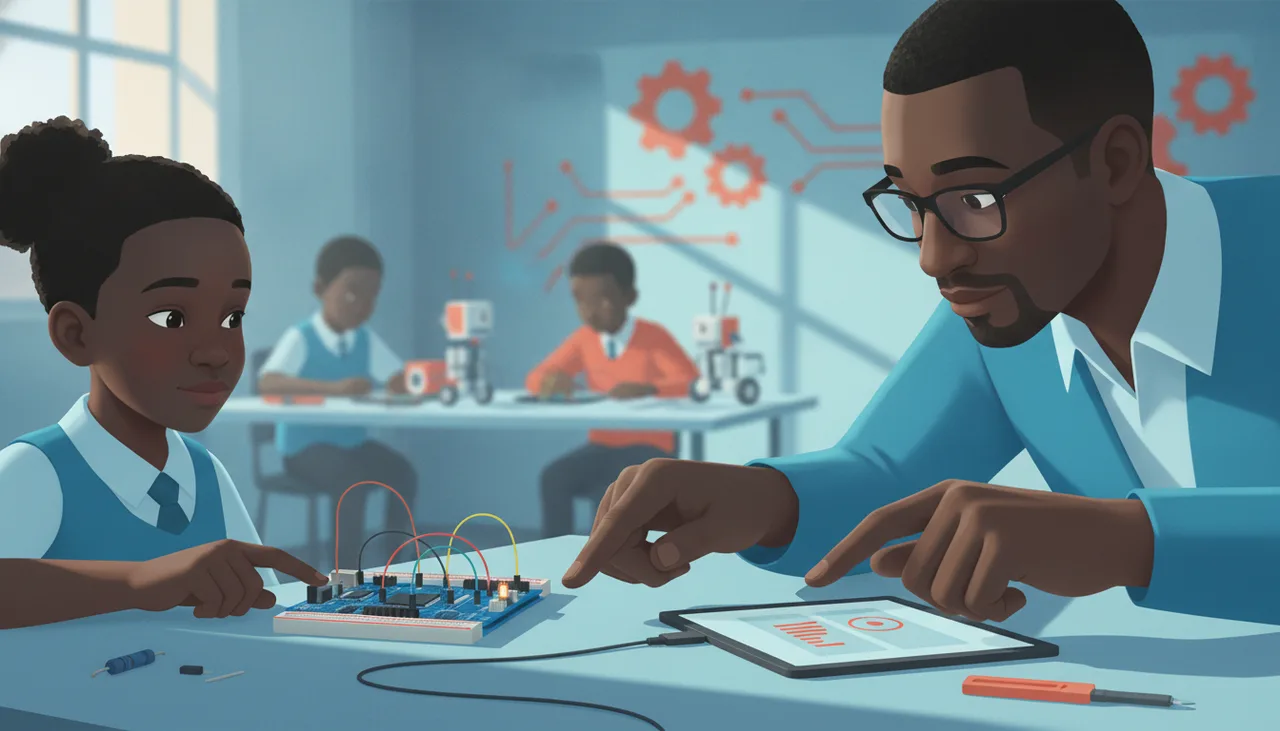
But when you focus on computational thinking, the constraints become manageable. Computational thinking can be taught 'unplugged.' Learners can design algorithms using physical cards, map out logic gates on a chalkboard, or debug physical systems manually. By the time they actually sit down at a computer, they are not wasting precious screen time wrestling with where a colon goes; they are using the computer to execute a solution they have already engineered.
How to Teach What Actually Matters
To prepare learners for the future, schools and parents must shift their focus from syntax-heavy tutorials to system-level thinking. Here is how to make that transition:
| Traditional 'Learn to Code' Focus | Future-Proof 'Computational Thinking' Focus |
|---|---|
| Memorising Python commands and syntax rules. | Understanding logic gates, loops, and conditional statements conceptually. |
| Building generic, copy-paste projects (like a basic calculator). | Decomposing real-world local problems (like water conservation or load-shedding mitigation). |
| Screen-only block-coding exercises with no physical context. | Using physical inputs (sensors) and outputs (motors) to see how logic interacts with the real world. |
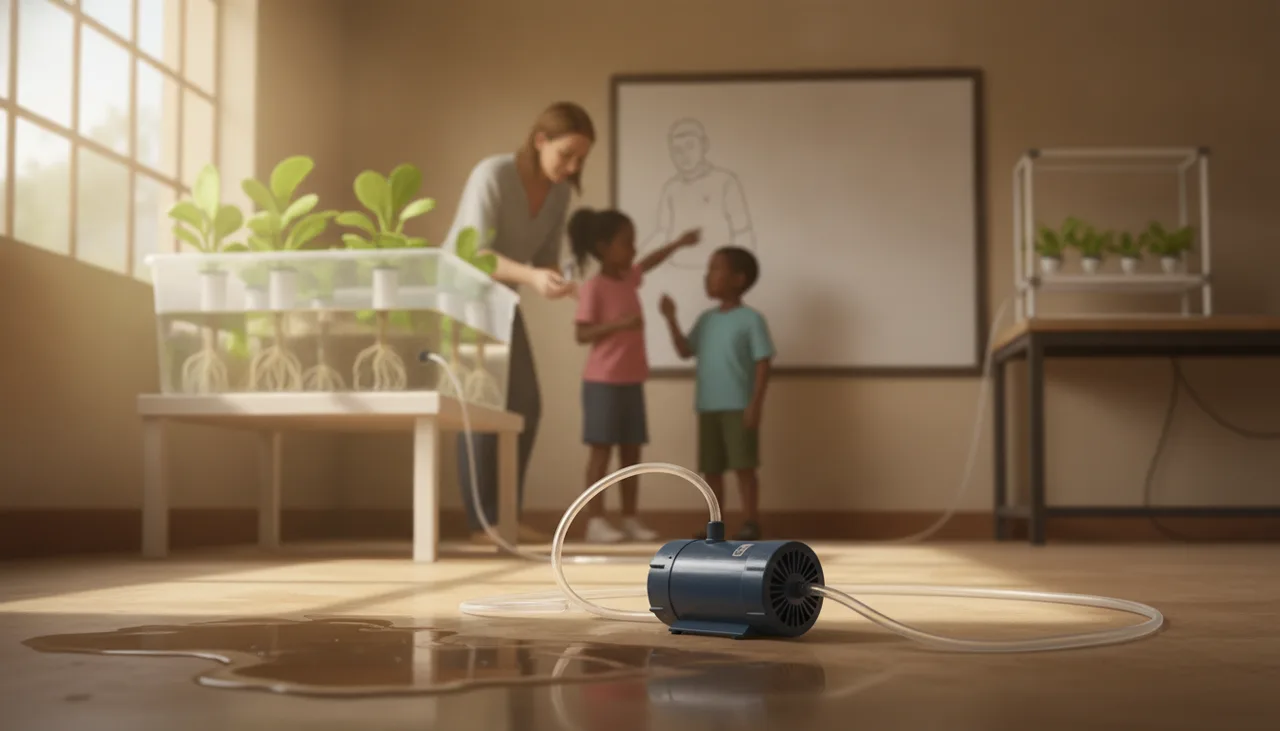
At Sheen Robotics, we designed our Sheen Academy curriculum specifically around this philosophy. We do not train learners to be syntax compilers. Instead, we use physical computing and IoT hardware to teach the underlying logic of systems. When a learner understands how to structure a feedback loop using a soil moisture sensor and a water pump, the specific programming language they use to write it becomes a secondary detail—one they can easily look up or generate with AI.
If we want South African youth to be creators of technology rather than mere consumers of imported software, we must stop teaching them to mimic machines. Machines are already excellent at being machines. Our job is to teach learners how to think.