3D printing in schools: buy, outsource, or partner?
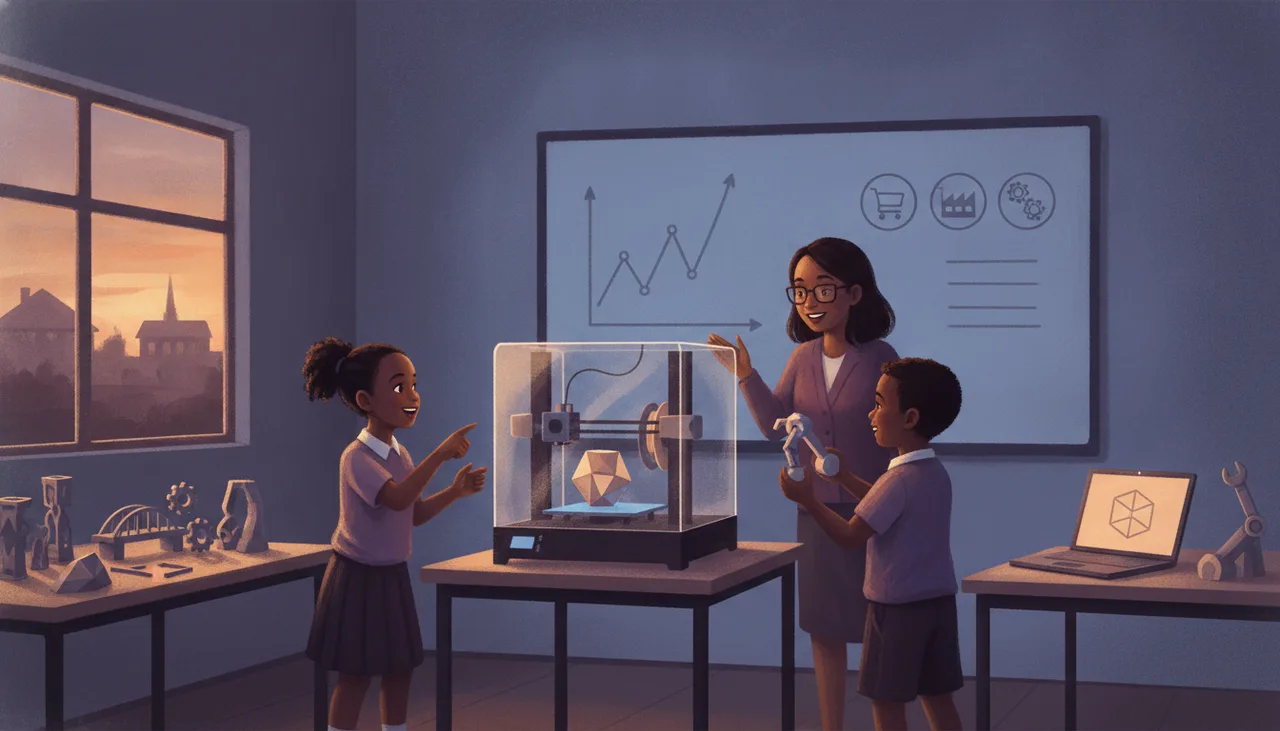
The right choice depends on how much you actually print: occasional volume favours outsourcing, steady weekly use justifies owning a machine, and project spikes suit a maker-partner.
The honest answer is that it depends on three things: how much you print, who will actually run the machine, and how predictable that demand is. A school that prints a handful of parts a term is usually better off outsourcing. One that prints most weeks for a design or robotics course can justify owning a printer. And a school with occasional big project spikes often does best with a maker-partner. This guide walks the three options and the real costs behind each, so you can match the model to your volume rather than to the machine that looks exciting in the catalogue.
Start with print volume, not the printer
The single most useful question is how often parts will actually leave the print bed, and on what schedule. Most schools fall into one of three patterns. Occasional demand means a few parts a term, often one-off enclosures or a competition bracket. Steady demand means small parts most weeks, usually tied to a course that runs all year. Spiky demand means long quiet stretches followed by a burst, typically before a showcase, science expo, or robotics competition. Each pattern points to a different answer, so it is worth being honest about which one you have before you compare hardware.
What owning a printer really costs
The purchase price is the part everyone sees and the smallest part of the true cost. Owning a machine means committing to a running budget and a person. The recurring lines that catch schools out are:
- Filament. A steady consumable, and the cheaper spools are false economy when they jam or warp.
- Consumables and wear parts. Nozzles, build plates, belts, and the occasional hot-end. Budget roughly 10 to 15 percent of the printer cost per year for spares if the machine is used regularly.
- Failed prints. Every failure wastes filament and lesson time. A power dip mid-print, common with load shedding, ruins a part that has been building for hours, so plan prints around the schedule or fit a small UPS.
- Supervision. Someone has to slice files, level beds, clear jams, and keep young hands away from a hot nozzle. This staff time is the real cost, and it does not appear on any invoice.
- Space and ventilation. A ventilated corner, away from foot traffic, matters more than most buyers expect.
None of this is a reason to avoid owning a printer. It is a reason to only buy one when your volume and your staffing can absorb it. If no teacher will realistically own the workflow, the machine becomes an expensive shelf ornament within a term.
When outsourcing per-part makes sense
Outsourcing means paying a print service per part and skipping ownership entirely. It suits low or unpredictable volume, because you pay only for what you use and carry no maintenance burden. The finish is usually cleaner than a first-year in-house setup, and there is no supervision overhead. The tradeoffs are turnaround and distance from the process. A part that would take an afternoon in-house can take days by the time it is queued, printed, and returned, which breaks the tight print-test-reprint loop that makes design lessons click. Students also do not see the machine work. For one-off enclosures, competition parts, and prototypes where finish matters more than speed, outsourcing is often the sensible default, and it is a good way to prove there is real demand before committing to hardware. Getting the sourcing decision right later is easier once you have a term of real print requests to size against, and a little help with lab sourcing avoids buying more machine than the timetable needs.
The maker-partner middle path
Between owning everything and outsourcing everything sits a partner who carries the parts you are not ready to own. That can mean a managed printing service that turns your files around quickly, or hands-on support to specify, set up, and maintain a machine on site so your staff are not learning slicer settings alone. At sheen we run a prototyping and printing service for exactly the spiky and one-off jobs, and a broader school service for setup and ongoing support. This middle path is also where 3D printing meets the rest of a robotics programme, since printed mounts and enclosures pair naturally with the sheenbot infinity board when a project needs a custom bracket rather than an off-the-shelf one. Use a partner to bridge the gap while demand grows, or to absorb the burst before a competition without buying a machine that then sits idle.
A quick decision guide by volume
Run your situation through this short list and the answer usually falls out:
- You print a few parts a term and finish matters more than speed. Outsource per-part.
- You print most weeks for a design or robotics course, and a named teacher will own the machine. Buy, and budget for consumables and supervision from day one.
- Your demand is spiky, quiet then a rush before a showcase or competition. Partner for the machine and support, or outsource the spike.
- No staff member will realistically maintain a printer. Do not buy. Outsource or partner instead.
- Same-lesson iteration is the point, print, test, and reprint the same day. Owning wins, because outsourcing turnaround will frustrate the class.
Takeaway
Match the model to your volume and your staffing, not to the machine on the stand. A sensible path for most schools is to start by outsourcing to prove the demand is real, graduate to owning once print requests are weekly and someone owns the workflow, and lean on a partner to bridge the gap or to swallow the occasional spike. The printer is the easy part to buy and the hard part to run, so decide who runs it before you decide what to buy.
Common questions
How many printers does one class need?
Usually one reliable machine, with prints staggered across the week, serves a class well. Buying several cheap printers you cannot keep running is worse than owning one you maintain properly. Reliability beats quantity.
Is a printer worth it if we only run robotics, not design?
Sometimes. You can print robot mounts, wheels, and enclosures, but if those parts are occasional it is often better to outsource them and keep lesson time on the robotics itself. Let the printing serve the learning, not the other way round.
What about filament safety in a classroom?
Ventilate the space, favour PLA over ABS for school use, supervise while the machine runs, and keep the hot nozzle away from younger learners. Treat it like any other workshop tool with a heat source.