What hydroponics teaches beyond biology: data literacy in a tank
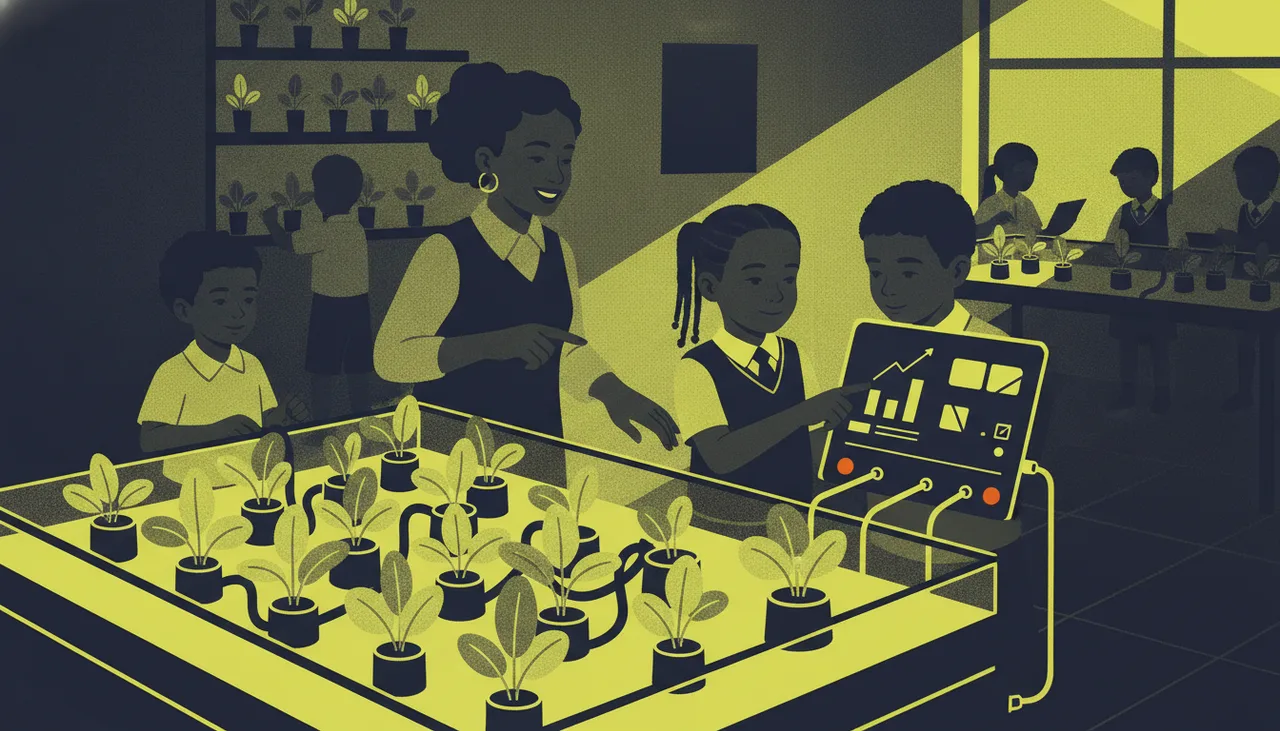
Growing plants in water turns a classroom into a live control system: learners read sensors, set thresholds and debug, practising the measure-chart-decide loop behind data literacy.
Grow a lettuce in water instead of soil and you have more than a biology project. You have a small control system a child has to keep alive. A hydroponic tank feeds back a stream of numbers every day: how acidic the water is, how strong the nutrients are, how warm it has become. Learning to read those numbers, notice when they drift, and act before the plant suffers is data literacy in its most concrete form. The measure-chart-decide loop behind a tank is the same loop behind every automated system a student will meet later.
The measure, chart, decide loop
The teaching value is not the plant. It is the loop the plant forces. A sensor takes a reading, the reading joins a chart, the chart shows a trend, and the trend prompts a decision. One number on its own means little. A week of pH readings plotted as a line tells a story: steady, climbing, or swinging every time the pump runs.
To get the line rather than the snapshot, the readings have to be logged over days, not glanced at once. A board such as the sheenbot∞ can read a pH or temperature sensor on a schedule and store the values, so learners come back to a graph instead of a single dip on a meter. Once they can see the shape of the data, the science stops being abstract.
Thresholds turn readings into decisions
A reading only becomes useful when the class agrees what counts as too high or too low. Set a pH band. Decide the water temperature at which summer heat becomes a problem. Pick the nutrient strength that means top up, or dilute. The moment a value crosses one of those lines, something has to happen.
That is conditional logic before anyone writes a program: if pH > 6.5 then add corrector. Learners who set thresholds for a tank are rehearsing exactly the reasoning that later drives a thermostat, an irrigation timer, or an alarm. The tank just makes the consequences visible, and slow enough to catch.
Debugging a living system
Plants fail in ways that punish guessing. When a leaf yellows, the cause might be pH, nutrients, root rot, a tank warming through a Cape Town December, or a pump that quietly stopped. There is rarely one obvious culprit, so learners have to isolate variables: check one thing, change one thing, wait, and see.
This is the same discipline as debugging code. Keep a log of what you changed and when. Do not change three settings at once, or you will never know which one worked. A hydroponic system teaches patience with feedback loops in a way that a program with an instant error message never quite does.
A starter checklist for a classroom tank
- Pick a fast crop such as lettuce or basil, so results show inside one school term.
- Measure the same things at the same time each day, so the data is comparable.
- Log readings rather than glancing at them, so learners get a graph, not a memory.
- Agree thresholds before you start, and write down what too high and too low mean.
- Change one variable at a time when something goes wrong, and note the result.
- Keep a shared notebook so the next group inherits what this one already learned.
Where it fits
None of this needs a robot, but it sits naturally alongside one. The sensing, logging and threshold logic are the same skills a coding and robotics class already builds, which is why a tank makes such a good crossover project. To see the loop in action with a group, a holiday workshop over the summer break is an easy place to start, or you can book a single trial class and watch how fast children move from reading a sensor to arguing about what the graph means. The biology is the hook. The systems thinking is what stays.