Starting an FTC team with zero engineering background
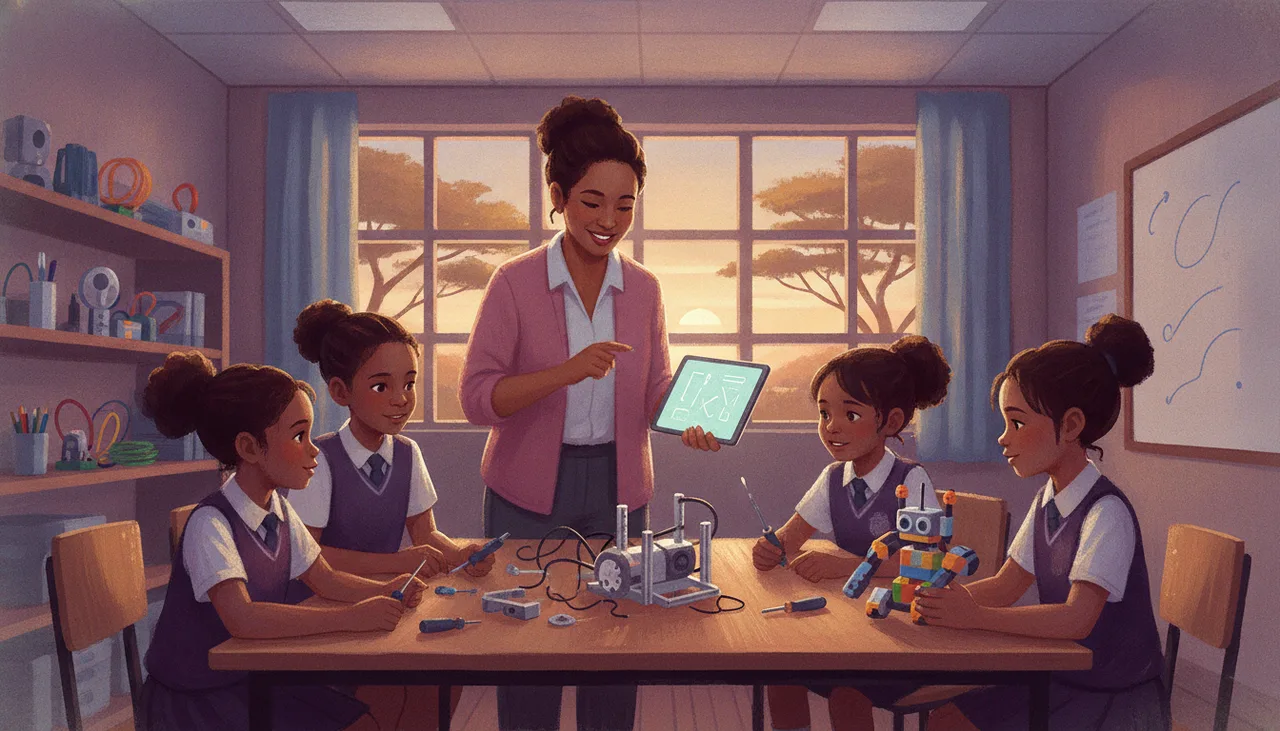
You do not need an engineering degree to coach a FIRST Tech Challenge team. The rookie's real job is facilitation and logistics, not robot design.
TL;DR
- You do not need an engineering degree to coach a FIRST Tech Challenge team. Your job is to organise people, protect deadlines and keep students unblocked, not to design the robot yourself.
- Rookie teams rarely lose because the robot is bad. They lose on logistics: a missing engineering notebook, no driver practice, a late registration, a part that never got ordered.
- The real minimum toolset is smaller than the catalogue makes it look. One competition kit, a laptop, a set of hand tools and a solid table will get you to your first event.
- Recruit one technical mentor if you can, but do not wait for one. Start with what you have and let a mentor join a team that is already moving.
- Plan the whole season backwards from your first competition date, then work forwards from today.
What the coach role actually is
The single most useful thing to understand before you start is that a FIRST Tech Challenge coach is a facilitator, not a chief engineer. The students design, build and program the robot. You create the conditions in which that can happen: a room, a schedule, a budget, transport, permission slips and a calm adult presence when a subsystem fails the night before an event.
This is good news if you come from teaching, administration, parenting or any organised profession. Those are exactly the skills that carry a rookie team. A former mechanic with no patience for teenagers will struggle more than a history teacher who runs a tight meeting. The engineering can be learned alongside the students, and it is better when you learn it with them rather than hand them answers.
Set the expectation early, with yourself and with parents, that you are the coach and not the builder. The moment an adult takes the screwdriver, the students stop owning the machine. Ownership is the whole point of the programme, and it is also what the judges reward.
Map the season backwards
The FIRST Tech Challenge game is revealed at a kickoff each September, and the season then runs across the school year toward qualifying tournaments and, for teams that advance, a championship. In South Africa that global calendar sits awkwardly on top of our January-to-December school year and our winter holidays, so a rookie coach has to plan deliberately rather than assume the season will carry them along.
Start from one fixed point: the date of your first competition. Everything else is scheduled backwards from there.
- Before kickoff: register the team, secure a meeting space, confirm a weekly time, and get students comfortable with basic building and coding. This is the quiet window rookies waste.
- Kickoff to first build: read the game manual together, watch the field reveal, and resist the urge to design a winning robot in week one. Build a simple drivable base first.
- Mid-season: iterate on one or two scoring mechanisms, keep the engineering notebook current every single meeting, and start driver practice long before you think you need it.
- Two to three weeks out: stop adding features. Reliability beats ambition at a rookie's first event. Practise the full match cycle, including setup and the autonomous period.
- Competition: pack spares, chargers, tools and the notebook. Assume something will break and that you will fix it in the pit.
Winter school holidays and load shedding will both eat into your build weeks, so budget slack. A team that meets for two focused hours a week, without fail, will beat a team that meets erratically for four.
The minimum viable toolset
Catalogues are designed to make you feel underequipped. You are not. To reach your first competition you need far less than the full parts list implies. The competition kit itself is the large expense and is largely non-negotiable, but almost everything around it can start small and grow.
A realistic starting set is one control and structure kit, a laptop that can run the programming environment, a basic set of metric hand tools, a battery charger, and a stable table. Add safety glasses because events require them. Beyond that, buy for the problem in front of you, not the problem you imagine.
One budgeting habit saves rookies real pain: set aside roughly 10 to 15 percent of your kit spend for spares and consumables. Servos strip, screws vanish, and a snapped part on the Friday before an event is a crisis only if you have no replacement. Treat spares as part of the kit, not an afterthought.
If you want to reduce hardware pressure in the early weeks, students can develop programming logic on screen before it ever touches a robot. A simulator lets a team debug the thinking without waiting for a shared physical build, which matters when you have one kit and eight eager hands.
Where rookie teams actually lose
Here is the uncomfortable truth every experienced coach learns: the robot is seldom what sinks a first-year team. The losses come from things unrelated to engineering talent.
| Common rookie instinct | What experienced teams do | Why it matters |
|---|---|---|
| Pour all time into the robot's hardware | Keep the engineering notebook current at every meeting | Judged awards, which decide advancement, reward documented process as much as performance |
| Start driver practice the week of the event | Practise driving for weeks, with a named backup driver | A reliable driver on an average robot beats a shaky driver on a great one |
| Design an ambitious multi-mechanism robot | Build one thing that scores reliably, then add | Rookies win with machines that finish matches, not machines that impress on paper |
| Treat admin as the coach's private chore | Give students real roles: safety, notebook, outreach, logistics | FIRST is a whole-team programme; the non-robot roles are graded and build ownership |
| Register and order parts "soon" | Lock registration and shipping timelines early | Missed deadlines and slow imports end more rookie seasons than broken gears |
Read that table again before your first meeting. Almost none of it requires you to understand a PID loop. It requires you to run a project. That is the reassuring part of coaching with zero engineering background: your existing skills map directly onto the things that decide the season.
Recruiting mentors without an engineering network
You will eventually want a technical mentor, someone who can answer a wiring question or sanity-check a gearbox. Do not treat this as a prerequisite. Waiting for the perfect mentor is a classic way to never start.
When you do look, cast wider than you think. Parents in trades, university engineering students who miss building things, a retired technician, an amateur radio or maker hobbyist, a local company's graduate engineers looking for community work. Ask for a defined, small commitment first: two evenings a month, or help with one subsystem. People say yes to specific, bounded requests far more often than to open-ended ones.
A mentor's job mirrors yours: guide, do not build. Brief them the same way you brief yourself. Their value is in asking the students good questions, not in handing over a finished mechanism. A mentor who takes over is worse than no mentor at all, because the team learns to wait for rescue.
Building the foundation before kickoff
The teams that cope best in their first season usually arrive with students who already know how to build and code a little. You can close that gap in the quiet months before a season starts, and this is the one place a structured programme earns its keep. Our coding and robotics academy in Cape Town runs term classes and holiday sessions that give beginners the loop of design, build, program and debug in a lower-stakes setting than a competition. The holiday workshops are a compact way to turn a group of interested learners into a group that can actually wire a motor and read a program.
For hands-on practice between formal sessions, a classroom board like the sheenbot infinity lets students rehearse sensors, motors and logic without tying up your one competition kit, and the block and code simulator lets them test programming ideas on any laptop. When you are ready to go deeper, our FIRST Tech Challenge support is built for exactly the coach this article is written for: someone capable and organised who has simply never done this before. Even if you never use any of it, the point stands: a season goes better when the fundamentals are in place before kickoff.
Takeaway
Starting an FTC team with no engineering background is not only possible, it is common, and the coaches who succeed almost never win on technical depth. They win on facilitation, documentation, driver practice and deadlines held. Register early, plan the season backwards, keep the notebook alive, build one reliable thing first, and let the students own the machine. Bring in a mentor when you find one, but start without waiting. The robot is the easy part; running the team well is the real work, and it is work you already know how to do.
FAQ
Do I really need to understand programming or mechanics to coach?
No. You need enough curiosity to learn alongside your students and enough discipline to run meetings and deadlines. The most common coaching mistake is doing too much of the technical work yourself, not too little. Aim to understand the robot well enough to ask good questions, and leave the answers to the team.
How many students make a workable rookie team?
A small team of around eight to twelve students is easier to run than a large one in year one. You want enough hands to cover building, programming, the notebook, driving and outreach, but few enough that everyone has a real job. Empty roles breed idle students; overcrowded roles breed spectators.
What is the engineering notebook and why does everyone stress about it?
It is the team's running record of decisions, designs, tests and reflections across the season. Judged awards lean heavily on it, and those awards influence which teams advance. It is also the single easiest thing for a rookie team to neglect, which is exactly why keeping it current every meeting gives you an edge.
How do we handle a limited budget and one shared kit?
Prioritise the competition kit and a spares allowance, borrow or improvise tools, and use on-screen simulation so students can make progress on the programming while the physical robot is occupied. Split the team so no one is idle: while two students build, others document, plan outreach or practise driving on the previous build.
When should we start driver practice?
Far earlier than feels natural. As soon as you have a drivable base, someone should be practising, and you should name a backup driver in case your first choice is unavailable on event day. Teams that treat driving as a learned skill consistently outperform teams with flashier robots.