
Smart farming as a school subject: why agritech belongs in STEM
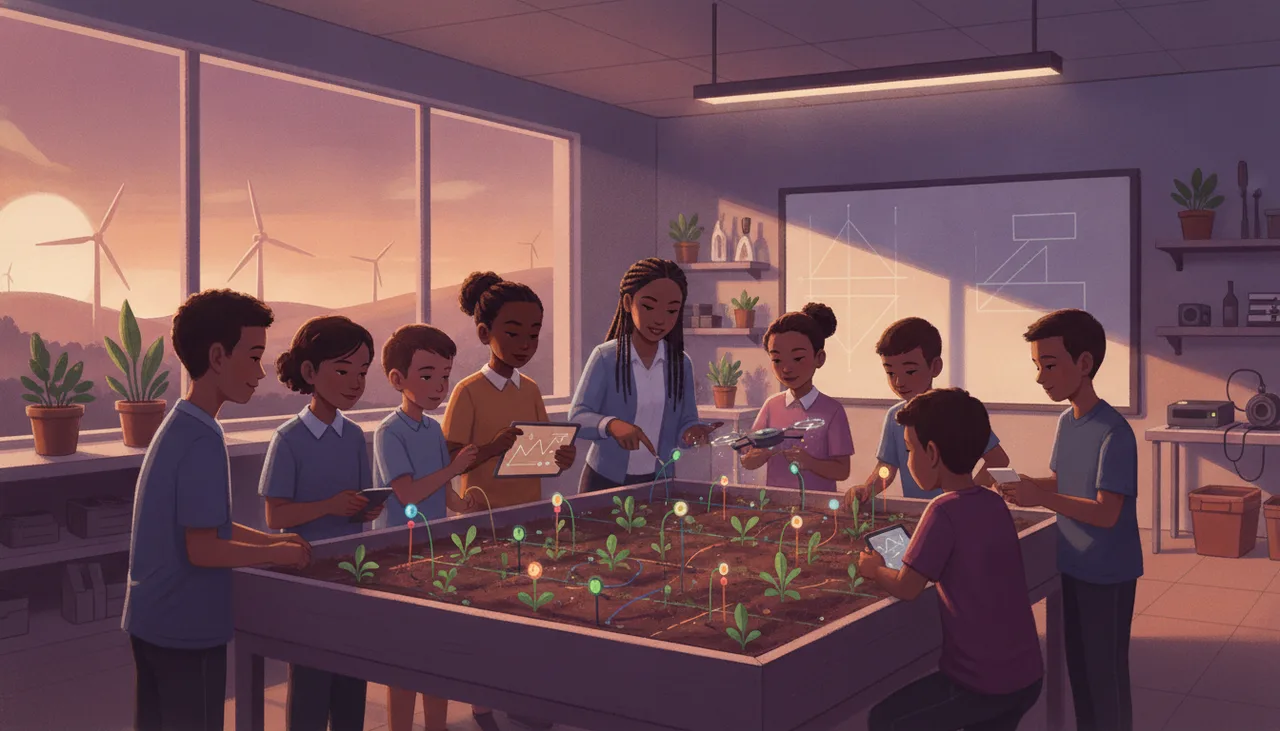
Agritech ties food security, real jobs and hands-on sensor data into one motivating context. Here is why smart farming makes such a strong STEM subject, and how to start.
Agritech belongs in STEM because it ties together three things learners already care about: food on the table, future jobs, and the sensors and data that make modern farming work. A soil-moisture reading is abstract on a worksheet. Attached to a real plant that a class is trying to keep alive, the same number becomes a reason to learn about voltage, thresholds and code.
Smart farming means using sensors, small controllers and simple automation to grow food more efficiently. It is one of the most grounded contexts a South African school can teach in. The goal is not to turn every child into a farmer. It is to use a problem everyone understands as a way to teach measurement, logic and data handling.
Why agritech is a natural fit for STEM
Food security is a live issue here, and learners feel it at home. That relevance is exactly what a good STEM context needs. Abstract coding exercises lose a class quickly; a wilting tomato plant does not. When the outcome matters to the learner, the underlying maths and code stop feeling like a chore.
Agritech is also honestly cross-curricular. A single watering project touches life sciences (plants and water), geography (climate and soil), maths (averages and thresholds) and technology (circuits and control). Teachers who worry about carving out separate coding time can fold a lot of it into subjects they already teach. And the jobs are real: precision farming, food processing and agricultural logistics all now expect people who can read a sensor and act on the data.
What learners actually measure and build
Strip away the buzzwords and smart farming comes down to a loop: measure something, compare it to a target, then do one thing about it. Learners wire up a sensor, read a value, set a threshold in code, and trigger an output when the value crosses the line.
The usual measurements are soil moisture, air temperature, humidity and light. These feed into a controller such as the sheenbot∞ board, which reads the sensor and runs the logic. The output might be a light that says water me, a small pump that switches on, or a simple log of readings the class can graph the next day. That measure-compare-act pattern is the same one used in far larger commercial systems, which makes it a genuine introduction rather than a toy.
Starter projects that work in a classroom
Start small and let the difficulty climb across a term. Each of these fits a normal 40-minute lesson once the kit is set up, and a class set of ten kits is enough to run in pairs.
- Thirsty-plant indicator. A soil-moisture sensor lights an LED when a pot drops below a set level. This is the whole loop in its simplest form.
- Greenhouse thermometer. Log temperature every few minutes across a school day, then graph it. Learners see how much a sunny windowsill swings.
- Light comparison. Put identical seedlings on two windowsills, measure light on each, and predict which grows faster. Data settles the argument.
- Automatic watering rig. Add a small pump so the plant waters itself when the soil is dry. This introduces safe control of an output.
- Class weather board. Combine temperature, humidity and light into one display the class checks each morning.
Keep power in mind. With load shedding still part of the school day, projects that run on a battery pack and log locally are more reliable than anything that assumes constant mains power. Low-power, offline-first design is a good habit to teach anyway.
Partnering with local growers
The projects get far stronger when there is a real grower on the other end. A community garden, a nearby small farm, or a school feeding-scheme plot gives learners real conditions, real questions and a real audience. Instead of watering a pot for its own sake, the class is answering a question someone actually has: which bed dries out fastest, or does the shade cloth help.
These partnerships do not need to be formal. A single visit, a shared spreadsheet of readings, or a grower who comes to see the final projects is enough to change the tone from exercise to contribution. It also quietly shows learners a career path they may not have pictured.
Fitting it into the school year
You do not have to commit curriculum time on day one. A lunchtime or after-school club is the low-risk way to test whether agritech lands with your learners before it goes near a CAPS scheme of work. If it works in the club, the strongest activities graduate into class time.
The winter holidays are a good on-ramp too. Our holiday workshops let learners try sensor-and-code projects in a short block without a term-long commitment, and a trial session is an easy way for a curious family to see whether it fits their child. For teachers wanting to build this into a programme, the academy can help shape the projects, and the boards and add-on sensors are on the store.
Where to start
Agritech earns its place in STEM because it is concrete, cross-curricular and locally urgent. You do not need a greenhouse or a big budget to begin. Pick one plant, one sensor and one threshold, run the thirsty-plant indicator with a small group, and let the questions the learners ask pull in the maths and code. From there the projects, and the partnerships, grow on their own. For more classroom-ready ideas, keep an eye on our newsroom.