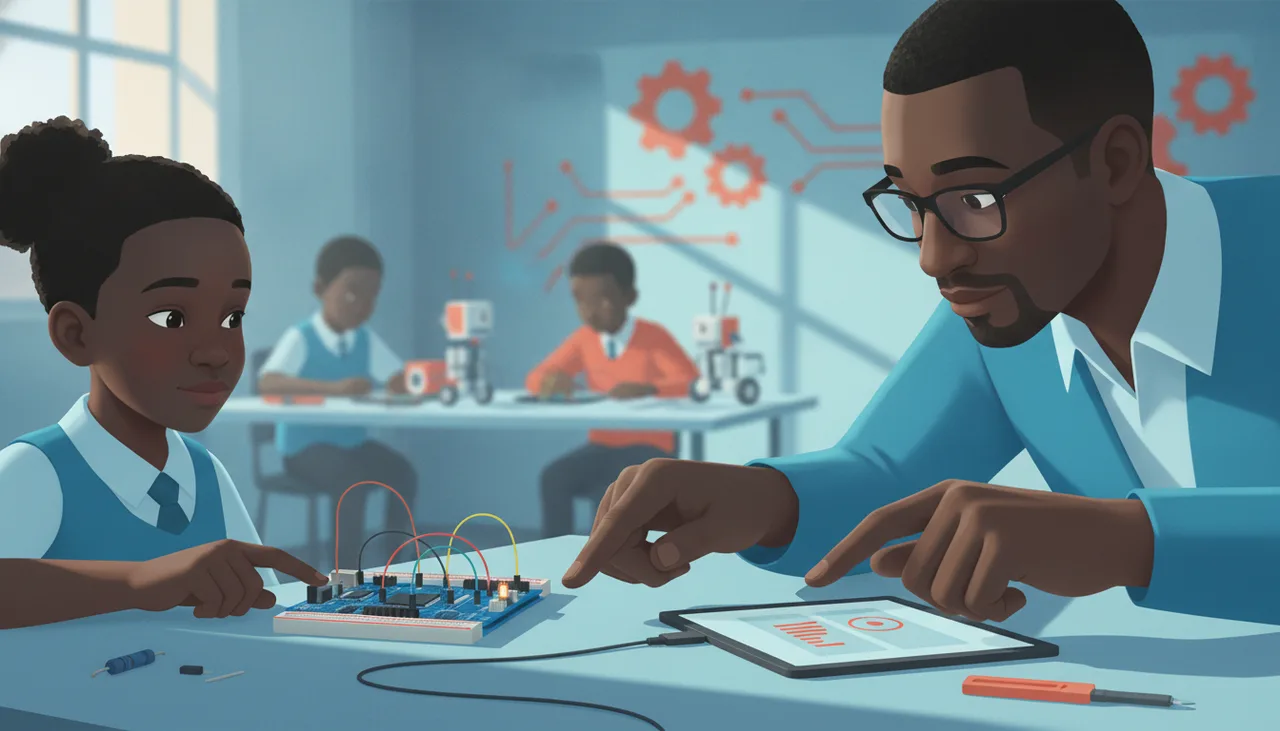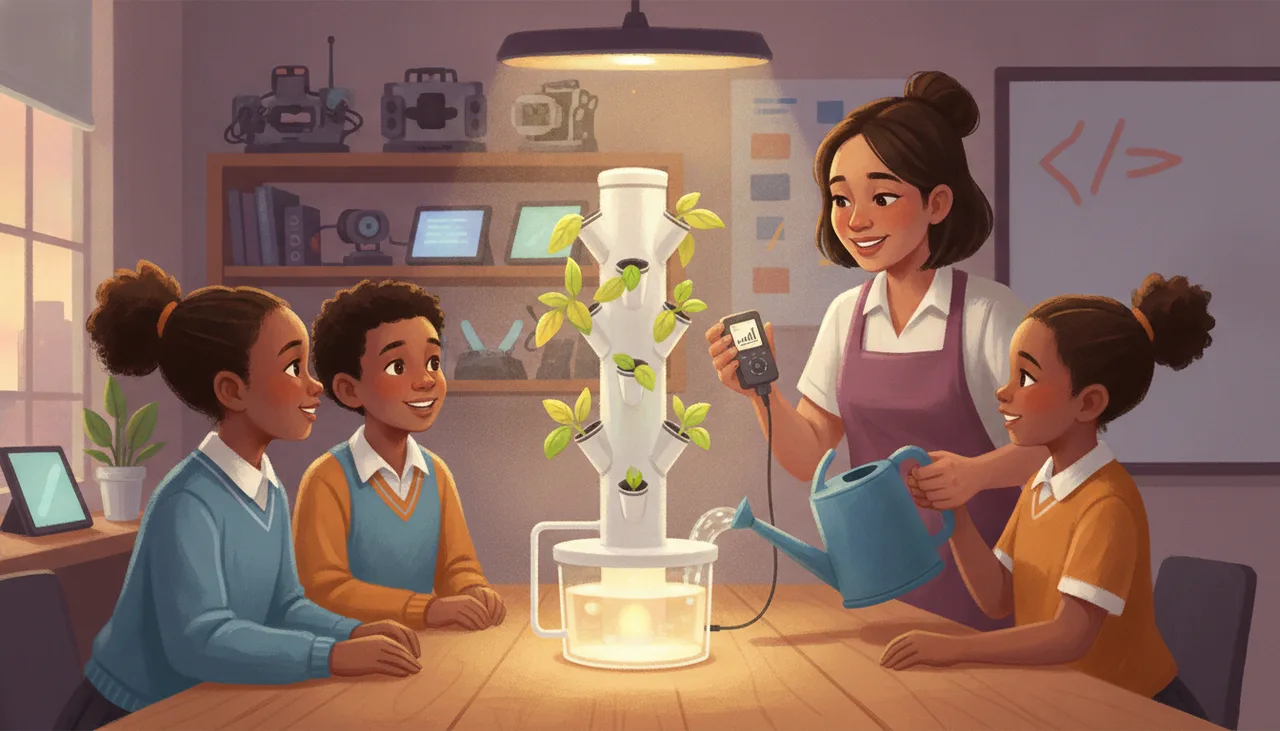
Is robotics just more screen time for your child?
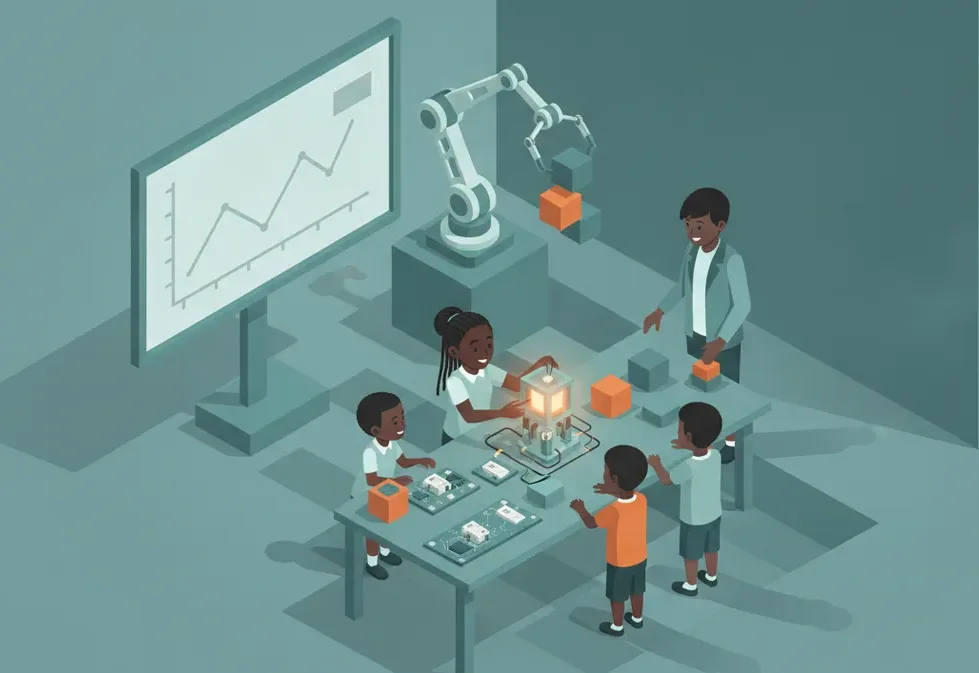
Not all screen time is equal. While passive consumption drains engagement, physical computing shifts children from digital consumers to active physical authors.
The short answer is: it depends entirely on whether your child is using the computer as a television or as a lathe. If they are clicking through gamified puzzles on a browser, yes, it is just more screen time. But if they are using a microcontroller to read a physical soil-moisture sensor and trigger a water pump, the screen is merely a window to control physical reality.
To understand the difference, we have to look closely at what actually happens in typical "coding for kids" franchises versus a genuine, hardware-first robotics lab.
The Trap: Gamified Screen-Time in Disguise
Many commercial coding programs marketed to parents are designed to keep children quiet and occupied. They use highly polished, gamified platforms where a child drags blocks to help an animated character navigate a maze. While this teaches basic sequencing, it suffers from the same cognitive loop as video games: high-frequency visual rewards, low physical engagement, and rapid screen-switching.
In these environments, the screen is the entire universe. If the child gets bored, they click randomly. If they get stuck, the software nudges them. The child remains a consumer of an environment built by someone else. This is not authorship; it is a digital chore disguised as play.
The Alternative: Physical Computing and Authorship
True robotics is "physical computing." Here, the screen is not the destination; it is simply the tool we use to instruct physical objects. The magic happens when a child writes three lines of code, uploads it to a physical microcontroller, and watches a real, physical light bulb flash or a motor spin.
In this context, the screen time is highly active. It is "authorship"—the digital equivalent of using a sewing machine, a circular saw, or a chisel. The child is not reacting to stimuli on a display; they are imposing their will onto physical copper, silicon, and plastic.
Minute-by-Minute: Inside a Hardware-First Lesson
To see how little of a robotics class is actually spent staring blankly at a monitor, let us look at the anatomy of a typical 60-minute hardware-first lesson at Sheen Robotics:
- Minutes 0–10: The Physical Challenge. The screens are closed. The instructor introduces a real-world problem. For example: "We need to build a system that alerts a driver when their car is too close to a wall." Students examine physical ultrasonic distance sensors, holding them in their hands to understand how they emit sound waves.
- Minutes 10–25: The Wiring Phase. Screens remain closed or ignored. Students use jumper wires, breadboards, and microcontrollers to build the physical circuit. They must align tiny metal pins, match positive to negative, and understand physical polarity. This is a fine-motor-skills task requiring spatial reasoning, not digital scrolling.
- Minutes 25–40: The Code as a Tool. Only now do the laptops open. Students write the minimal code required to read the sensor and light up an LED. The screen is used intensely but briefly—perhaps for 10 or 15 minutes of active, logical typing and logical thinking.
- Minutes 40–55: Debugging Physical Reality. This is where the real learning happens. Inevitably, the system does not work on the first try. But unlike a software game, the error could be anywhere. Is it a bug in the code? A loose wire? A backward LED? An ungrounded circuit? Students must look away from the screen, trace the physical wires with their fingers, and test their assumptions against physical laws.
- Minutes 55–60: Reflection and Pack-up. Laptops are shut. Students disassemble their circuits, sort their components back into their physical kits, and discuss why certain hardware choices worked better than others.
"When a child is debugging a physical circuit, they aren't looking at the screen. They are squinting at a breadboard, checking if a resistor is in row 14 or row 15. That is physical problem-solving, not screen addiction."
The South African Context: Power and Practicality
In South Africa, this hardware-first approach is not just pedagogically superior; it is highly practical. During bouts of load-shedding, schools and homes often lose Wi-Fi. A curriculum that relies entirely on heavy, cloud-based browser games falls apart. By contrast, physical computing platforms like the ones we use can run entirely offline. A low-power microcontroller can be programmed via a laptop running on its internal battery, allowing the lesson to continue uninterrupted even when the lights go out.
How to Spot a Genuine Provider
If you are looking for a robotics program for your child, do not be swayed by glossy marketing. Ask the provider these three direct questions:
- Do the children use physical hardware in every single lesson? If they spend the first term on "virtual robots" or screen-only simulators, you are paying for glorified screen time.
- What happens when a student's project doesn't work? If the answer is "the teacher fixes the code," avoid them. A good instructor guides the student to debug both the code on the screen and the physical wiring on the desk.
- Are the components proprietary or industry-standard? If they are using closed-loop, click-together plastic toys, the learning is limited. If they are handling real resistors, sensors, and microcontrollers, they are learning actual engineering.
If you want to see what this looks like in practice, you can book a trial session at our Cape Town lab via our Academy Trial Page, where your child will build their very first physical circuit within the first thirty minutes.
Ultimately, the goal of robotics education is not to add another screen to your child's life. It is to demystify the screens they already have, transforming them from passive consumers of global tech into active creators of their own physical solutions.