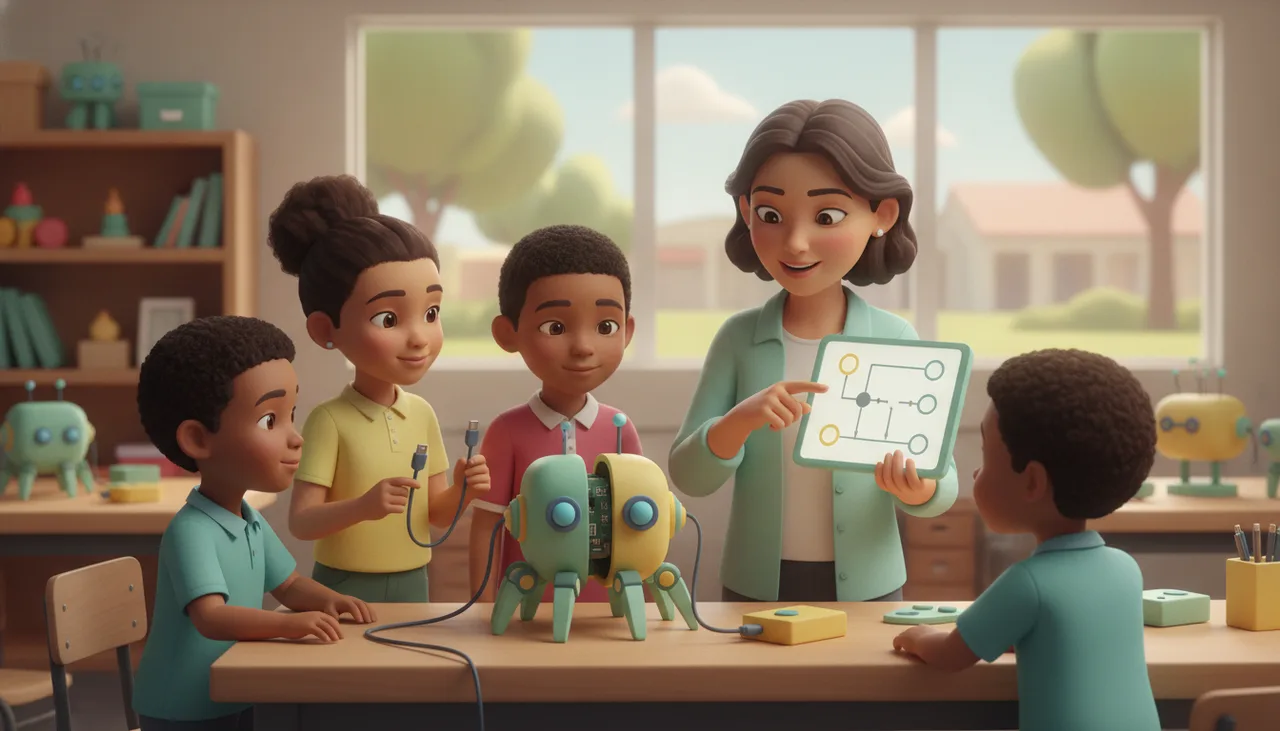
The robot pet project: servos, sensors and personality

A robot pet turns servos and sensors into a project kids love: build the body, then program a personality as simple idle, react and sleep states.
A robot pet is one of the most reliable projects for pulling a distracted class or a bored child back into coding. You build a small creature from a servo or two and a sensor, then spend most of the time giving it a personality: a way of behaving that makes it feel alive. The useful trick for teaching is that personality is just a set of rules, so the project feels like play while it quietly teaches real programming.
Why the robot pet wins attention back
Most learners hit a wall at some point. A worksheet stops landing, or a project has too many right answers and not enough of the child in it. A robot pet resets that because there is no single correct outcome. One learner makes a nervous cat that hides, another makes a puppy that follows your hand. The floor is low, so nobody is stuck, and the ceiling is high, so the fast finishers keep going. Naming the pet is half the motivation, and once a child has named something they tend to want it to work.
Personality is a small state machine
You do not need behaviour trees or anything fancy. Three states are enough to make a robot feel alive: idle, react and sleep. In idle, the pet does gentle, slightly random movement, a small ear twitch or a head turn every few seconds, so it never looks switched off. In react, it responds to something in the room. In sleep, after a stretch of nothing happening, it powers down its movement and waits quietly until something wakes it.
The whole program is a loop that asks one question: what state am I in, and what should happen next. That is a clean, honest introduction to state, and children grasp it quickly because they already know that a real pet is either mucking about, reacting to you, or asleep.
Sensors are the senses
The magic moment is the first time a sensor changes the pet's mood on its own. Map each input to a feeling. A distance sensor means someone is approaching, so the pet wakes and looks curious. A sound spike means a bang, so it startles. A light sensor going dark means night, so it gets sleepy. Keep the mapping simple and readable, one input to one mood, and let learners add more once the first one works.
Servos are how the pet shows the mood. A single servo can wag a tail, tilt a head or flap a pair of ears, and that small amount of motion carries a surprising amount of character. A controller that can drive a couple of servos and read a sensor at the same time keeps the wiring honest; the sheenbot∞ board handles both, which means the build stays about behaviour rather than about untangling cables.
A weekend build checklist
- A controller board that can drive servos and read at least one sensor.
- One or two micro servos for movement, such as a tail, ears or a head tilt.
- One input sensor to begin with, a distance or sound sensor works well.
- A body from whatever you have: cardboard, a 3D print or a LEGO frame.
- Spare servo horns and a small budget for breakages, roughly ten to fifteen percent of the kit cost, because moving parts do get pushed too hard.
If you are gathering parts, the servos and sensors in the sheen store are the same ones we use in class, so the project matches what a child sees at the academy.
Running it in a lesson
Do not build all three states at once. Start with idle only and get the pet twitching. Add react in the next session, then sleep after that. Splitting it this way gives every child a working robot at the end of each lesson, which matters far more than a perfect one at the end of the term. It stretches nicely across a few weeks of a weekly class, or fits a school-holiday build if you would rather do it in one intense go through a holiday workshop.
The takeaway is that personality is programming. A robot pet gives children a reason to care about idle loops, sensor readings and simple decision rules, because those rules add up to something that behaves like it has a mind of its own. It is the project we reach for when engagement has dipped, and it almost always brings it back.