
Kratky vs pumps: choosing passive or active hydroponics for school
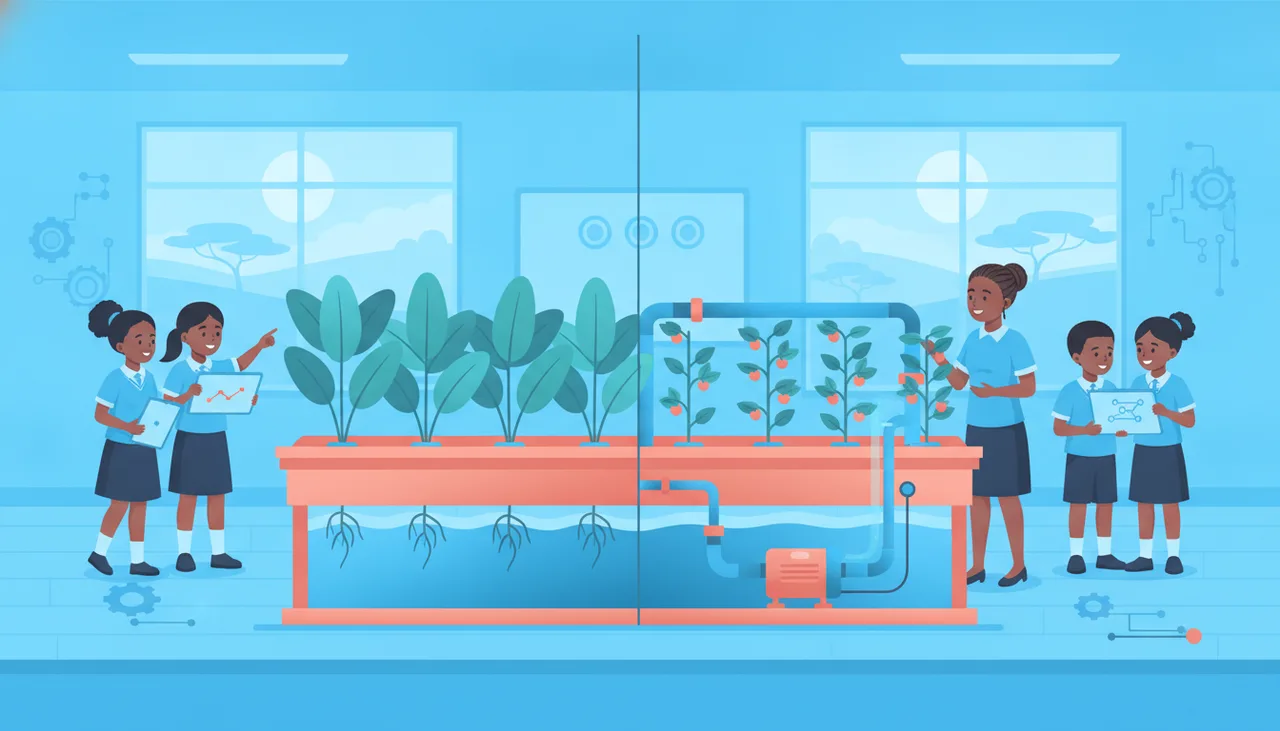
Passive Kratky survives holidays and load shedding but grows mostly leafy greens; active pumped systems grow more and automate better but need power and daily care. Decide by your term calendar.
If you want a hydroponics project that survives a weekend, a long holiday and a bout of load shedding, choose the passive Kratky method and accept that you will mostly grow leafy greens. If you want faster growth, fruiting crops and a system worth automating, choose an active setup with pumps and commit to power and near-daily checks. For most classrooms the deciding factor is your term calendar and who is around to tend the plants.
What the Kratky method is
Kratky is passive, non-circulating hydroponics. A net pot holding the plant sits over a sealed reservoir of nutrient solution. As the plant drinks, the water level drops and an air gap forms, so the lower roots stay in the solution while the upper roots reach into moist air for oxygen. There is no pump, no timer and no moving part to fail. You fill the reservoir once, plant, and come back to harvest.
That simplicity is why a Kratky method classroom setup is so forgiving. A wide-mouth jar, or a lidded tub with holes cut for net pots, is often the whole build. It suits short-cycle leafy greens such as lettuce, spinach and bok choy, and herbs like basil and mint. It will happily sit through a weekend or a school holiday with nobody watching, which is exactly the problem most school gardens struggle with.
What active systems add
Active systems use a pump to move or aerate the solution. Common classroom versions are deep water culture with an air pump, nutrient film technique with a small water pump, and ebb-and-flow that floods and drains on a timer. Constant oxygen and a steady supply of fresh nutrient at the roots mean faster growth and support for thirstier, heavier crops such as tomatoes, peppers and strawberries. You can also top up and adjust the solution mid-cycle without disturbing the plants.
The cost of all that is real. Active systems need a reliable power point, pumps can clog or fail, and the reservoir wants checking most days. A power cut stops circulation, so load shedding becomes a planning problem rather than a background annoyance.
The honest tradeoffs
Neither option is better in the abstract. They fail and shine in different places.
| Factor | Passive (Kratky) | Active (pumps) |
|---|---|---|
| Setup cost | Low; often reused containers | Higher; pump, tubing, timer |
| Electricity | None | Required for circulation or aeration |
| Maintenance | Fill once, harvest | Check and top up most days |
| Crop range | Leafy greens and herbs | Greens plus fruiting crops |
| Holiday survival | Strong; runs unattended | Weak without a staff plan |
| Load shedding | Unaffected | Needs a backup or short outages only |
| Automation potential | Limited | High; sensors and a pump to control |
Match the system to your term calendar
South African school terms run in four blocks with real holiday gaps, and the holidays are where classroom hydroponics usually dies. Work backwards from your calendar before you buy anything. A build that starts and finishes inside teaching weeks can be either kind, because someone is on site daily. A build that has to bridge a holiday needs to be passive, unless a staff member will come in to refill and run the pump. September is early spring, so a project planted now rides warming days into the fourth term, a good window for leafy greens either way.
| Your situation | Better choice | Why |
|---|---|---|
| Build fits inside teaching weeks | Either | Someone is on site to check daily |
| Project must bridge a term holiday | Passive | No one to refill or run a pump |
| Frequent load shedding, no backup | Passive | No power means no circulation |
| You want fruiting crops or bigger yield | Active | Thirsty plants need constant feed and oxygen |
| Goal is coding and automation | Active | A pump and sensors give students something to control |
Which system fits your teaching goal
Be honest about the lesson. If the goal is biology, Kratky is the cleaner teacher: students watch roots, oxygen and nutrients do their work with nothing else in the way. If you also want coding and automation, an active bench gives students something to measure and control. A water-level sensor, a temperature probe and a pump they can switch turn a plant tray into a real control project.
That is the point where a hydroponics bench becomes a robotics project. Pairing an active build with the sheenbot∞ board lets students read a sensor, make a decision in code, and drive the pump in response, and it slots into the lesson sequences we run at the academy. You can source the boards and sensors through the store. If you would rather someone tend the system over the break while students keep building, a holiday workshop can cover both, and a short trial session is an easy way to see whether the automation angle suits your class before you commit a term to it.
Before you choose, answer these
- Will the system need to survive a school holiday with nobody watching?
- Do you have a reliable power point, and a plan for load shedding?
- Leafy greens only, or do you want fruiting crops and bigger yields?
- Is the goal biology alone, or coding and automation as well?
- Who checks and tops up the reservoir on weekends?
Takeaway
Kratky is the safe default for a first classroom project: cheap, quiet and forgiving. Move to pumps when you want more yield, a wider range of crops, or an automation project worth building. Plenty of schools do both, starting passive to learn the biology and adding an active bench once students are ready to instrument it. You can find more classroom project guides in the newsroom.
FAQ
Can a Kratky setup grow tomatoes?
It can be done, but it is a poor fit for a class. Fruiting crops are thirsty and heavy feeders, and a single non-circulating reservoir struggles to keep up over a long cycle. For reliable results, keep Kratky for leafy greens and move fruiting crops to an active system.
Does load shedding ruin an active system?
Not instantly. Roots tolerate a short outage, especially in cooler weather. The risk grows with longer cuts and warm days, when oxygen in still water runs down. A small battery or UPS on the air pump covers most schedules, and a passive system sidesteps the issue entirely.
How much space does a class set need?
A class set of around ten Kratky tubs fits on a couple of benches near a window. An active setup needs the same bench space plus a power point and somewhere it will not matter if a little water spills.