Can scheduling my geyser actually save money in a load-shedding country?

While the thermodynamic savings of turning off your geyser are modest, pairing smart scheduling with Time-of-Use tariffs and load-shedding data can cut your hot water costs significantly.
Yes, scheduling your geyser can save money, but the actual savings from physics alone are much smaller than most people think. For a typical South African household, turning off a geyser for part of the day yields a modest thermodynamic saving of roughly R30 to R60 per month. However, when you factor in Time-of-Use tariffs and the chaos of load-shedding, smart scheduling becomes highly profitable—not because you are using less energy, but because you are buying energy at cheaper times and preventing useless heating cycles during blackouts.
The Physics: Standing Losses vs Reheat Energy
A common myth persists in South African households: "It takes more energy to reheat a cold geyser than to keep it hot." This is thermodynamically incorrect. Heat loss from a container is directly proportional to the temperature difference between the water inside and the ambient air outside. When you turn your geyser off, the water cools down, the temperature difference decreases, and the rate of heat loss slows down. A cooler geyser loses less energy to the surrounding air than a hot one.
The actual saving, however, is strictly limited by the quality of your geyser's insulation. Under South African National Standard (SANS) 151, a modern, B-rated 150-litre geyser has a standing loss of approximately 1.5 to 1.9 kilowatt-hours (kWh) per 24 hours when maintained at 60°C. If you turn the geyser off for 16 hours a day, you lower the average temperature of the water over that period, reducing standing losses by roughly 30%. This saves about 0.5 kWh per day. At a typical municipal tariff of R3.50 per kWh, this translates to a saving of R1.75 per day, or roughly R52 per month. It is a real saving, but it will not single-handedly slash your electricity bill.
The Load-Shedding Complication
Load-shedding disrupts simple scheduling. If you use a basic mechanical timer in your distribution board, a two-hour power cut will push the timer's clock back by two hours (unless it has a battery backup, which often fails after repeated outages). This means your geyser might end up heating during peak hours or, worse, failing to heat before your morning shower.
Furthermore, if load-shedding forces you to heat your geyser to a higher temperature (for example, raising it from 60°C to 70°C to "store" more thermal energy through a long blackout), you accelerate your standing losses. The higher temperature difference increases the rate of heat loss, partially offsetting the savings you hoped to achieve.
The Real Financial Win: Time-of-Use Tariffs
The true financial benefit of geyser scheduling in South Africa is temporal, not thermodynamic. Municipalities are increasingly moving residents to Time-of-Use (ToU) tariffs, such as Cape Town's Home Flex tariff. Under these structures, electricity consumed during peak hours (typically 06:00 to 09:00 and 17:00 to 19:00 on weekdays) is priced significantly higher than during off-peak periods.
A standard geyser element draws 2 kW to 3 kW. Running a 3 kW element for two hours during a peak window costs substantially more than running it late at night or midday. By scheduling the geyser to run strictly during off-peak hours, you can easily save R150 to R300 per month on tariff differentials alone, even if the total kilowatt-hours consumed remains exactly the same.
What You Need to Control and Verify Savings
To capture these savings without sacrificing hot water, you cannot rely on blind timers. You need an intelligent control system that combines three elements: real-time power monitoring, temperature sensing, and load-shedding awareness. If you want to design or install a system capable of this level of coordination, our home IoT solutions offer the precise hardware and integration frameworks required to turn these calculations into automated savings.
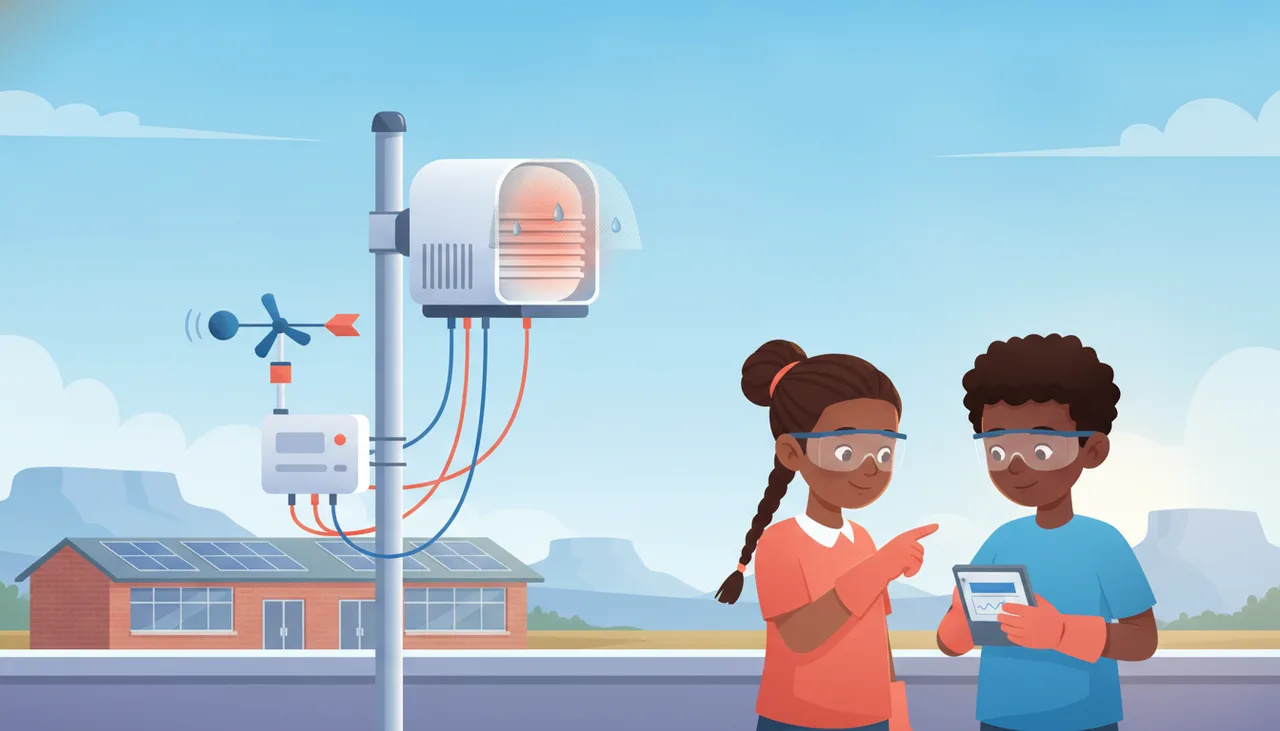
A truly smart system does not just run on a clock. It monitors the actual temperature of the water at the top and bottom of the cylinder. If the water is already at 55°C, it prevents the element from firing. It also references the local load-shedding schedule via API to ensure that heating cycles are completed just before an outage begins, rather than being interrupted halfway through, which wastes energy on incomplete heating cycles.
Comparing the Strategies
The table below outlines how different management strategies perform under typical South African municipal conditions, assuming a 150-litre geyser and a standard Time-of-Use tariff structure.
| Strategy | Standing Loss Savings | Tariff Optimization | Load-Shedding Resilience | Estimated Monthly Saving |
|---|---|---|---|---|
| Always On | None (Maximum loss) | None (Heats during peak) | Poor (Cold water after blackouts) | R0 (Baseline) |
| Mechanical Timer | Low (Approx. 10-20%) | Moderate (Can drift out of sync) | Very Poor (No awareness of outages) | R30 - R80 |
| Smart Controller (IoT) | Moderate (Approx. 20-30%) | High (Strictly off-peak heating) | High (Adapts to load-shedding schedules) | R180 - R350 |
To sum up: scheduling your geyser does save money, but the thermodynamic savings of turning it off are minor. The real financial victory lies in smart scheduling that avoids peak municipal tariffs and navigates load-shedding schedules. To achieve this, invest in active sensing and smart control rather than a simple, blind timer.