
FTC drivetrain choices for rookie teams
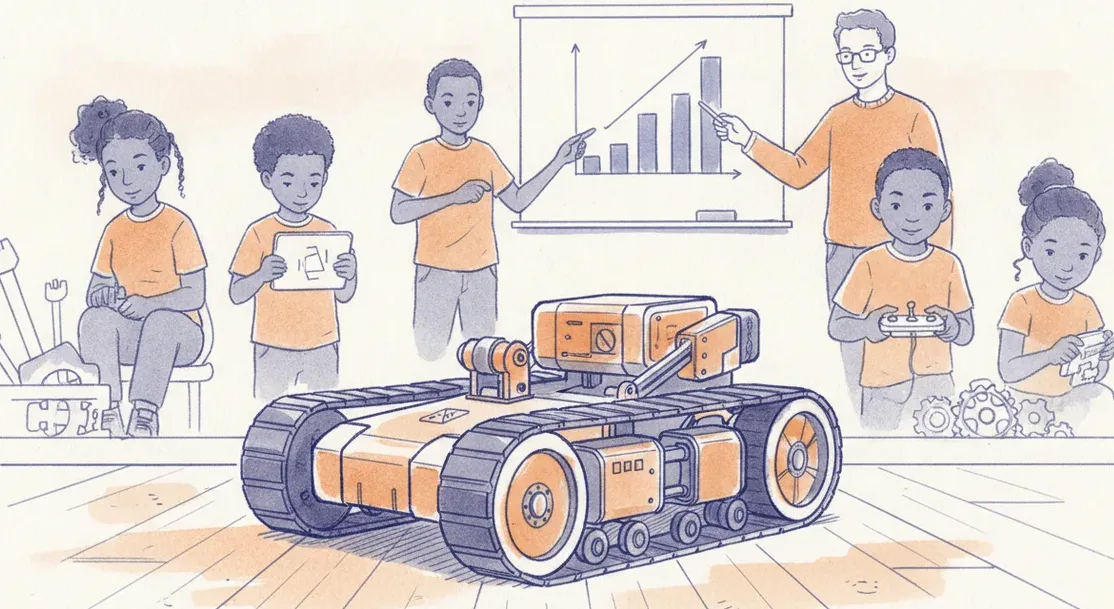
For a rookie FTC team, a simple, well-built tank drivetrain you can drive for hours beats a clever mecanum or swerve you cannot keep running. Build quality and practice win.
The short answer
For a rookie First Tech Challenge team, the best drivetrain is the one you can build well and drive a lot. In practice that means a simple tank (skid-steer) base for most teams, or a mecanum drive only if the game clearly rewards sideways movement and you have the discipline to tune it. A plain robot that keeps scoring will beat a clever one that spends half the day in the pit. The drivetrain is the foundation everything else bolts onto, so choose it for reliability before anything else.
Pick the drivetrain the game actually needs
Before you compare wheel types, read this season's game. How often does the robot need to move sideways to line up at a scoring spot? How much pushing and defence will happen on the field? Robots that must slot into a tight scoring location or slide around a crowded field benefit from strafing. Robots that mostly shuttle between two zones do not. Do not choose mecanum because a reveal video looked impressive. Choose it because the tasks reward it. For most rookie-relevant games, a straightforward forward, reverse and turn base does the large majority of the job.
The realistic options for a first year
There are really three buckets a rookie team should think about, and only two of them are sensible.
- Tank / skid-steer. Four or six wheels driven as two sides; the robot turns by running the sides at different speeds. It is simple, robust, cheap and has strong pushing power. The trade-offs are no strafing and some wheel scrub on turns. A six-wheel drop-centre layout turns more cleanly.
- Mecanum drive. Four mecanum wheels let the robot strafe and rotate in place, so it is effectively omnidirectional. Off-the-shelf kits from the main FTC suppliers make it approachable. The trade-offs are higher cost and weight, lower traction (it is easier to shove off a spot), sensitivity to weight balance and roller wear, and more demand on both driver skill and code.
- Everything exotic. Swerve, X-drive and other holonomic setups have a high parts count, high cost and a large failure surface. They are a trap for a first-year team. Leave them for season two or three, once the basics are automatic.
Build quality beats a clever concept
A modest design built well beats a brilliant design built loose, every time. The failures that sink rookie robots are almost always mechanical hygiene, not ambition: chains that skip because tension was never set, set screws that back out because nobody used threadlocker, motor mounts that flex, wheels that are not square so the robot pulls to one side. Build on proper commercial structure with hex shafts and bearings rather than improvised brackets. Assume that any fastener that can vibrate loose will, somewhere in a long competition day. A tube of threadlocker, a set of lock nuts and a pre-match checklist do more for your ranking than an extra mechanism.
Driver practice is the real multiplier
The single biggest predictor of rookie results is hours behind the controller. A simple tank robot that has been driven for forty hours will out-cycle a mecanum robot that has been driven for four. So build the drive base early, in the first weeks, and hand it to your drivers while the rest of the team works on the arm or intake. You do not need a full official field to practise. A taped rectangle on a hall floor is enough to rehearse picking up, scoring and recovering after an opponent pushes you. This is the same reliability-and-repetition habit we build at the sheen academy and in our holiday robotics workshops, long before a student steps up to a competition robot. Younger builders start on the sheenbot∞ board, where the same build-test-repeat loop is the whole point.
A rookie drivetrain checklist
- Default to tank. Only choose mecanum if the game clearly rewards strafing and your team has the build discipline to keep it tuned.
- Use a commercial drivetrain kit. Do not reinvent the structure in week one.
- Finish the drive base in the first few weeks so drivers can start practising.
- Threadlock every set screw, use lock nuts, and check chain or belt tension before every match.
- Carry spares: wheels, at least one drive motor, and a set of charged batteries.
- Keep the weight low and centred. Balance matters even more on mecanum.
- Log at least a couple of driving sessions a week and treat driving as a skill, not an afterthought.
Load shedding and budget, the local reality
Two South African constraints shape rookie planning. First, imported drivetrain kits and control electronics are a large line item in rand, so it is worth buying something reliable once instead of a fragile setup you replace twice. Budget a little for spares from the start. Second, load shedding eats into build and practice time, so charge batteries and laptops whenever the power is on, and keep a rough practice schedule that survives an unexpected outage. A robot the team can service quickly is worth more than one that only runs perfectly in ideal conditions.
Takeaway
The rookie trap is buying complexity you cannot maintain. Reliable-simple beats clever-fragile in almost every season. Get a solid drive base built early, keep every fastener tight, and spend the rest of your time driving. You can always add sophistication next year, once the fundamentals run without thinking. If you want to build those habits before a first FTC season, a trial class is a low-pressure place to start.
Common questions
Is mecanum too advanced for a first-year team?
Not automatically, but it is optional. If you have a mentor who is comfortable tuning drive code and setting up the hardware, mecanum is workable. If the team is already stretched, a tank base will not hold you back, and it frees time for driving practice.
How much should we spend on the drivetrain?
Enough for a reliable commercial kit and a small set of spare motors, wheels and batteries. Skip the exotic upgrades in year one. In rand, imported parts are expensive, so the cheapest path over a season is usually to buy solid once rather than fragile twice.
When should we start driver practice?
As soon as the base rolls, which should be weeks before your first event, not the night before. Early, boring, repeated practice is what separates rookie teams that advance from teams that do not.