Coding without a computer: unplugged activities that actually work
Unplugged coding teaches the ideas behind programming with bodies and cards, not screens. Here is when it works, three activities that stick, and when it becomes theatre.
Unplugged coding means teaching the ideas behind programming, such as sequences, loops, conditionals and sorting, using bodies, cards and chalk instead of a screen. Done well, it makes an abstract idea physical and sticks in a way a tutorial rarely does. Done badly, it is a party game with a coding label stuck on it. The difference is not the activity itself but whether a child can tell you what they just practised.
What unplugged coding is actually good for
The biggest win is that it strips away everything that gets in the way of the idea. No logins, no typing, no syntax errors, no waiting for a device to charge, and no lesson lost to load shedding. A child reasons about the logic directly instead of fighting the tool.
It is also cheap and scales to a full class. One set of number cards or a chalked grid on the playground can occupy thirty learners at once. That makes it a strong fit for the youngest learners, for a first exposure to a single concept, and for the warm-up minutes of a lesson before anyone touches a keyboard.
Three activities that actually work
These three earn their place because the physical action is the concept, not a decoration around it.
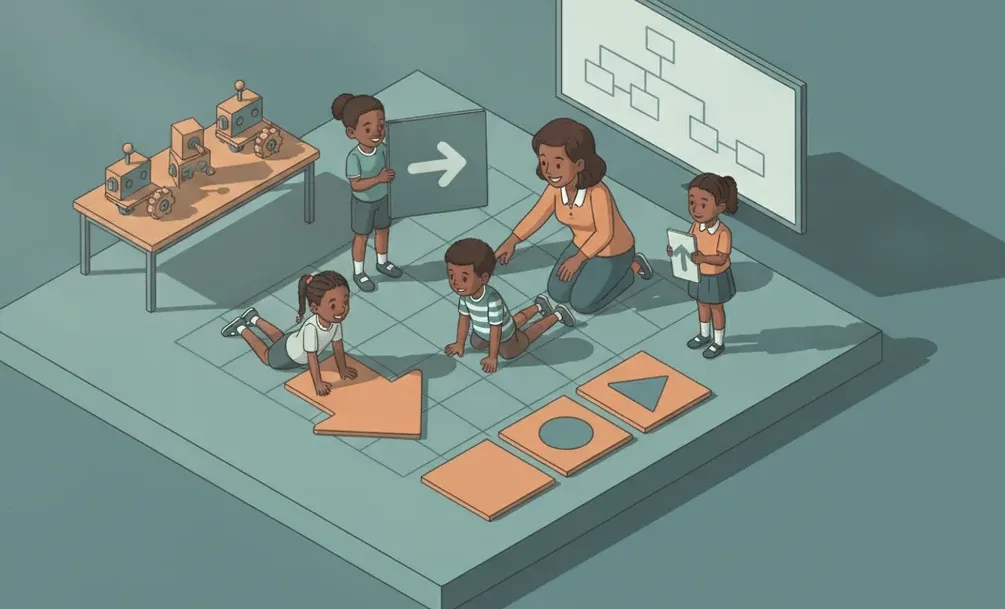
- Sorting networks. Chalk a network of lines and comparison boxes on the ground. Each learner holds a number and walks the path. At every box, the two who meet compare and swap so the smaller carries on one way and the larger the other. They come out sorted. It shows comparison-based sorting and, quietly, the idea that many comparisons can happen at the same time.
- Human robots. One child is the robot and can only follow exact instructions. Another gives step-by-step commands to cross the room or build a tower of blocks. The robot does precisely what is said, not what is meant, so a vague step fails visibly. This teaches sequencing and, more importantly, debugging: the class fixes the instruction, not the robot.
- Binary games. Give five cards showing 16, 8, 4, 2 and 1 dots. Flipping cards face up and adding the dots lets learners build any number to 31. It makes binary counting concrete and answers the question of how a machine stores a number with only on and off.
Notice what each one has in common. The learner can point at the result and explain the rule. If a child can only say it was fun, the concept did not land.
When unplugged becomes theatre
The failure mode is easy to spot once you know the tell. Everyone is moving, laughing and busy, but nobody can name the idea they practised. Usually one of these is true:
- The game has more rules than the concept it is supposed to teach, so the rules become the lesson.
- The adults do all the thinking and the children just perform the steps.
- It is used as the whole curriculum rather than a bridge to something that runs.
Unplugged is a way in, not a destination. A term of clapping games and card sorts with nothing that ever executes leaves children who can talk about coding but have never watched their own logic run and fail and get fixed.
Bridge back to something that runs
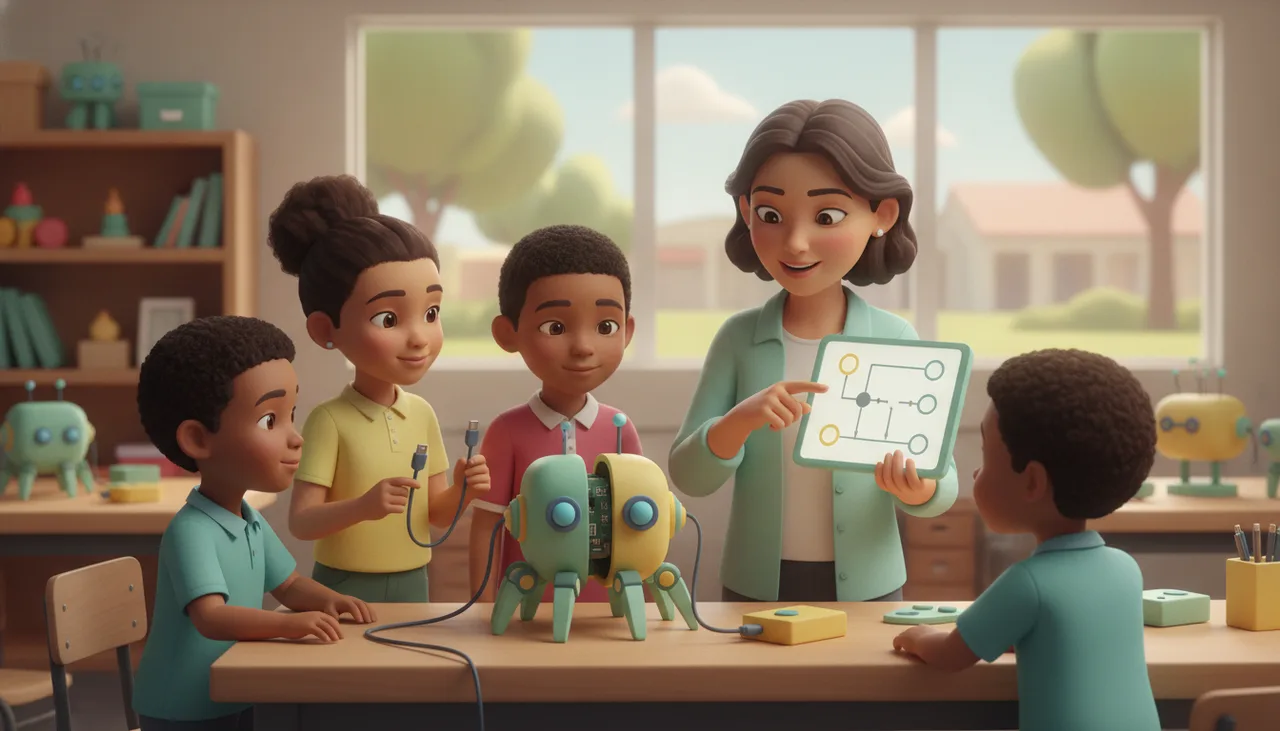
The best use of an unplugged activity is as the first ten minutes, not the whole hour. The moment a child understands sequencing with their body, move that same idea onto something that actually does what it is told. That can be a simple block editor on a shared laptop, or a physical board like the sheenbot infinity, where the same step-by-step logic lights an LED or moves a motor. The jump from human robot to a real one is short when the concept is already in their hands.
If you want that bridge built for you, our lessons at the sheen academy in Cape Town start with the physical idea and end with working code, and a free trial class is the low-risk way to see whether it fits your child. The summer holiday workshops run the same way over the December break, using unplugged warm-ups to introduce a concept before the learners build it for real.
The takeaway
Unplugged coding is genuinely useful when the movement is the concept and the child can explain the rule afterwards. Sorting networks, human robots and binary games pass that test. Treat them as a doorway, keep them short, and always walk through to something that runs. Used that way, coding without a computer is one of the best ways to prepare a child for coding with one.