Block coding vs Python for kids: when should they switch?
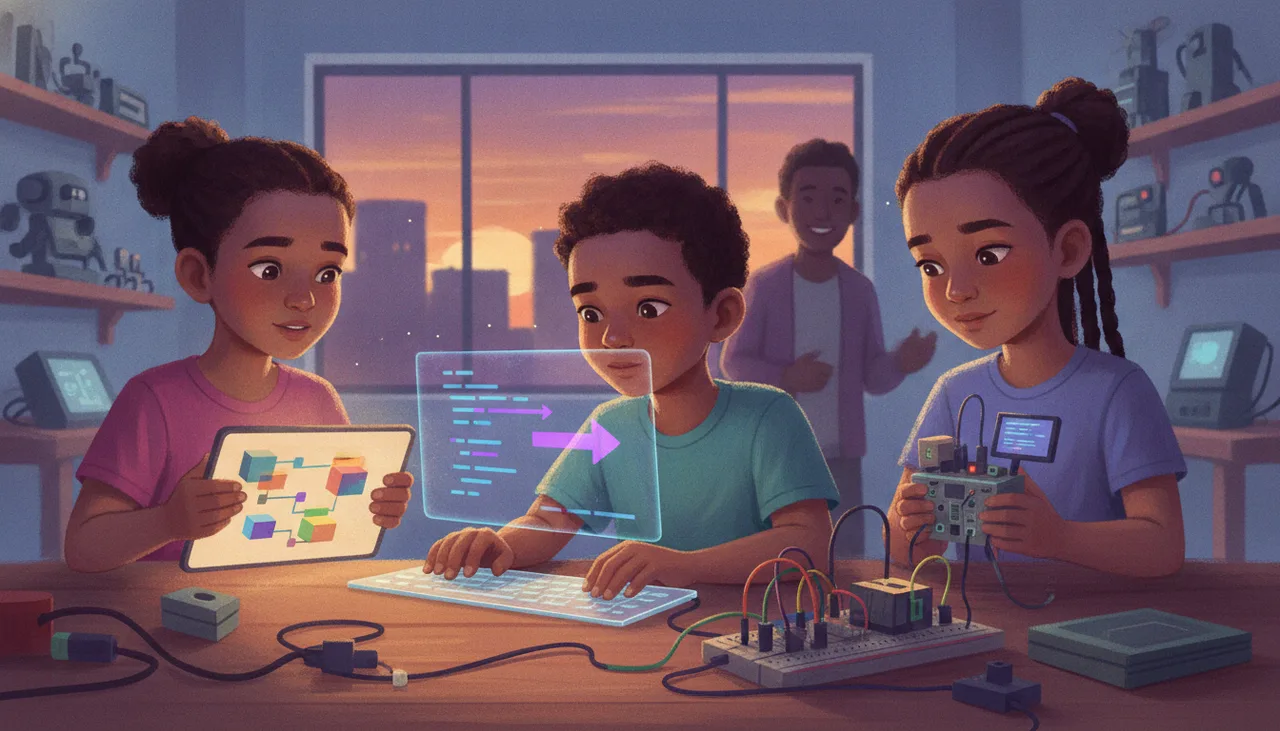
There is no magic age. Move a child from blocks to Python when they fight the blocks or reach for functions and data, and switch the language while keeping the same board.
Most children start coding by dragging and snapping colourful blocks together, and at some point a parent wonders whether it is time to move up to a real language like Python. The honest answer is that there is no fixed age or grade. You switch when your child shows specific signals, and the smoothest switch keeps the same robot or board and changes only the language sitting on top of it.
What blocks actually do, and what they do not
Block coding tools like Scratch remove one specific kind of friction: syntax. A young coder does not have to remember a colon, close a bracket, or line up indentation. They pick a block that says repeat 10 times and it works. That freedom lets them spend their attention on the thinking that matters, which is sequencing, loops, conditions, and events.
What blocks do not do is make the thinking easier. A block program and a Python program that both blink a light ten times contain exactly the same logic. This is worth stressing, because parents sometimes treat blocks as baby coding and rush to text too early. Blocks are not a lesser version of programming. They are the same ideas with the typing removed.
The signals it is time for Python
Age is a weak guide. Some eight-year-olds are ready and some thirteen-year-olds are happier staying in blocks a while longer. Watch for behaviour instead of birthdays:
- They fight the blocks. A project has grown so large that scrolling and dragging is slower than typing would be, and you see them rebuilding the same block group over and over.
- They ask for things blocks make awkward. Functions with parameters, lists and dictionaries, or reading a value once and reusing it later. When a child wants to name and reuse a chunk of logic, text is the natural home for it.
- They copy and paste to duplicate behaviour instead of looping or reusing. That instinct means they have outgrown the guardrails.
- They are curious about how the real code looks. Motivation matters more than readiness on paper.
If none of these are happening, there is no rush. A child who is still discovering new things inside blocks is learning plenty.
Change the language, not the whole platform
Here is the mistake that stalls more transitions than anything else: switching everything at once. A child is moved to a brand new website, a new editor, and a new language on the same afternoon, and loses every familiar landmark. The robot behaves differently, the buttons are in new places, and Python errors arrive on top of all of that.
A better route holds the hardware and the environment constant and swaps only the language. If your child has been building on the sheenbot infinity board, that same board runs MicroPython, so the motors, sensors, and screen they already know respond the same way. The first Python program can do something they have already done in blocks, which means the only new thing is the spelling. Everything else stays as a safe reference point.
Many block editors, including the sheen canvas, can show the Python that a block program generates. Sitting with your child and reading that generated code together is one of the gentlest bridges there is. They see a block they know and the line of text it becomes, right next to each other, and the translation stops feeling like a leap.
A gentle transition plan
You do not need a curriculum to start. A few low-pressure habits do most of the work, and the July holidays are a good quiet window to try them, with no homework competing for attention.
- Rebuild something familiar. Take a small project they already finished in blocks and redo it in Python. Same result, new spelling.
- Read generated code before writing from scratch. Let them study the Python behind their own blocks before they face a blank screen.
- Keep the programs short. A ten-line script that fails is far easier to debug than a hundred-line one, so early errors stay friendly.
- Do not delete the blocks. Let them move back and forth for a term. Some projects will still be faster in blocks, and that is fine.
- Pair the language with a goal. Make the robot follow a line pulls a child through the syntax pain far better than learn Python for its own sake.
If you would rather follow a structured version of this jump, our academy sequences it inside a proper curriculum, and a free trial lesson is a low-risk way to see where your child actually sits on the blocks-to-text line.
Takeaway
There is no calendar date for the blocks-to-Python switch. Blocks remove syntax, not thinking, so a child working in blocks is already doing real programming. Move to Python when they fight the blocks or reach for functions and data, and when you move, change only the language and keep the board and the environment they already trust. Done that way, the switch feels like a small step rather than starting over.
Common questions
What age should kids move from Scratch to Python?
There is no set age. Readiness shows up as behaviour, not a birthday. A motivated nine-year-old building large block projects may switch before a casual twelve-year-old. Watch for the signals above rather than the calendar.
Is block coding just for little kids?
No. Blocks and text contain the same logic. Blocks simply remove the typing so a coder can focus on ideas. Plenty of adults sketch out programs in block tools first. It is a tool choice, not an age badge.
Should we change platforms as well as languages?
Try not to. Changing the robot, the editor, and the language together removes every familiar reference at once. Keep the hardware and environment the same and let Python be the only new thing your child has to learn.