Why Classroom Hydroponic Seedlings Grow Tall, Thin, and Fall Over
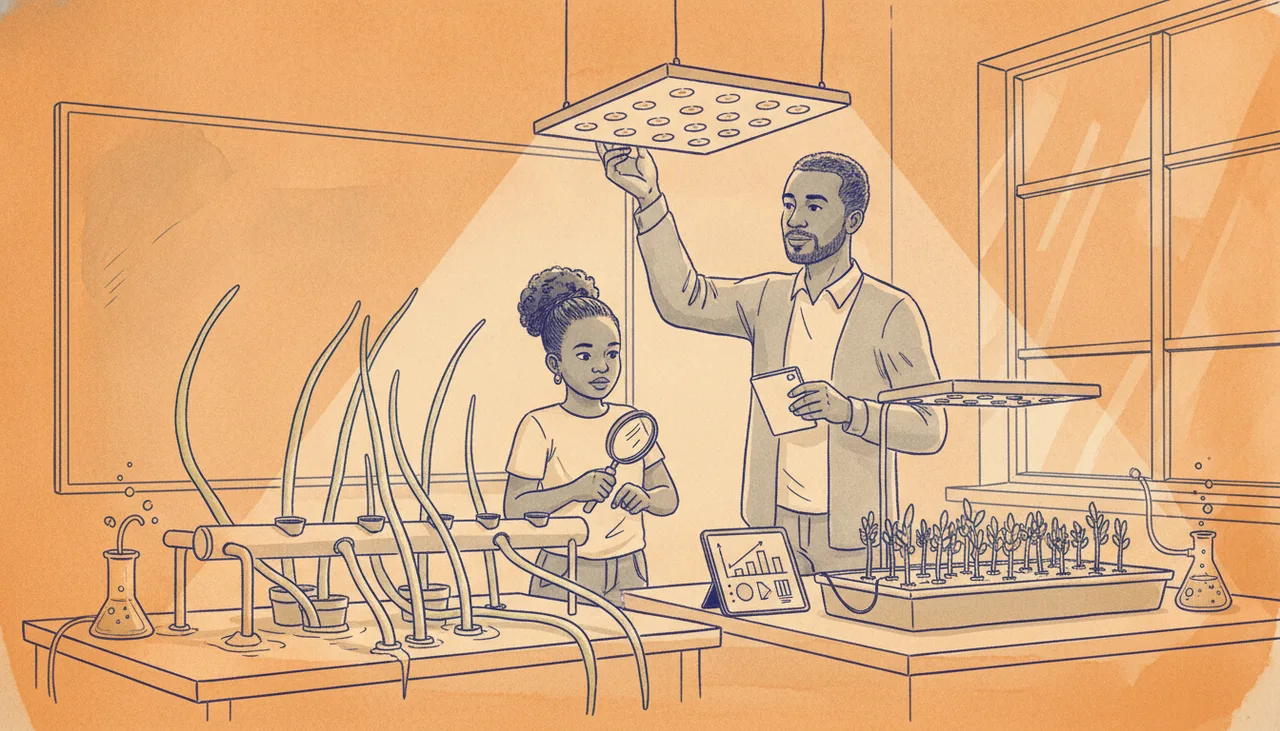
Your seedlings are suffering from etiolation—an evolutionary panic response to weak light. Here is how to fix light height, photoperiod, spectrum, and airflow to build stocky stems.
Your seedlings are growing tall, pale, and spindly because they are starving for light. In botany, this phenomenon is called etiolation. When a newly sprouted seed detects inadequate light intensity, it triggers a survival mechanism: it halts leaf development and channels all of its stored cotyledon energy into stretching its stem upwards, searching for an unshaded canopy. The result is a fragile, top-heavy seedling that cannot support its own weight and collapses—often referred to as ‘legginess’.
In a school environment, this usually stems from three mechanical mistakes: keeping the grow light too far away, running the light for too few hours, and leaving the air completely stagnant.
1. The Inverse-Square Law: Your Lights Are Too Far Away
The single most common mistake in classroom hydroponics is mounting a light bar 30 to 50 centimetres above the seed tray ‘so the plants have room to grow’. While intuitive, this ignores basic optics. Light intensity drops off rapidly according to the inverse-square law: double the distance between the fixture and the leaf canopy, and the light intensity drops to one quarter of its original value.
Human eyes adapt dynamically to ambient light, making indoor classrooms look adequately bright to teachers even when the light level is far below what a photosynthetic plant requires. A classroom windowsill or an overhead fluorescent tube that looks bright to you delivers only a fraction of the photon flux density (PPFD) a young seedling needs.
- For standard LED grow strips or T5 fluorescent fixtures: Position the light 5 to 10 cm directly above the seedling tops.
- For high-intensity LED panel fixtures: Maintain a distance of 20 to 30 cm, adjusting downward if stems start to stretch.
- The rule of thumb: Raise the light progressively as the seedlings grow, keeping the fixture as close as possible without transferring excessive heat to the delicate leaves.
2. Daily Light Integral (DLI) and the Classroom Photoperiod
Seedlings do not just need intense light; they need light for enough hours each day to accumulate sufficient energy through photosynthesis. This total volume of light received in a 24-hour cycle is known as the Daily Light Integral (DLI).
Classrooms naturally run on a schedule that works against plant biology. Lights often get switched on when the first teacher arrives at 07:30 and turned off when the cleaner locks up at 15:30. An 8-hour photoperiod is insufficient for indoor hydroponic vegetables like lettuce, spinach, or basil, which thrive on 14 to 16 hours of continuous light per day followed by an unbroken dark period for respiration.
In South African schools, power disruptions complicate this further. When load-shedding strikes, basic mechanical pin-timers lose their time calibration and drift, resulting in erratic day-night cycles. Using battery-backed digital timers or low-cost smart relays keeps the lighting cycle consistent, ensuring seedlings receive their required photoperiod regardless of schedule interruptions.
3. Light Spectrum: The Role of Blue Light
Not all light encourages compact, sturdy growth. Plant photoreceptors, specifically cryptochromes, rely on the blue end of the light spectrum (around 400–500 nm) to regulate cell elongation and signal the plant to stay compact with short internodes (the spacing between leaves). Red light drives biomass production and flowering, but a red-heavy or diffuse warm-white light source without sufficient blue will encourage stems to stretch aggressively.
If you are using warm household LED bulbs or relying purely on ambient classroom light, seedlings will stretch rapidly toward the nearest source. Dedicated full-spectrum LED fixtures, such as those integrated into our automated classroom hydroponics kits, provide the balanced blue-to-red ratio necessary to keep young plants stocky and structurally sound.
4. Stagnant Air: The Missing Mechanical Stress
Even under adequate light, seedlings grown in completely still classroom air tend to remain weak. In nature, seedlings are exposed to regular breezes. This physical movement bends the stem, triggering a biological response called thigmomorphogenesis. The plant produces ethylene, redistributes auxins, and deposits lignin into the cell walls, thickening the stem to brace against physical forces.
Without airflow, the plant has no mechanical incentive to build structural strength. Adding a small 5V or 12V computer fan running on low speed across the seedling tray accomplishes two things:
- It exercises the stems, producing stocky, fibrous plants capable of holding upright.
- It breaks the boundary layer of humidity around the leaf surface, improving transpiration and preventing fungal damping-off.
A Classroom Triage Checklist
| Symptom | Root Cause | Immediate Fix |
|---|---|---|
| Stem taller than 5 cm with only two tiny leaves | Light fixture placed too high | Lower the light to 5–10 cm above the canopy immediately. |
| Seedlings leaning at a sharp 45-degree angle | Unidirectional ambient light (e.g. windowsill) | Place grow lights directly overhead; do not rely on side windows. |
| Pale yellow, limp stems collapsing at the base | Insufficient light duration combined with stagnant air | Extend photoperiod to 16 hours/day using a timer; add a gentle fan. |
| White fungal fuzz at the soil/rockwool line | High humidity and no air movement | Increase ventilation and reduce watering frequency in the germination tray. |
Once a seedling has stretched to three or four times its normal height and collapsed, it is usually faster to start a new batch than to nurse weakened stems back to health. Adjust your fixture height, set your timer for 16 hours, point a small fan at the tray, and resow. Within seven days, you will see the difference: thick, upright green shoots with tightly packed leaf sets ready for transfer into your main hydroponic channels.