Can You Put Classroom Hydroponics by a Window, or Do You Need Grow Lights?
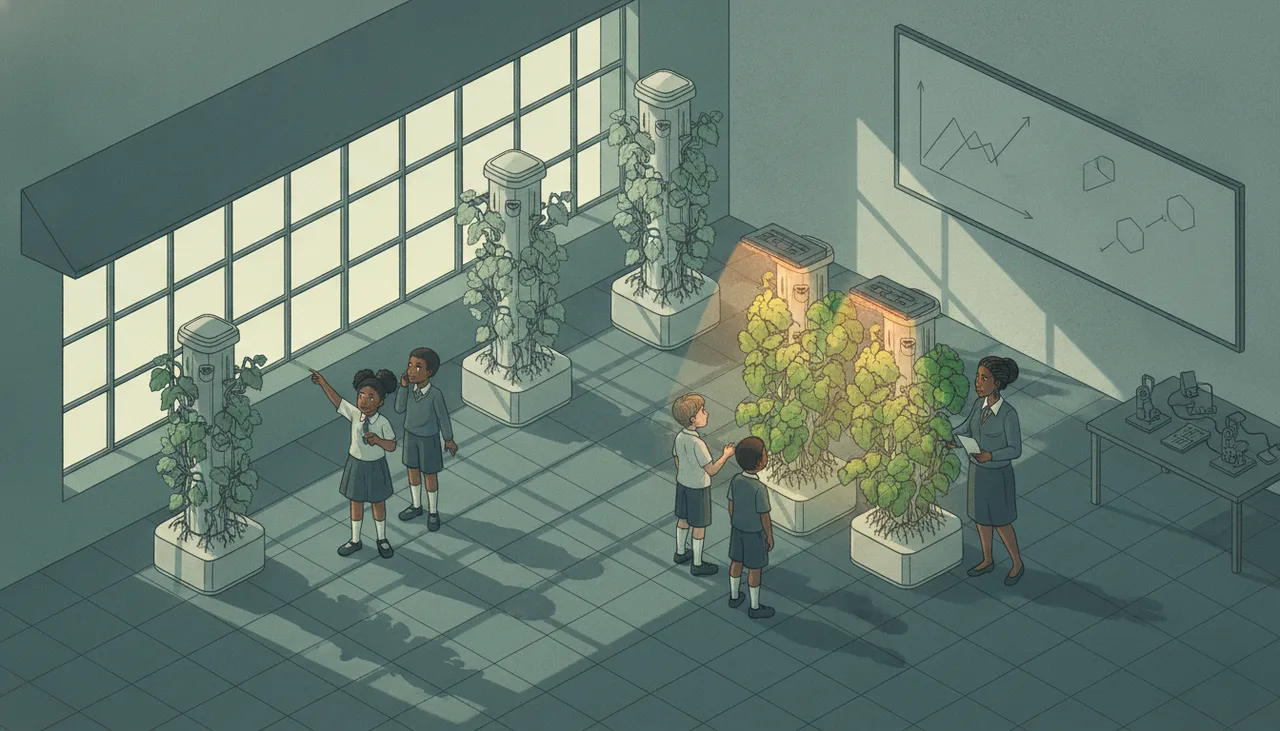
South African school windows cut usable plant light by over 60% due to eaves and UV safety glass. For reliable crop growth, dedicated LED grow lights are essential.
In almost every South African classroom, putting a hydroponics system next to a sunny window leads to leggy, pale seedlings that collapse before harvest. While the classroom may feel brightly lit to human eyes, the physical reality of school architecture—deep concrete eaves, UV safety laminate, tinted solar glass, and rapid light falloff—starves crops of the energy they need. To run a reliable classroom hydroponics programme, you need dedicated grow lights.
The Human Eye vs Plant Biology
The core reason teachers expect window sills to work is that human vision adjusts automatically to changing light levels. Our pupils dilate to make a room with 500 lux feel perfectly clear and readable. Photosynthesis does not work on perception; it operates on raw photon counts.
Plants require Photosynthetically Active Radiation (PAR)—photons in the 400 to 700 nanometre wavelength range. The cumulative measurement of this light over a 24-hour cycle is the Daily Light Integral (DLI), measured in moles of photons per square metre per day (mol/m²/d).
- Leafy greens and culinary herbs (lettuce, basil, spinach, mint) require a minimum DLI of 12 to 16 mol/m²/d to grow compact, crisp leaves in a predictable 30-to-40-day harvest cycle.
- Fruiting crops (tomatoes, chillies, strawberries) require 20 to 30 mol/m²/d to set flowers and mature fruit.
- A typical classroom window sill in South Africa often delivers only 3 to 6 mol/m²/d on an average school day once architectural barriers are accounted for.
Why South African School Windows Block Usable PAR
South African school buildings are intentionally designed to reject passive solar heat. The structural features that keep a classroom habitable in February directly undermine crop growth:
- Overhangs and Deep Eaves: Standard school designs feature concrete eaves or veranda walkways extending 1 to 2 metres outward. These completely block direct, overhead midday sunlight (when PAR values outside peak at 1,500–2,000 µmol/m²/s) and permit only low-angle light in the early morning or late afternoon.
- Laminated Safety and Tinted Glass: Standard school glazing (and retrofitted safety films) filters out UV rays and significant portions of the blue and red spectrum to reduce interior glare and thermal gain, cutting incident PAR by 40% to 70% before the light even enters the room.
- The Inverse Square Law: Light intensity drops exponentially with distance from the glass. A hydroponic tier sitting just 60 cm away from the window receives less than one-third of the light hitting the glass pane itself. The back half of the rack lives in effective darkness.
- Directional Orientation: Only unshaded, directly North-facing windows provide meaningful direct light during the school term. South-facing windows deliver diffuse ambient light that rarely exceeds 50 µmol/m²/s—barely enough to keep established plants alive, let alone grow new tissue.
What Happens Without Artificial Lighting
When seedlings do not receive their minimum DLI threshold, they exhibit severe etiolation. Stems stretch rapidly toward the window, cell walls thin out, and the plant fails to produce adequate chlorophyll. In a water-based system where water and nitrogen are readily available, this creates top-heavy, brittle plants that snap under their own weight or rot at the root collar.
| Crop Type | Minimum Daily DLI | Target PPFD (for 14h day) | Outcome Next to Standard School Window |
|---|---|---|---|
| Loose-leaf Lettuce | 12 mol/m²/d | 240 µmol/m²/s | Stretched stems, bitter flavour, harvest delayed past 70 days. |
| Basil | 14 mol/m²/d | 280 µmol/m²/s | Pale leaves, tall fragile stems, rapid damping-off disease. |
| Bok Choy | 14 mol/m²/d | 280 µmol/m²/s | Premature flowering (bolting) without forming solid stems. |
| Dwarf Tomatoes | 22 mol/m²/d | 440 µmol/m²/s | Flowers drop before pollination; no fruit sets. |
The Electrical Reality: Sizing Lights for School Labs
Replacing unreliable window light does not require expensive high-voltage industrial fittings. Modern full-spectrum LED bars designed for horticulture are highly efficient and run on low wattage.
For a standard vertical shelf or classroom rack, plan for 80 to 120 watts of high-efficiency LED lighting per square metre of growing canopy. Using fixtures with a high proportion of 450 nm (blue) and 660 nm (deep red) light, plus broad white balance (4000K–5000K), allows students to inspect plant health under normal visual conditions while supplying the exact photons required for dense cellular structure.
If you are building or configuring automated systems, explore the modular racks and sensor-integrated systems in our hydroponics collection, which pair full-spectrum LED bars with automated photoperiod controls.
Managing Load-Shedding and Photoperiods
A frequent objection from school administrators is electricity consumption and grid downtime. Fortunately, leafy greens respond to total daily photon accumulation, not strictly uninterrupted continuous exposure.
- Photoperiod: Set your LED timer for 14 to 16 hours per day (for example, 05:00 to 20:00).
- Outages: If a two-hour power cut occurs during the day, the system simply drops two hours of accumulation. A crop running on a 14-hour timer can absorb intermittent outages without entering dormancy, provided the overall weekly DLI remains above baseline.
- Energy Cost: A 100W LED bar running 14 hours a day consumes 1.4 kWh per day—roughly R4.00 to R5.50 per day depending on municipal tariffs.
For educators seeking complete multi-tier food production systems with built-in power, lighting, and environmental monitoring, our tailored vertical farming solutions provide the engineering specifications needed to deploy reliable, high-yield agricultural setups in South African schools.